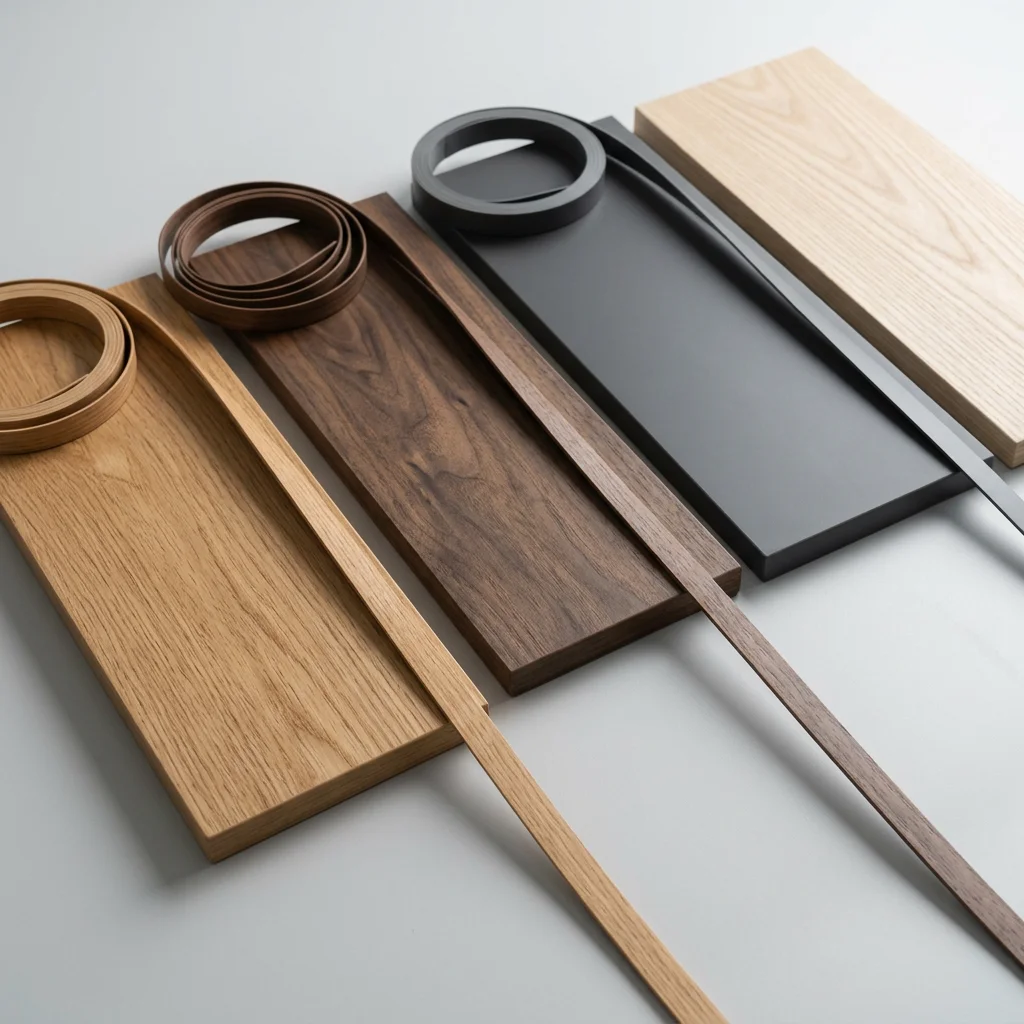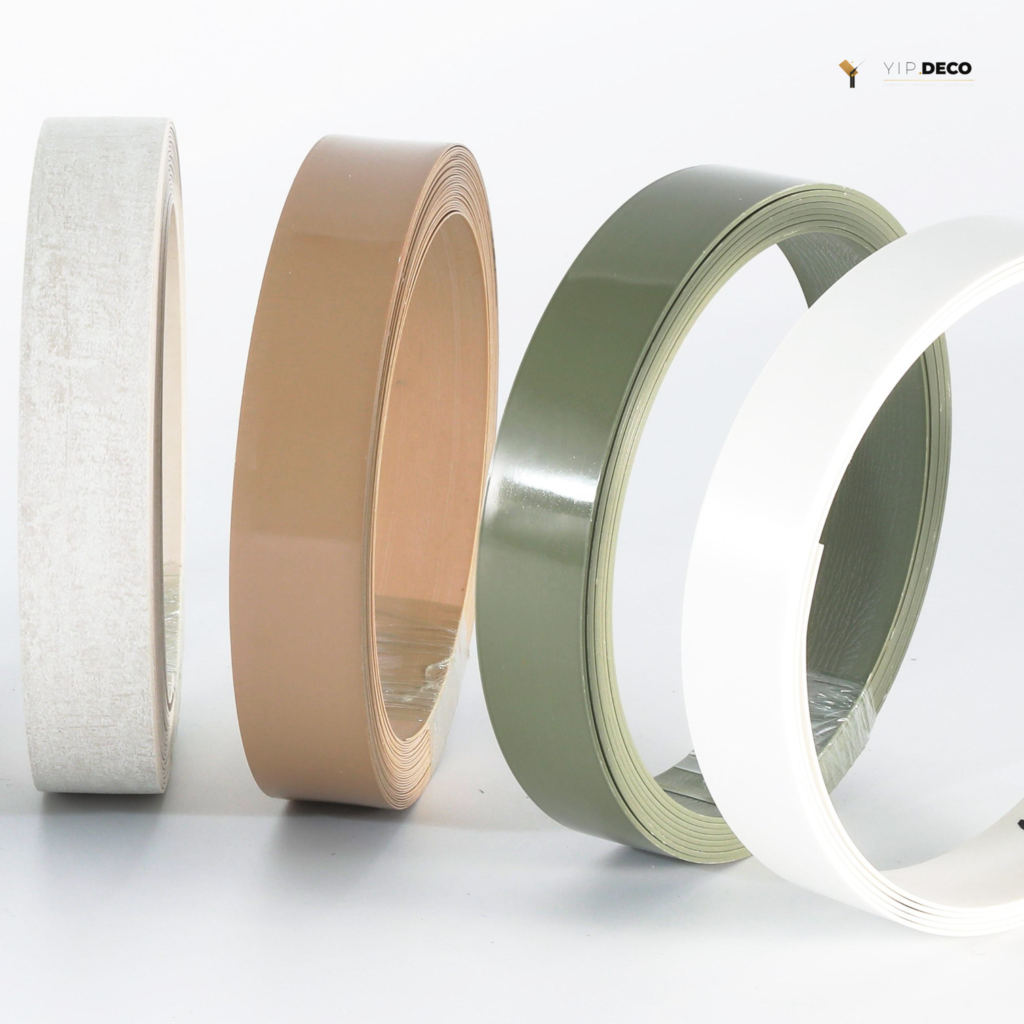
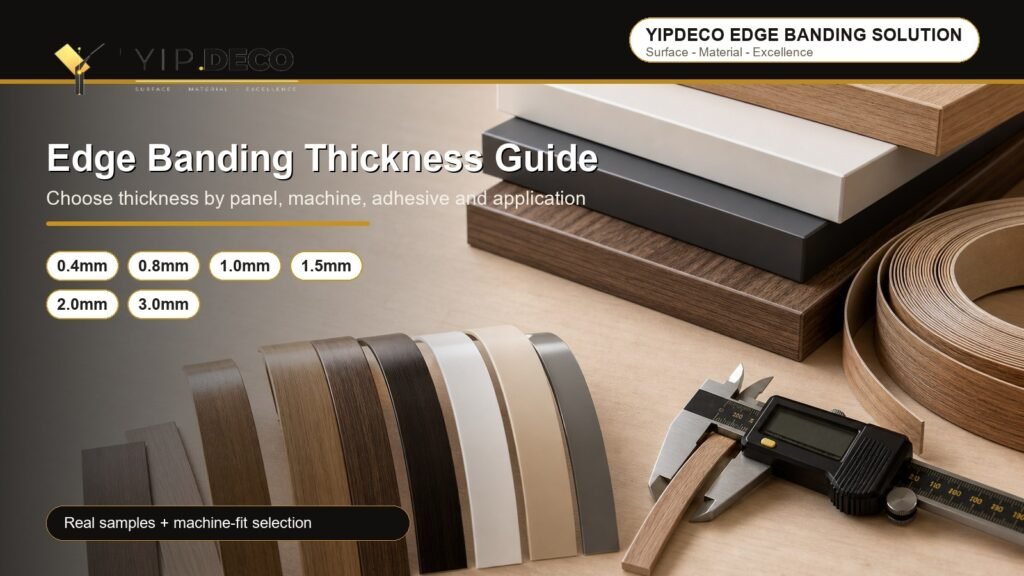
Edge banding thickness should be selected by matching the panel, furniture application, edge banding machine, adhesive, trimming tools, and expected use. For most cabinet doors and standard furniture panels, 0.8mm to 1.0mm is common. For worktops, heavy-use panels, and project furniture, 1.5mm to 2.0mm is often safer. Thicker is not always better if the machine and trimming setup cannot process it cleanly.
From YipDeco's 15 years of factory and machinery experience, edge banding thickness is not only a material specification. It is a production decision. A roll that looks strong on paper can still create trimming marks, glue-line problems, tool overload, or edge damage if the thickness does not match the board, glue system, and edge banding machine.
> YipDeco Insight: Many buyers ask for "the best edge banding thickness", but in real production the better question is: "Which thickness will run reliably on my machine for this furniture application?" A 2mm edge may be excellent for a worktop, but it can become a problem if the machine pressure, trimming tools, scraper setting, or feed speed are not suitable.
Quick Edge Banding Thickness Guide
The table below gives a practical starting point. It is not a universal rule. Buyers should confirm the final specification with physical samples and a real machine trial before bulk orders.
| Edge banding thickness | Common applications | Main advantage | What to check before ordering |
|---|---|---|---|
| 0.4mm | Back panels, low-impact furniture, hidden or low-contact edges | Economical and flexible | Easy to damage on exposed edges; not suitable for heavy-use panels |
| 0.8mm | Cabinet doors, wardrobes, office furniture, standard panel furniture | Balanced appearance, cost, and easy processing | Color match, glue line, trimming quality, and machine pressure |
| 1.0mm | Cabinets, wardrobes, shelves, mid-range furniture | Better edge coverage than 0.8mm while still easy to process | Scraper setting, buffing result, and visible edge smoothness |
| 1.5mm | Shelves, drawers, commercial furniture, higher-use panels | Stronger protection and more solid edge feel | Tool sharpness, feed speed, corner rounding, and adhesive contact |
| 2.0mm | Worktops, table edges, project furniture, heavy-use cabinets | Better impact buffer and rework tolerance | Machine capacity, trimming clearance, scraper pressure, and corner finish |
| 3.0mm | Special project furniture, thick panels, architectural millwork | Strong visual edge and high durability reserve | Requires suitable machine, tools, pressure, and production testing |
For many furniture factories, the practical choice is not one thickness for every job. It is a thickness system: 0.8mm or 1.0mm for general panels, 1.5mm or 2.0mm for higher-use parts, and 3.0mm only when the design, machine, and process can support it.
Why Thicker Edge Banding Is Not Always Better
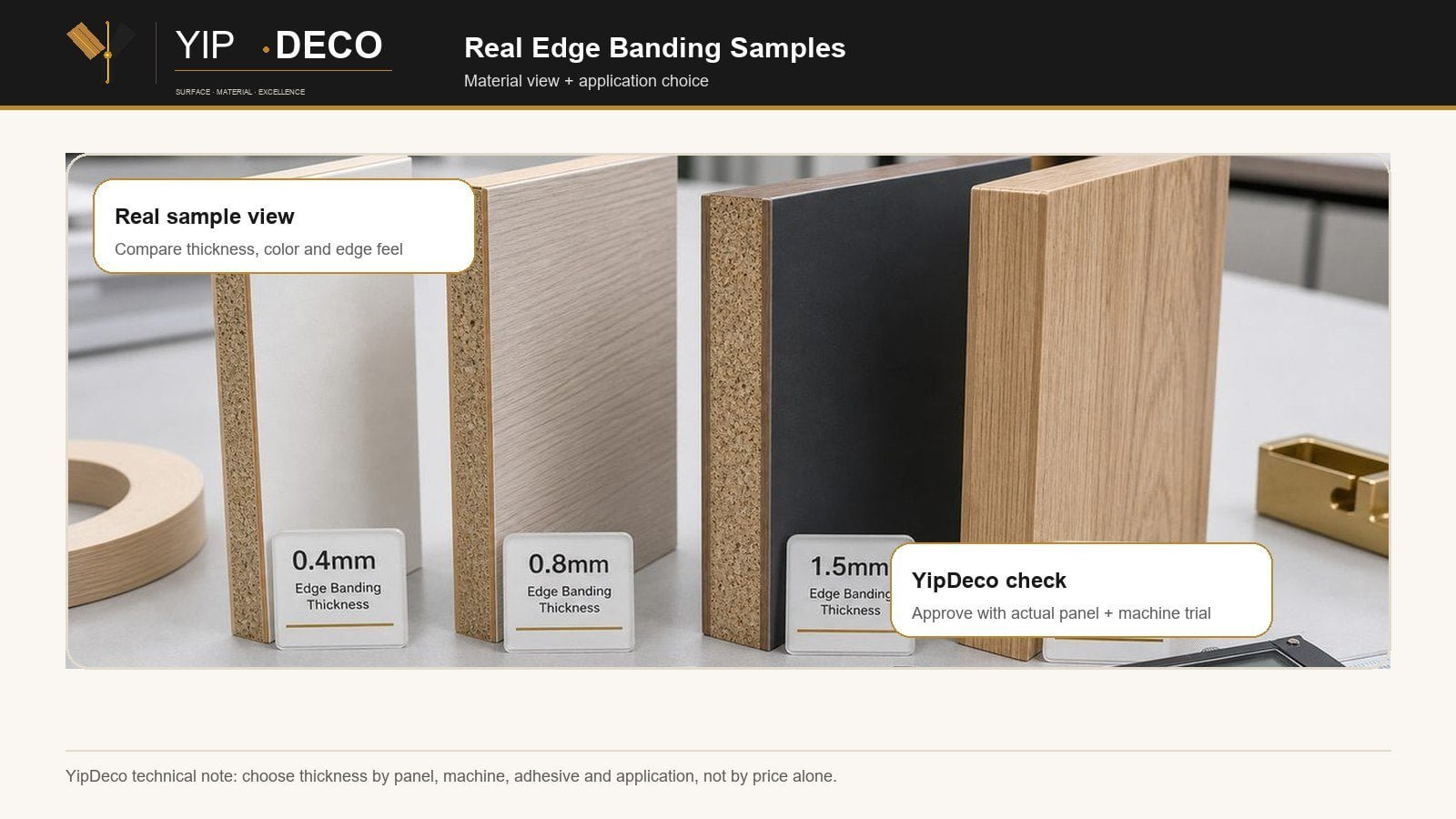
One common mistake is assuming that thicker edge banding is automatically higher quality. In real production, thicker edge banding can create new problems if the machine setup is not ready for it.
Thicker edge banding usually needs stronger and more stable pressure, enough trimming clearance, sharp cutters, suitable scraper settings, and careful corner rounding. If the tools are worn or the scraper pressure is too aggressive, the edge may show white stress lines, rough trimming, or surface marks.
Thicker material can also make glue-line control more difficult. If the pressure is uneven, the adhesive contact may not be consistent across the edge. If glue amount, temperature, or feed speed is not adjusted, the result can be peeling, open joints, or visible glue lines.
From a factory point of view, thickness should improve the final product without creating rework. A 2mm edge is useful only when the production line can process it cleanly.
How to Choose Thickness by Furniture Application
Different furniture parts have different edge requirements. A wardrobe door, a drawer side, a worktop, and a hotel furniture panel do not experience the same impact, cleaning, handling, or visual inspection.
For cabinet doors and wardrobe panels, 0.8mm to 1.0mm is often enough. These parts need a clean color match, smooth trimming, and stable glue line. The edge is visible, but it may not need the same impact buffer as a worktop.
For shelves, drawers, and commercial furniture, 1.0mm to 1.5mm may be a better balance. These parts are handled more often and may need stronger edge protection. The machine still needs to cut and scrape the edge smoothly.
For worktops, table edges, school furniture, retail fixtures, and heavy-use project furniture, 1.5mm to 2.0mm is often selected because it gives more protection and rework tolerance. However, buyers should test the exact thickness on the real edge banding machine before confirming the order.
For special architectural millwork or thick panels, 3.0mm may be used for a stronger edge appearance and higher durability reserve. This should be treated as a project specification, not a default furniture specification.
How Machine Settings Affect Edge Banding Thickness
Edge banding thickness must match the machine. This is where many sourcing mistakes happen.
A buyer may send a correct thickness requirement, but the factory's machine may not be adjusted for that thickness. Manual edge banders, semi-automatic machines, automatic edge banders, hot-air systems, laser systems, and PUR lines do not all behave the same way.
Before bulk production, the factory should check the items below. Worker safety should also be part of any machine trial; OSHA's machine guarding guidance notes that moving machine parts need suitable safeguards to protect operators from preventable injuries.
| Machine or process point | Why it matters for thickness | What to observe in the trial |
|---|---|---|
| Pressure rollers | Thicker edge banding needs stable contact pressure | Open joints, uneven bonding, or edge lifting |
| Feed speed | Too fast may reduce heating or bonding stability | Peeling, weak corners, rough trimming |
| Trimming cutters | Thick edge banding needs sharp tools and enough clearance | Chipping, white stress lines, rough edge |
| Scraper setting | Excessive pressure can mark the surface or expose stress | Scratches, gloss change, uneven edge line |
| Buffing unit | Final finish depends on pressure and wheel condition | Visible lines, dull surface, heat marks |
| Corner rounding | Important for 1.5mm, 2.0mm, and 3.0mm edges | Cracking, whitening, uneven corners |
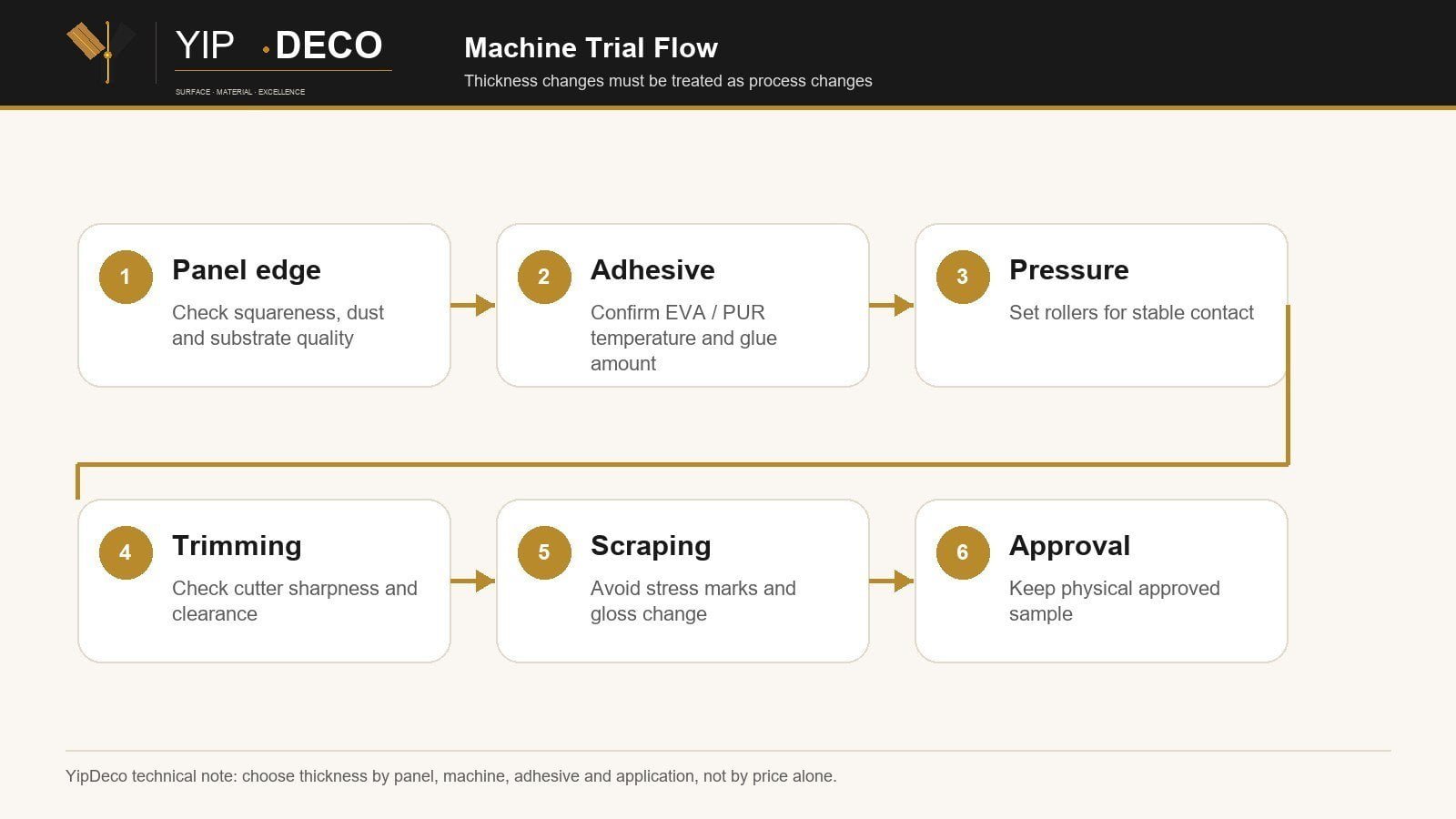
> YipDeco Insight: When customers report trimming failure, the cause is not always the edge banding material. Sometimes the thickness changed, but the cutter, pressure, scraper, or feed speed stayed the same. Thickness changes should be treated like a process change, not just a purchasing change.
How Adhesive Choice Affects Thickness Selection
Adhesive is another reason thickness cannot be selected in isolation. EVA and PUR systems can both work with many edge banding thicknesses, but the operating conditions are different.
EVA adhesive is widely used because it is practical, economical, and suitable for many furniture production lines. For standard 0.8mm, 1.0mm, and many 1.5mm applications, EVA can perform well when glue temperature, glue amount, pressure, and backside primer are suitable.
PUR adhesive is often used when stronger moisture or heat resistance is required. It can be useful for kitchens, bathrooms, commercial furniture, or project furniture, but it also requires proper process control. Open time, curing conditions, and machine cleaning should be considered.
For thicker edge banding, the factory should pay attention to adhesive contact. If the edge is thick but pressure is weak, the bonding line may not be stable. If glue application is too heavy, the finished panel may show a visible glue line.
How Panel Type and Surface Finish Change the Decision
The panel substrate and surface finish also affect thickness selection.
MDF, plywood, particleboard, chipboard, and laminated panels can behave differently during cutting, gluing, and trimming. If the panel edge is rough, dusty, or not square, even good edge banding may not bond well. For furniture sold into North America, substrate compliance can also matter; the U.S. EPA publishes formaldehyde emission standards for composite wood products, which buyers may reference separately from edge banding specifications.
Surface finish matters too. High gloss, soft touch, matte, woodgrain, and solid color edges all show defects differently. A small trimming mark may be less visible on some woodgrain finishes but obvious on high gloss or solid black panels.
For color-sensitive furniture, buyers should match edge banding thickness together with color, gloss, texture direction, and glue-line visibility. Photos are useful for communication, but final approval should rely on physical samples.
YipDeco supports buyers with edge banding, surface foil, and material matching support so the panel surface and edge can be checked as one system.
Common Buyer Mistakes When Ordering Edge Banding Thickness
Mistake 1: Choosing by price only
Thin edge banding can reduce cost, but it may not be suitable for exposed or heavy-use furniture. If a buyer uses 0.4mm edge banding on parts that need stronger protection, the finished furniture may chip, peel, or look low-value after use.
Mistake 2: Assuming 2mm is always better
2mm edge banding can be a strong choice for worktops and heavy-use panels, but it is not automatically better for every project. If the machine cannot trim it cleanly, the final result may look worse than a well-processed 1.0mm edge.
Mistake 3: Ignoring the edge banding machine
The machine must be part of the buying discussion. Buyers should confirm machine type, adhesive system, feed speed, pressure range, trimming tools, and corner rounding requirements before ordering a new thickness.
Mistake 4: Not testing real panels
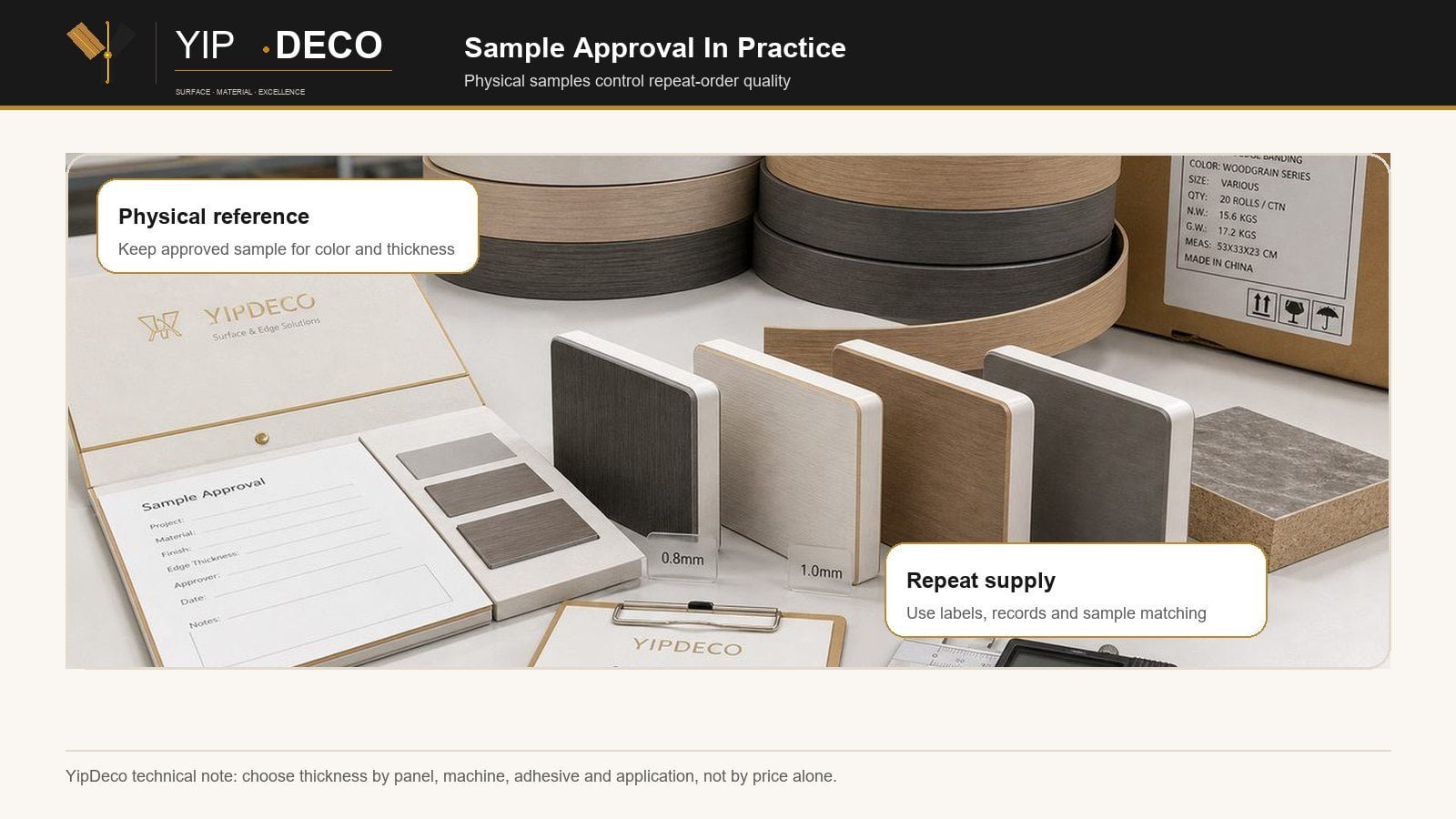
A sample roll should be tested on the actual board and production line. A desk sample may look fine, but the real answer comes after gluing, pressing, trimming, scraping, buffing, and corner rounding.
Practical Thickness Selection Checklist
Before confirming bulk orders, buyers should prepare the following information:
- Panel type: MDF, plywood, particleboard, chipboard, or other substrate.
- Panel thickness and edge condition.
- Furniture application: cabinet door, wardrobe, shelf, worktop, drawer, table, retail fixture, or project furniture.
- Target thickness: 0.4mm, 0.8mm, 1.0mm, 1.5mm, 2.0mm, or 3.0mm.
- Edge banding material: PVC, ABS, PP, PET, acrylic, veneer, laser, or other option.
- Surface finish: solid color, woodgrain, matte, high gloss, soft touch, metallic, or custom finish.
- Adhesive system: EVA, PUR, hot air, laser, or other system.
- Machine type and process: manual, semi-automatic, automatic edge bander, hot-air line, laser line, or PUR line.
- Required packaging: roll size, labels, carton strength, pallet plan, and export shipping method.
- Sample approval method: physical sample, machine trial, and approved reference sample for repeat orders.
This checklist helps avoid a common problem: choosing a thickness that looks correct in the quotation but fails during production.
Explore Our Range
If you are choosing edge banding thickness, the next step is to test the material with your real panel, machine, and application.
| Product range | Best for | Next step |
|---|---|---|
| PVC, ABS, PP, PET and Laser Edge Banding | Cabinets, wardrobes, office furniture, worktops, retail fixtures, and project furniture | Compare thickness, material, color, backside primer, and machine processing |
| Surface Foil | Decorative panel surfaces that need coordinated color, gloss, woodgrain, matte, or high gloss effects | Match surface finish and edge banding before bulk production |
| Sample and Project Support | Furniture factories, distributors, and project buyers checking specifications before ordering | Send panel type, machine information, target thickness, and application details |
Next step: Request edge banding thickness samples from YipDeco
Final Recommendation
The best edge banding thickness is the one that matches the furniture application, panel substrate, machine capability, adhesive, trimming process, and visual requirement. For many cabinet and wardrobe projects, 0.8mm to 1.0mm is a practical choice. For heavier-use panels, shelves, worktops, and project furniture, 1.5mm to 2.0mm may be more suitable. For special millwork, 3.0mm should be tested carefully before bulk production.
Do not choose thickness by price alone, and do not assume thicker is always better. A reliable result comes from matching the material to the real production line.
Send YipDeco your board type, furniture application, edge banding machine information, adhesive system, and target thickness. We can help prepare matching edge banding samples for machine testing before bulk orders.
Ready to check your project? Send Your Edge Banding Thickness Inquiry