Commercial contractors rarely choose a wall finish on material price alone. The real question is whether the specified system can be installed on the available substrate, within the shutdown window, by the available crew, and still pass the client’s finish review.
For many hotel, retail, office and multi-unit renovation projects, SPC wall panels can reduce wet-trade stages and simplify scheduling. Ceramic tile remains a strong specification where direct heat, heavy service conditions, established wet-area details, or a traditional grouted finish control the decision. The smarter choice depends on installed cost and project risk, rather than price per square metre.
Quick Comparison: SPC Wall Panels vs Ceramic Tile
| Decision factor | SPC wall panels | Ceramic tile |
|---|---|---|
| Installation sequence | Measure, cut, fit, fix, finish joints and edges | Prepare, waterproof where required, set tile, wait, grout, clean |
| Typical trade | Panel fitter or trained interior installer | Skilled tile setter |
| Waiting stages | Depends on the approved adhesive or mechanical system | Adhesive and grout waiting times depend on the selected products |
| Wall weight | Relatively light | Relatively heavy |
| Visual format | Large-format continuous-grain, stone, wood or solid decors | Individual modules with visible grout joints |
| Wet-area logic | Panel core plus sealed joints, penetrations, perimeter and substrate | Tile plus grout, waterproofing, substrate and movement-joint system |
| Best-fit projects | Fast renovations, hospitality, retail, feature walls | Direct-heat zones, heavy-duty areas, specified tile finishes |
| Main procurement check | Exact wall-panel construction and installation system | Tile type, mortar, grout, membrane and installation method |
This table is a screening tool. A project specification should still confirm fire documentation, cleaning chemistry, wet-area details, substrate requirements and local code acceptance for the exact product and assembly.
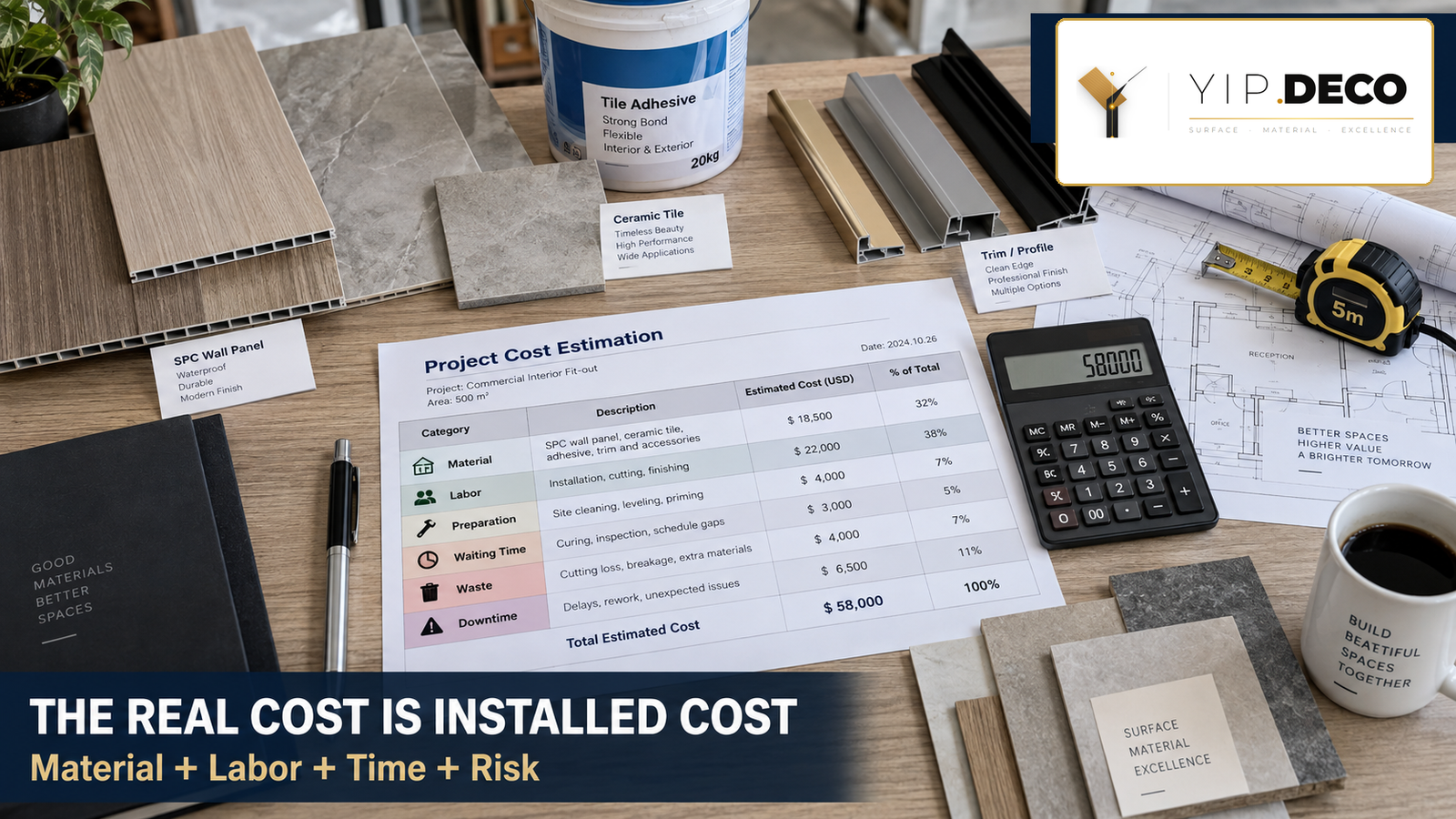
The Real Cost Comparison Is Installed Cost
Material price per square metre leaves out the parts of the job that often decide the margin. A more useful comparison is:
Installed cost = material + accessories + substrate preparation + labor + tools + waste + waiting time + rework risk + downtime
Ceramic tile is a wet-trade system. The crew may need to correct the wall, waterproof wet locations, spread mortar, cut and set individual tiles, wait, grout and clean. Product-specific times matter: one MAPEI wall-tile adhesive lists a four-to-eight-hour wait before wall grouting, while other products and site conditions differ. Use the selected product’s technical data sheet, such as the manufacturer’s Kerabond T technical data, rather than a generic estimate.
SPC wall panels use a different workflow. Large panels are measured, cut and fixed with the approved adhesive, mechanical system or a combination of both. Joints, penetrations and perimeter edges then receive the details required by the system. There is no tile-setting or grouting stage, although an adhesive installation may still have a cure period before the wall is loaded or exposed to service.
That difference can reduce site handoffs, but it does not guarantee that SPC will be cheaper. Curved walls, numerous outlets, complex reveals, poor substrates or difficult access can increase fitting time.
Build the ROI Case With Project Inputs
A responsible bid comparison uses the contractor’s own measured quantities. Avoid claims such as “50% faster” unless the crew, wall condition, layout and scope are defined.
For a hotel renovation, enter these variables:
- Total wall area and number of rooms.
- Existing wall condition and required correction.
- Number of corners, doors, outlets and service penetrations.
- Panel or tile format and cutting pattern.
- Crew size, skill level and local hourly cost.
- Waterproofing, adhesive, trim and accessory requirements.
- Product-specific cure or waiting periods.
- Waste and breakage allowance.
- Value of each room or area being offline per day.
- Inspection, snagging and handover requirements.
For a 1,000 m² corridor project, multiply measured crew-hours by the local labor rate, add any reopening value, then include trims, adhesive, waste and substrate correction. This produces a bid-specific figure instead of a marketing percentage.

Where SPC Wall Panels Usually Create the Most Value
Hotel and hospitality renovations
Rooms, corridors and public areas often have fixed shutdown windows. A large-format dry-fit system can help when the substrate is suitable and the edge details have already been resolved. Continuous-grain decors can also create a consistent visual result across repeated rooms.
Retail refreshes
Retail programs value repeatable finishes and short closures. Panels can cover large wall areas without a grid of grout lines, while factory-produced decors help keep several locations visually consistent. Samples should still be approved under the project’s lighting before production.
Renovation over an existing finish
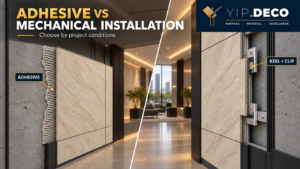
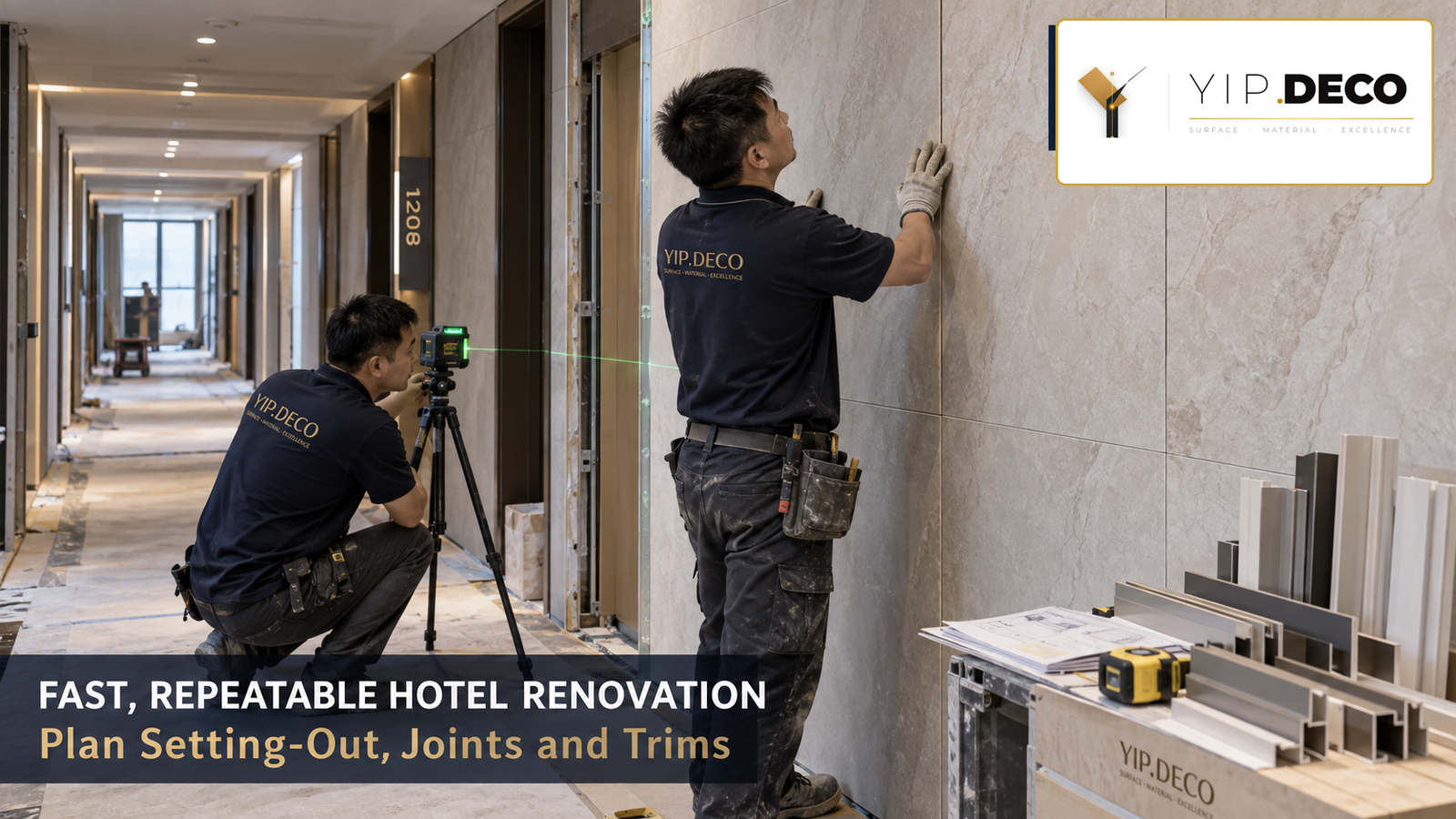
Some SPC panel systems can be installed over existing tile or other sound, flat surfaces. “Install over” does not mean “ignore the wall.” The estimator must check adhesion, flatness, contamination, loose finishes, moisture, movement and the effect of extra thickness at doors, outlets and transitions. YIPDECO’s guide to adhesive versus mechanical wall-panel installation explains how the fixing decision changes with the substrate and service conditions.
SPC Wall Panels Are Not SPC Flooring Turned Sideways
Buyers often treat “SPC” as one specification. That creates risk. Flooring data such as wear class, click-load performance and indentation resistance do not automatically describe a wall panel.
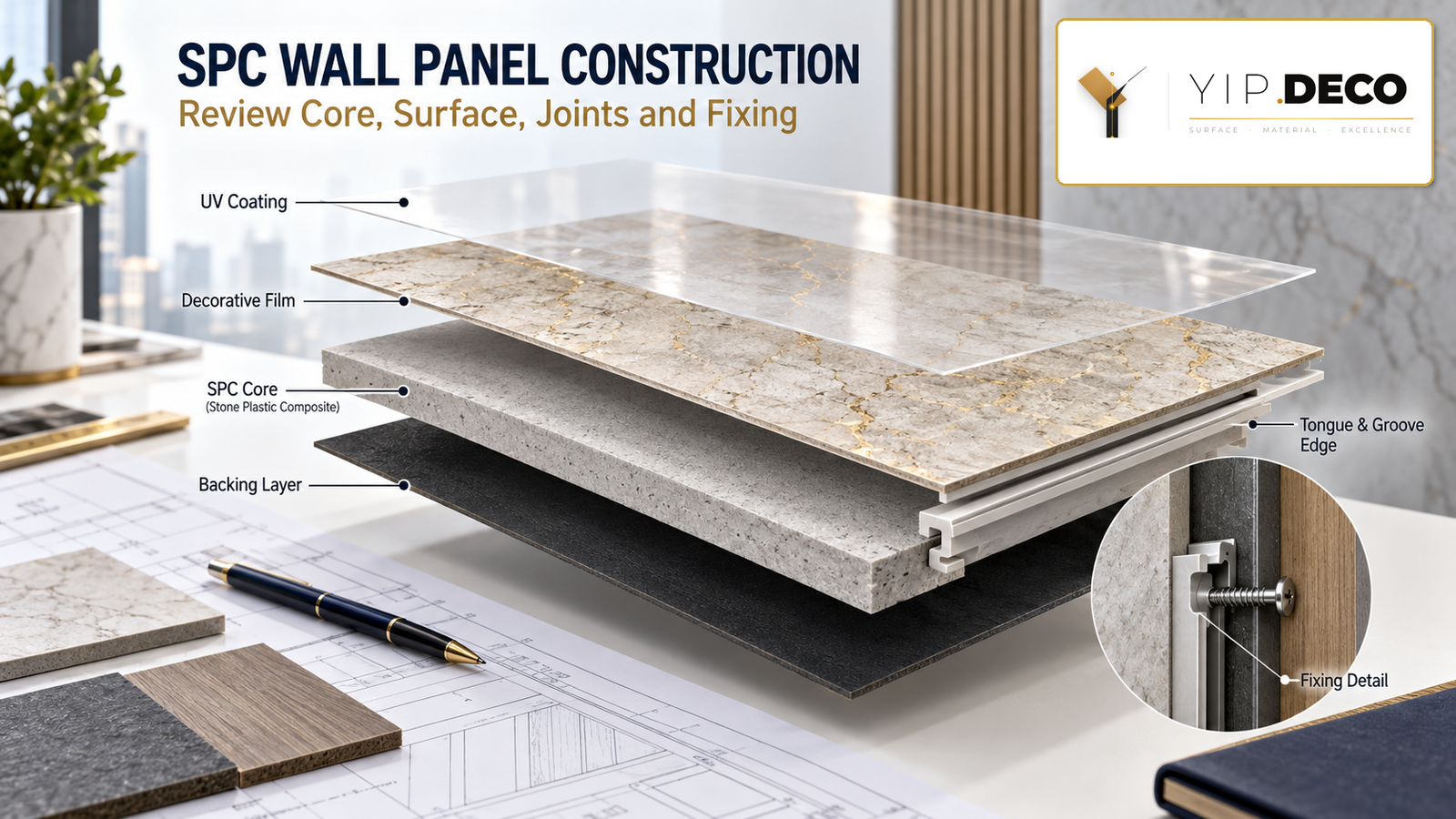
A wall-panel submittal should identify:
- panel construction and core composition;
- total thickness, dimensions and tolerances;
- decorative surface and cleaning limits;
- edge or joint system;
- recommended adhesive and/or mechanical fixing;
- substrate requirements;
- perimeter, corner and penetration details;
- temperature and service limitations;
- fire and emissions documents available for the exact configuration;
- packaging, batch control and color approval process.
Review the actual YIPDECO SPC wall-panel range and request the data sheet for the configuration being quoted. Product-family language should never substitute for an exact order specification.
Wet Areas: The Core Is Only One Part of the Assembly
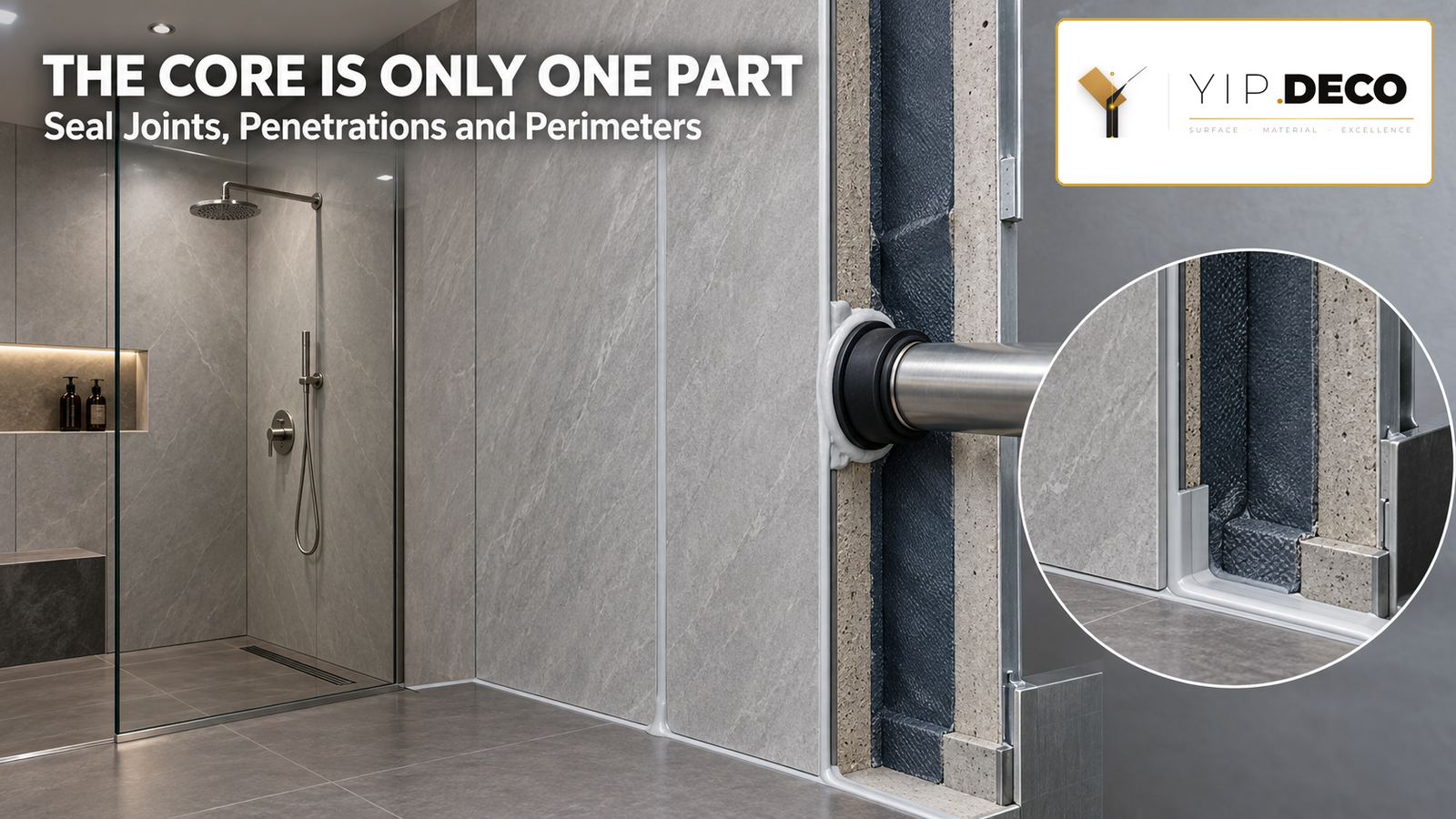
A moisture-resistant or waterproof core is useful, but it does not make every completed wall waterproof. Water can reach the substrate through unsealed joints, corners, penetrations, fixtures or perimeter gaps. The correct decision therefore considers the entire assembly.
The same principle applies to tile. The Tile Council of North America notes that grout joints are not waterproof and that wet-area protection depends on the installation method and substrate. See the TCNA ceramic-tile FAQ. Schluter likewise explains that a tiled wet area needs an integrated waterproofing system behind or directly below the tile covering; its shower-system overview illustrates the assembly approach.
For either finish, confirm:
- whether the area is splash-exposed, intermittently wet or continuously wet;
- the required membrane or waterproof substrate;
- how internal and external corners are sealed;
- how pipes, valves and other penetrations are treated;
- how the wall connects to the floor, tray, ceiling and adjacent finishes;
- compatible sealants, adhesives and cleaning products;
- inspection and testing requirements under the local code.
SPC may simplify the visible finish, but the project still needs a designed moisture-management detail.
Site Conditions, Cutting and Safety
Both systems require accurate cutting and a safe work plan. Ceramic and porcelain tile cutting can generate silica-containing dust. OSHA treats stationary saws used on silica-containing tile as masonry saws and specifies controls for covered work. See OSHA’s construction silica guidance.
Panel cutting has a different dust and offcut profile, but extraction, PPE and the manufacturer’s safety information still apply.

When Ceramic Tile Is the Better Specification
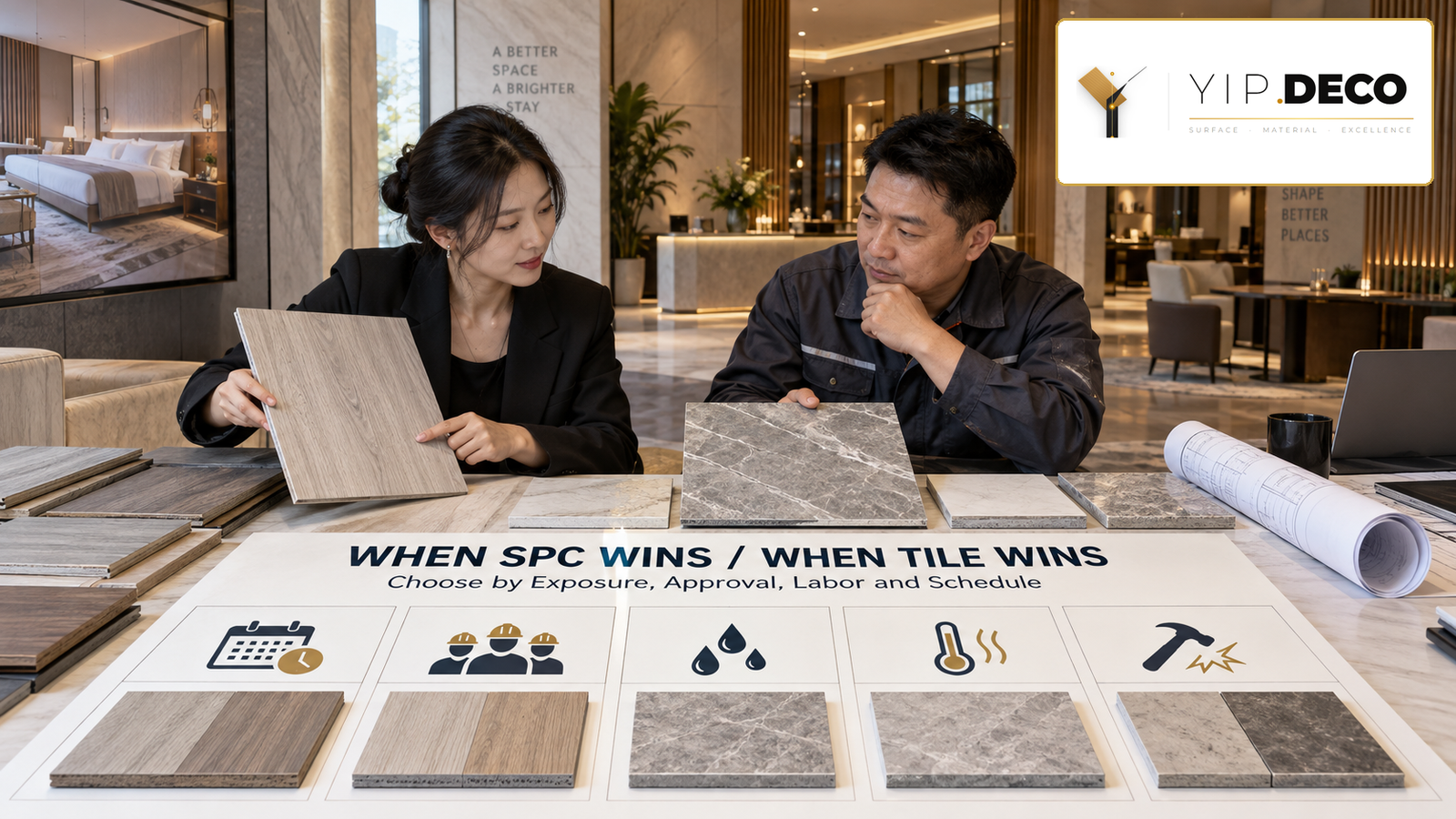
SPC wall panels should not be positioned as a universal replacement. Ceramic or porcelain tile may be the better choice when:
- the wall is near direct flame, intense radiant heat or equipment that exceeds the panel system’s temperature limits;
- the surface faces severe abrasion or repeated heavy impact and a suitable tile assembly is specified;
- the consultant, authority or client specification explicitly requires tile;
- the design depends on a genuine ceramic, porcelain or grouted modular appearance;
- the contractor already has an optimized tile workflow and the schedule has enough curing time;
- a tested and approved tile assembly is available while the proposed panel configuration lacks the required documentation.
Conversely, SPC often deserves serious evaluation when shutdown time, wall weight, repeatability, large-format visual continuity and fewer wet-trade stages carry measurable value.
Five Documents to Request Before Approving SPC Wall Panels
- Exact product data sheet for the panel construction, thickness and finish.
- Installation guide covering approved substrates, fixing methods, joints, corners and penetrations.
- Sample and decor approval for color, sheen, texture and batch reference.
- Available third-party reports required by the project, matched to the exact product configuration and market.
- Packing and QC information for large or multi-phase orders.
YIPDECO can prepare physical SPC wall-panel samples so the contractor, distributor and client can review the finish before committing to a bulk order.
Frequently Asked Questions
Are SPC wall panels always cheaper than ceramic tile?
No. Compare the installed system. SPC can be advantageous when labor, shutdown time and wet-trade sequencing are expensive, while tile can remain competitive where skilled crews, proven details and adequate time are already available.
Can SPC panels be installed directly over old tile?
Some systems can, provided the existing tile is sound, clean, dry enough for the specified adhesive, sufficiently flat and compatible with the fixing method. Check loose tiles, contamination, movement joints and the extra finished-wall thickness first.
Can SPC wall panels be used in commercial bathrooms?
They can be considered when the exact product is suitable and the complete wall assembly addresses joints, penetrations, edges, substrate and local wet-area requirements. A waterproof core alone is not a complete waterproofing specification.
Do SPC wall panels require skilled installers?
They do not normally require tile-setting skills, but installers still need training in substrate assessment, setting-out, cutting, adhesive or mechanical fixing, joint alignment and trim details.
What is the best way to compare installation speed?
Run a small mock-up or measure crew productivity on a representative area. Record preparation, cutting, fitting, waiting, cleaning and snagging time for both systems. Use those values in the project estimate.
Final Decision
For commercial projects, SPC wall panels often make the strongest case where labor cost, shutdown time and repeatable large-format finishes drive the budget. Ceramic tile remains a credible choice where heat, heavy service conditions, an established wet-area assembly or a tile-specific design brief dominates.
Before substituting one for the other, compare the complete assembly and obtain approval for the exact product, fixing method and documentation. Request an SPC sample and project-specific data sheet with the wall area, application, substrate, target finish, destination market and required reports.