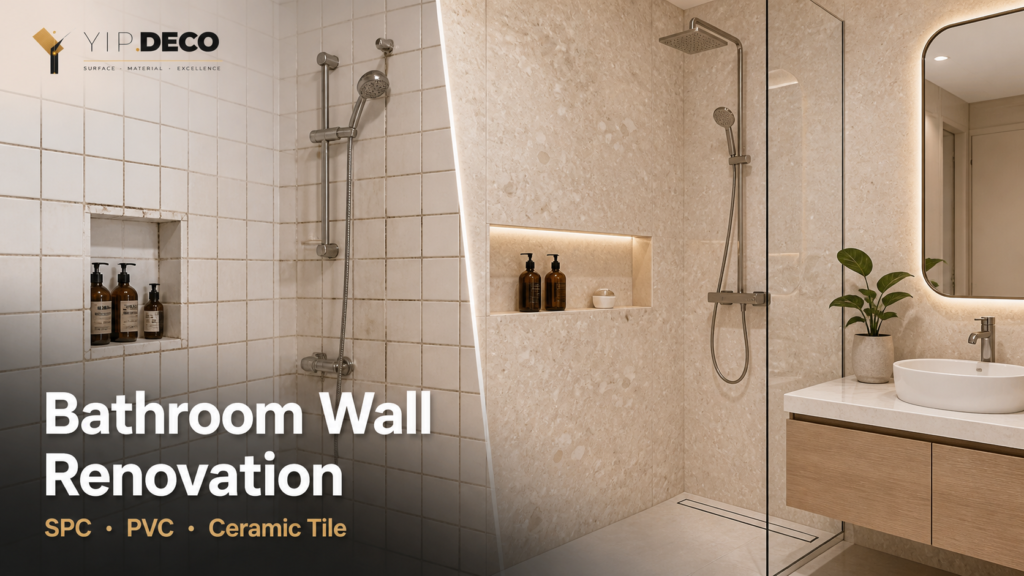
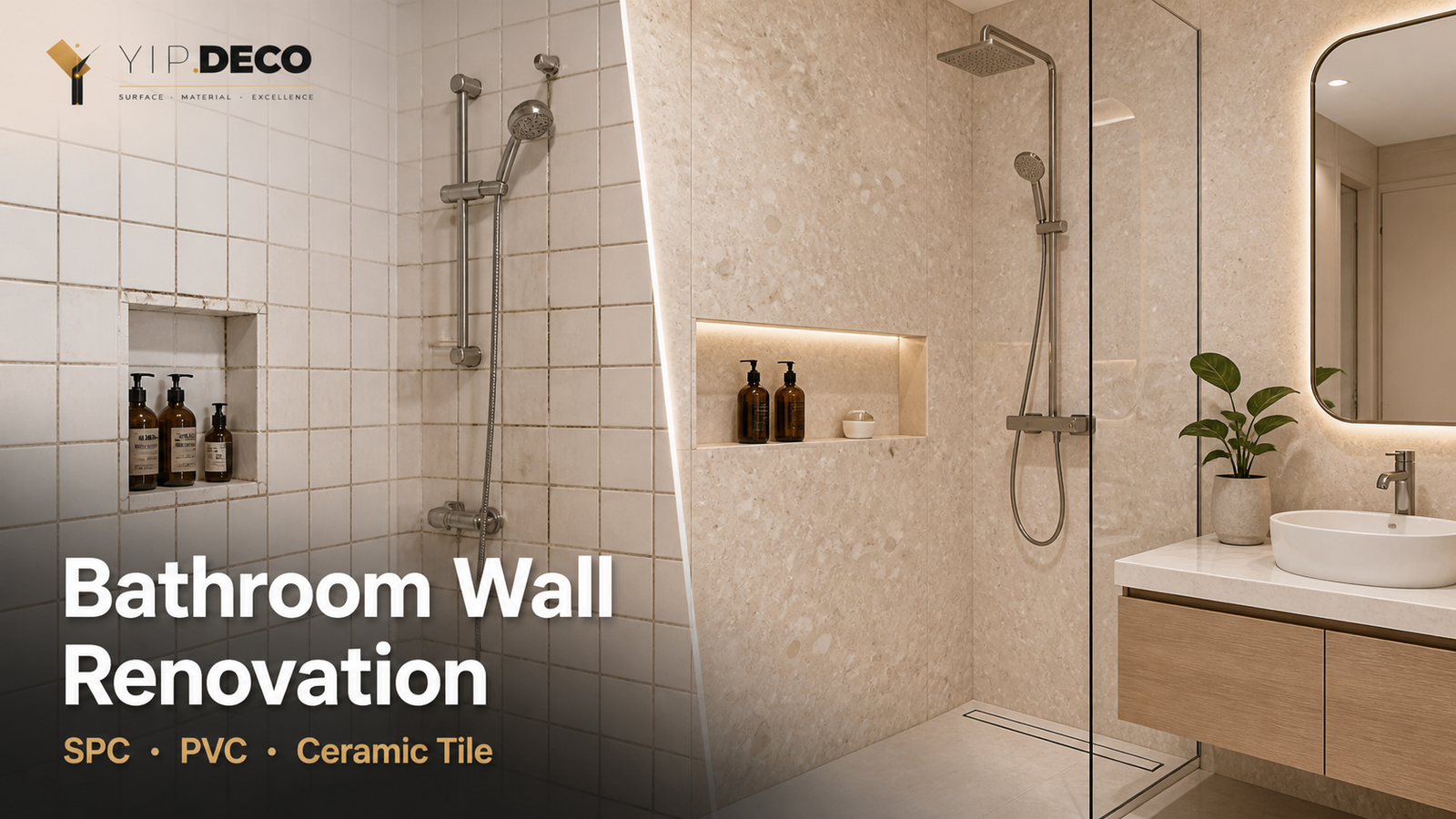
Bathroom Wall Panels for Renovation: SPC, PVC or Ceramic Tile?
Bathroom renovation buyers often ask a simple question: should we use SPC wall panels, PVC wall panels, or ceramic tile?
The honest answer is that the material choice should not start with the catalog picture. It should start with the wall condition, the moisture level, the installer skill available, and the part of the bathroom being renovated. A shower wall, a vanity backsplash, a dry feature wall, and a ceiling edge are not the same environment. If a buyer treats the whole bathroom as one condition, the risk of choosing the wrong product becomes much higher.
For renovation projects, SPC wall panels are usually the stronger choice for wet bathroom walls and tile-alternative applications, especially where buyers want faster installation and less grout maintenance. PVC wall panels can still be useful for dry decorative bathroom zones or budget-sensitive wall upgrades, but they should be evaluated carefully before being used in constant wet or steam-heavy areas. Ceramic tile remains a familiar and durable option, but grout maintenance, installation time, curing, wall preparation, and future repair should be part of the cost calculation.
This article explains how we usually think through this decision when buyers send bathroom project photos, samples, or renovation requirements.
YipDeco Insight
In real bathroom renovation inquiries, the most useful answer rarely comes from comparing one catalog photo against another. We first look at the application environment: whether the wall is a direct wet zone, whether the old substrate is stable, how the corners will be finished, and whether the buyer can approve physical samples before bulk order. That is also where our wall-panel and matching-accessory experience matters. A panel selection is only reliable when the material, trims, sealing details, sample record, and export order requirements are checked together.
Quick Decision Guide
| Bathroom area or project condition | Better starting option | Why |
|---|---|---|
| Shower wall, wet wall, hotel bathroom, apartment bathroom renovation | SPC wall panels | Moisture-resistant core, fewer joints, fast installation, tile-alternative positioning |
| Dry decorative wall, toilet wall away from direct water, budget feature wall | PVC wall panels | Lightweight, decorative, cost-sensitive, easy to apply in suitable dry areas |
| Traditional specification, high local installer acceptance, code-driven projects | Ceramic tile | Familiar system, hard surface, well-known installation method |
| Old wall with loose tile, damp substrate, mold, hollow areas, or unstable plaster | Fix substrate first | No wall panel or tile system should cover an unstable or wet base |
| Buyer needs matching trims, corners, and clean finishing | Wall panel plus accessories | Finishing details decide whether the renovation looks professional |
For material samples and project advice, send the bathroom zone, wall photos, and target finish through the YipDeco contact page.
Start with the Bathroom Zone, Not the Product Name
One mistake we see in buyer conversations is asking, "Which bathroom wall panel is best?" without separating the installation zones.
In a bathroom renovation, the wall behind the shower is not the same as the wall behind a mirror. A decorative wall near the toilet does not face the same risk as the lower wall next to a bathtub. A hotel bathroom may need faster turnover than a private villa bathroom. A distributor may also need a product that ordinary installers can apply consistently, not only a product that looks impressive in one showroom.
Before choosing between SPC, PVC, and ceramic tile, divide the bathroom into zones:
- Direct wet zone: shower wall, bathtub surround, wet room wall, lower wall exposed to splashing.
- High humidity zone: ceiling edge, wall near ventilation gaps, poorly ventilated bathroom wall.
- Semi-dry zone: vanity backsplash, toilet wall, upper decorative wall.
- Dry decorative zone: feature wall, corridor-facing bathroom wall, dressing area wall.
SPC belongs naturally in wet and moisture-risk zones. PVC can be suitable in dry and semi-dry decorative zones, depending on product structure and installation. Ceramic tile can still be the right answer when the local market expects tile or when the project specification is already built around tile.
The important point is not to force one product into every zone.
Why Renovation Is Different from New Construction
In new construction, a contractor can plan the wall system from the beginning. The wall can be leveled, waterproofing can be applied, tiles can be installed, grout can cure, and the whole schedule can absorb the time.
Renovation is different.
Renovation buyers often care about:
- how much dust and noise the work creates;
- whether the old wall must be demolished;
- how many days the bathroom is unusable;
- whether skilled tile labor is available;
- whether the product can cover a large area quickly;
- whether the new surface will be easy to clean;
- whether the finished result looks modern enough for the next tenant, guest, or buyer.
This is where bathroom wall panels become attractive. The conversation is not only about material performance. It is about disruption, installation time, and total project risk.
When an importer asks us about SPC bathroom wall panels, the real question is often: "Can my customer renovate faster without creating a maintenance problem later?" That is a better question than "Is SPC better than tile?"
Where SPC Wall Panels Make the Most Sense
SPC wall panels are most useful when the buyer wants a bathroom wall surface that can reduce grout maintenance, support faster installation, and perform better in moisture-heavy wall scenes than ordinary decorative panels.
SPC stands for stone plastic composite. In wall panel applications, it usually refers to a rigid composite core with a decorative surface and protective finish. The panel is not simply SPC flooring moved to the wall, and it is not just a thin PVC decorative film. A proper SPC wall panel system should also include corner trims, connectors, edge profiles, and installation details that protect exposed edges and joints.
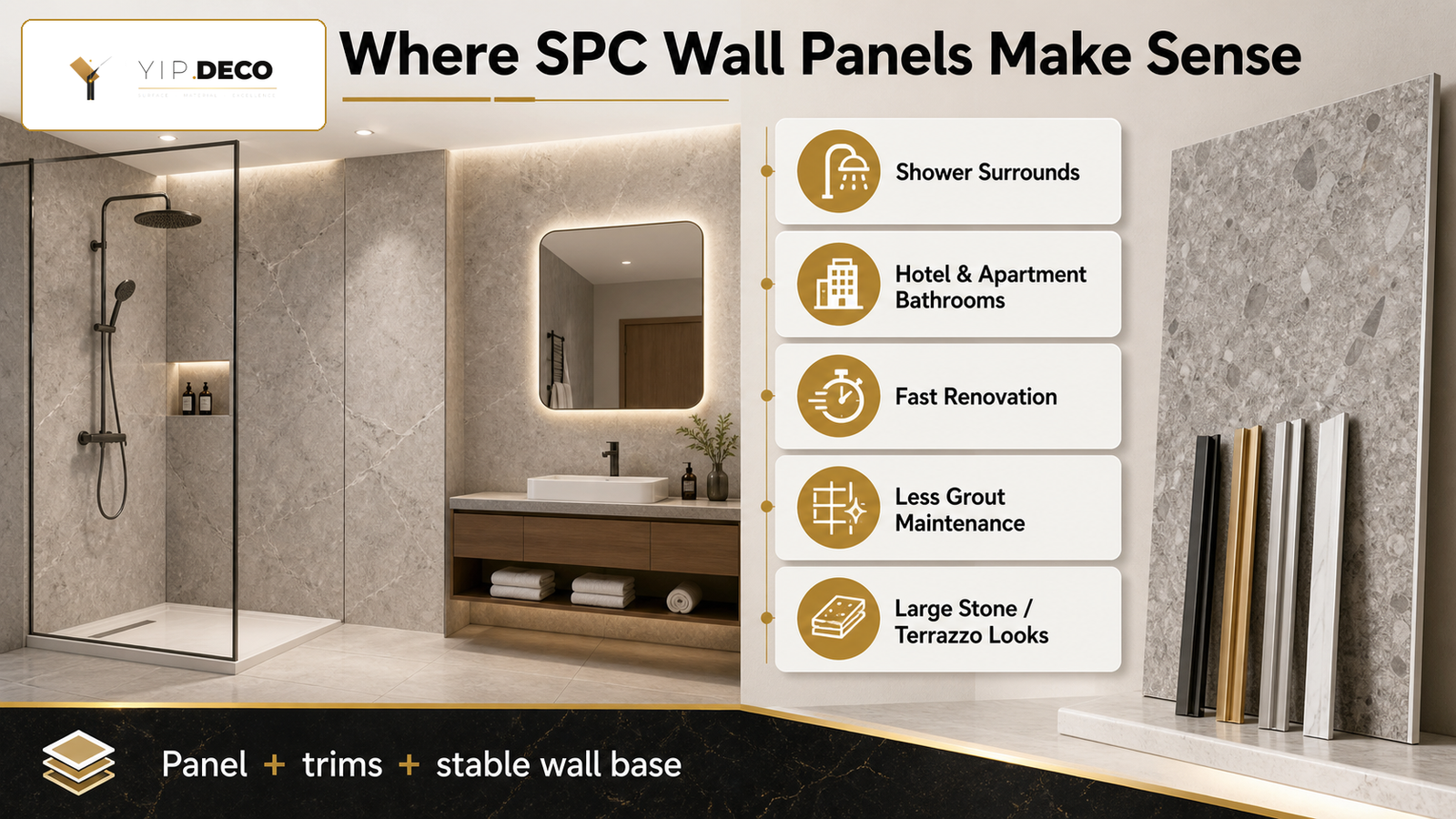
SPC is worth considering for:
- shower surrounds;
- hotel and apartment bathrooms;
- bathroom renovation where speed matters;
- tile-replacement wall projects;
- moisture-heavy walls where grout maintenance is a concern;
- projects where large-format stone, terrazzo, marble, wood grain, or grid patterns are requested.
Its value is not that it is "harder than ceramic tile." Ceramic tile is extremely hard. The value is that SPC wall panels can reduce the number of grout lines and simplify the wall system.
For many renovation buyers, grout is the part they dislike most. It becomes dirty, changes color, and can be difficult to clean in high-humidity spaces. The U.S. EPA notes that indoor mold growth is controlled by controlling moisture, and bathrooms that stay damp require better ventilation and cleaning frequency. That is why material selection, wall detailing, and ventilation should be considered together, not separately. Reference: EPA guide to mold, moisture, and your home.
Where PVC Wall Panels Can Still Be the Right Choice
PVC wall panels should not be dismissed. They are useful in many decorative interior projects, including some bathroom-related areas. The key is to use them in the correct environment.
PVC panels can be a good option for:
- dry decorative bathroom walls;
- toilet walls away from constant water exposure;
- quick cosmetic renovation in low-risk zones;
- budget-sensitive projects;
- lightweight decorative applications;
- color or texture upgrades where the wall is stable and dry.
The risk appears when buyers treat PVC and SPC as interchangeable for wet bathroom walls. Some PVC decorative panels may look similar to SPC panels in photos, but the core structure, thickness, rigidity, and edge behavior may be different. In constant wet or high-humidity areas, the wrong PVC product or poor sealing can lead to edge lifting, deformation, visible joint issues, or later rework.
This does not mean PVC is low quality. It means PVC needs the right scene.
When we discuss PVC bathroom wall use with buyers, we usually ask:
- Is this wall directly exposed to shower water?
- Is the room ventilated?
- Is the wall dry and stable?
- Will the panel edges be sealed correctly?
- Is the buyer expecting a tile replacement, or only a decorative upgrade?
- Does the customer understand the difference between dry-zone decoration and wet-zone wall protection?
If the buyer needs a true wet-wall tile alternative, SPC should usually be evaluated first. If the buyer needs a dry decorative wall upgrade, PVC may be enough and more cost-effective.
When Ceramic Tile Is Still the Practical Choice
Ceramic tile remains a strong material. It is familiar to contractors, widely accepted by homeowners, and often required by local project specifications. In some markets, tile is still the easiest product to sell because the customer already understands it.
Ceramic tile may still be the right choice when:
- local building specifications require it;
- the contractor team specializes in tile installation;
- the project owner prefers traditional materials;
- the wall needs a very high local acceptance level;
- replacement tiles and skilled maintenance are easily available;
- the design depends on small tile modules or special ceramic finishes.
The weak point is rarely the tile body. It is usually the system around it: grout, substrate preparation, curing time, waterproofing detail, and future maintenance.
The CDC also emphasizes that mold grows where moisture is present and that moisture problems must be fixed, not only cleaned. Reference: CDC mold overview. That advice matters for tiled bathrooms and panel bathrooms equally. If the wall behind the surface is wet, loose, or damaged, the visible material cannot solve the root problem.
The Substrate Checklist Before Choosing Any Bathroom Wall Panel
Before recommending SPC, PVC, or tile, the existing wall condition should be checked.
For renovation projects, ask these questions first:
-
Is the wall flat enough? Large-format panels need a reasonably flat base. If the wall has strong waves, hollow areas, or uneven old tile, direct installation may create gaps or stress.
-
Is the wall dry? A panel should not be used to hide a moisture problem. If the wall is damp because of leakage, condensation, or failed waterproofing, the source must be fixed first.
-
Is the old surface stable? If old tiles are loose, hollow, cracked, or falling away, covering them directly is risky. The new system depends on the stability of the old base.
-
Are corners and edges planned? Bathroom failures often happen at edges, internal corners, external corners, and transitions. The panel is only one part of the system. Trims and connectors matter.
-
How will joints be sealed? Even moisture-resistant panels need correct joint treatment. A good panel with poor sealing can still create problems.
-
Can the installer follow the system? A product that requires careful accessories but is installed without them will not perform as expected.
This is why buyers should send wall photos, drawings, rough measurements, and installation environment details before finalizing material. It is also why sample confirmation is not optional.
Can Bathroom Wall Panels Be Installed Over Old Tiles?
This is one of the most common renovation questions, and the answer needs to be careful.
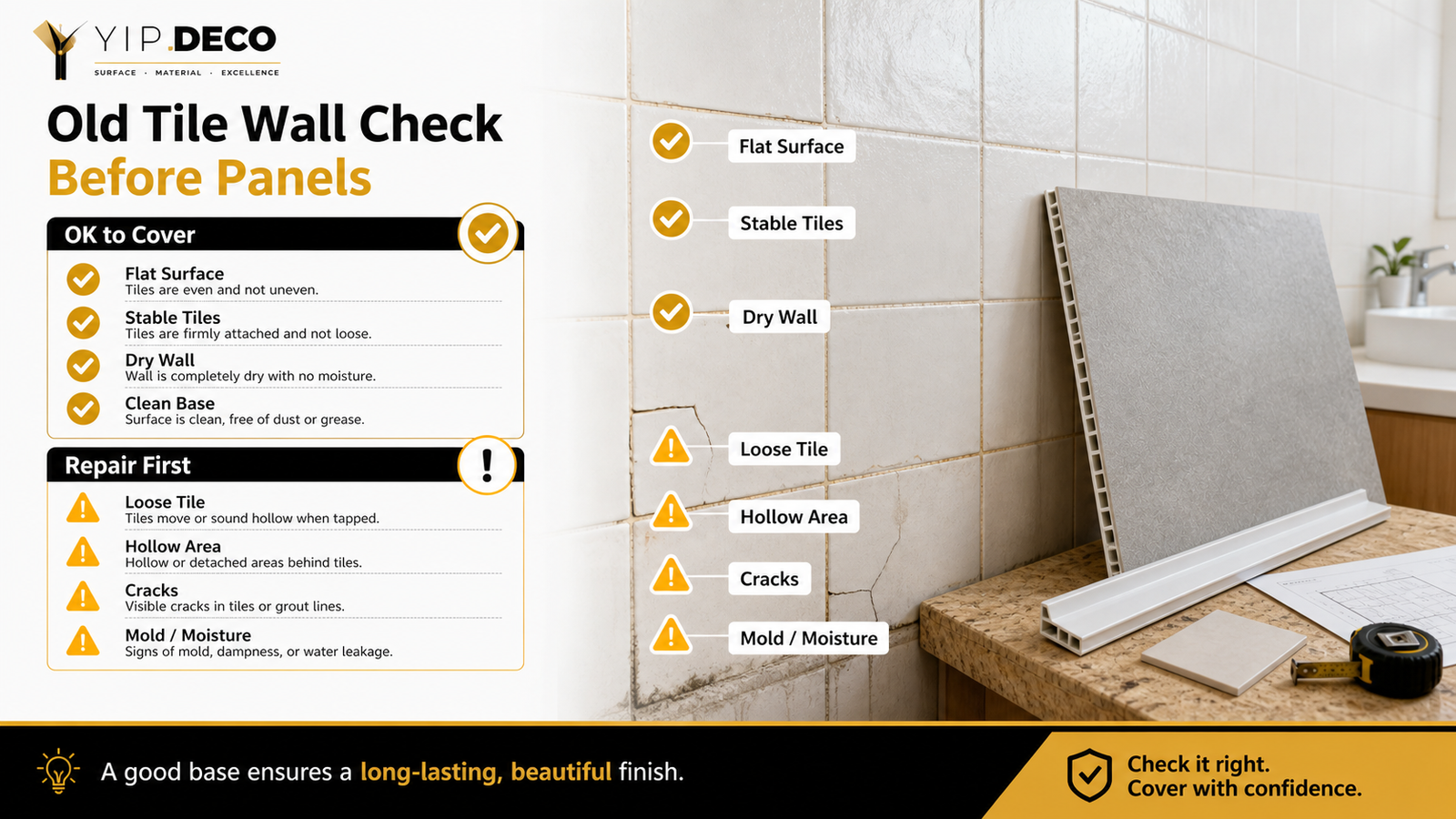
In some projects, bathroom wall panels can be installed over an existing tiled wall. But this should only be considered when the old tile surface is flat, stable, clean, dry, and firmly bonded to the wall. If old tiles are loose, hollow, cracked, or moisture-damaged, covering them with a new panel does not solve the real problem. It hides the problem until the new surface starts to fail.
For an importer or distributor, this distinction is important because downstream customers often want a simple sales message: "No demolition required." That message can be useful, but it should not become an unlimited promise. A more professional statement is:
Bathroom wall panels may reduce demolition work when the existing wall is stable and properly prepared. The substrate must be checked before installation.
That sentence protects the buyer, the installer, and the supplier.
Before installing over old tiles, check:
- whether any tiles sound hollow when tapped;
- whether grout lines are loose, cracked, or mold-damaged;
- whether the wall has water leakage behind it;
- whether the surface is oily, dusty, or uneven;
- whether the old tile height creates edge transition problems;
- whether corner trims can cover the transition cleanly;
- whether doors, windows, fixtures, and vanity edges still align after adding panel thickness.
SPC wall panels can be attractive in tile-over-tile renovation because large panels cover the surface quickly and create a modern look. But the installer still needs a stable base, correct adhesive or fixing method, and proper trim treatment. The panel system is only as reliable as the wall below it.
For PVC panels, the same logic applies, with an additional caution: if the area is a true wet zone, the buyer should evaluate whether PVC is the right material at all. Dry decorative wall coverage is different from shower wall replacement.
Installation Method: Adhesive, Trims, or Connector System?
Bathroom renovation buyers often focus on panel design and forget installation accessories. In practice, accessories often decide whether the result looks professional.
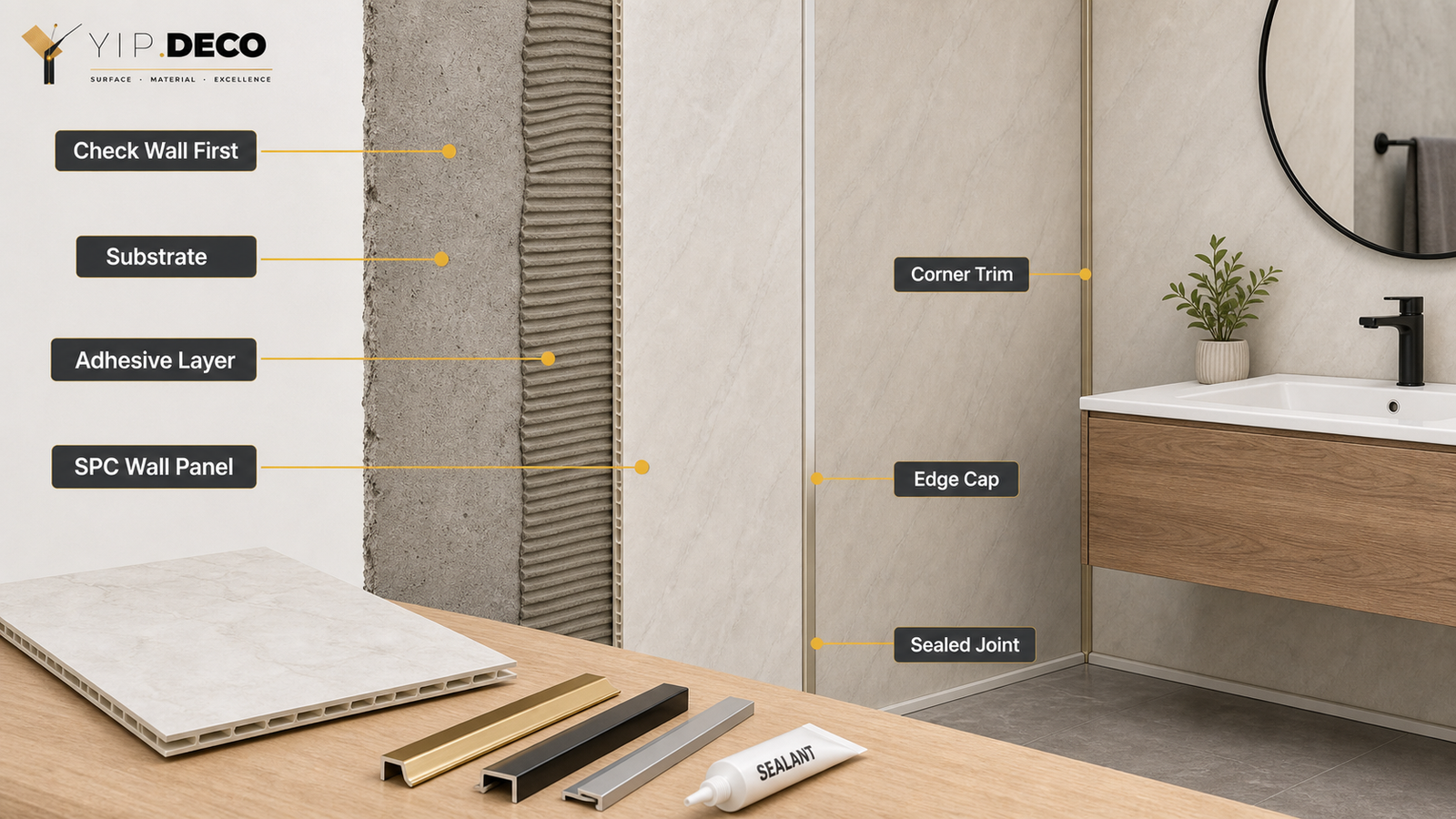
A panel installed with exposed raw edges will not look like a complete product. A shower wall without proper corner treatment may collect water in weak points. A vanity backsplash without a clean edge line may look unfinished. This is why wall panel sourcing should include both the panel and the finishing system.
Common installation-related items include:
- adhesive or fixing method;
- internal corner trim;
- external corner trim;
- edge cap;
- transition trim;
- skirting or bottom edge detail;
- joint connector;
- same-color or metal accessory selection;
- sealing method around fixtures;
- cutting plan for wall height and panel width.
For project buyers, it is useful to ask the supplier for a simple installation drawing or accessory recommendation before placing the order. This does not replace the installer, but it helps the buyer understand whether the system is complete.
For distributors, this also affects inventory planning. If you sell only panels without trims, contractors may source mismatched accessories locally. That can create color mismatch, poor corner finishing, and customer complaints that are not caused by the panel itself.
At YipDeco, we see this especially in wall solution projects where the buyer also needs matching colors across panels, grille profiles, and corner accessories. The surface is only one part of the visual result.
SPC vs PVC vs Ceramic Tile: Practical Comparison
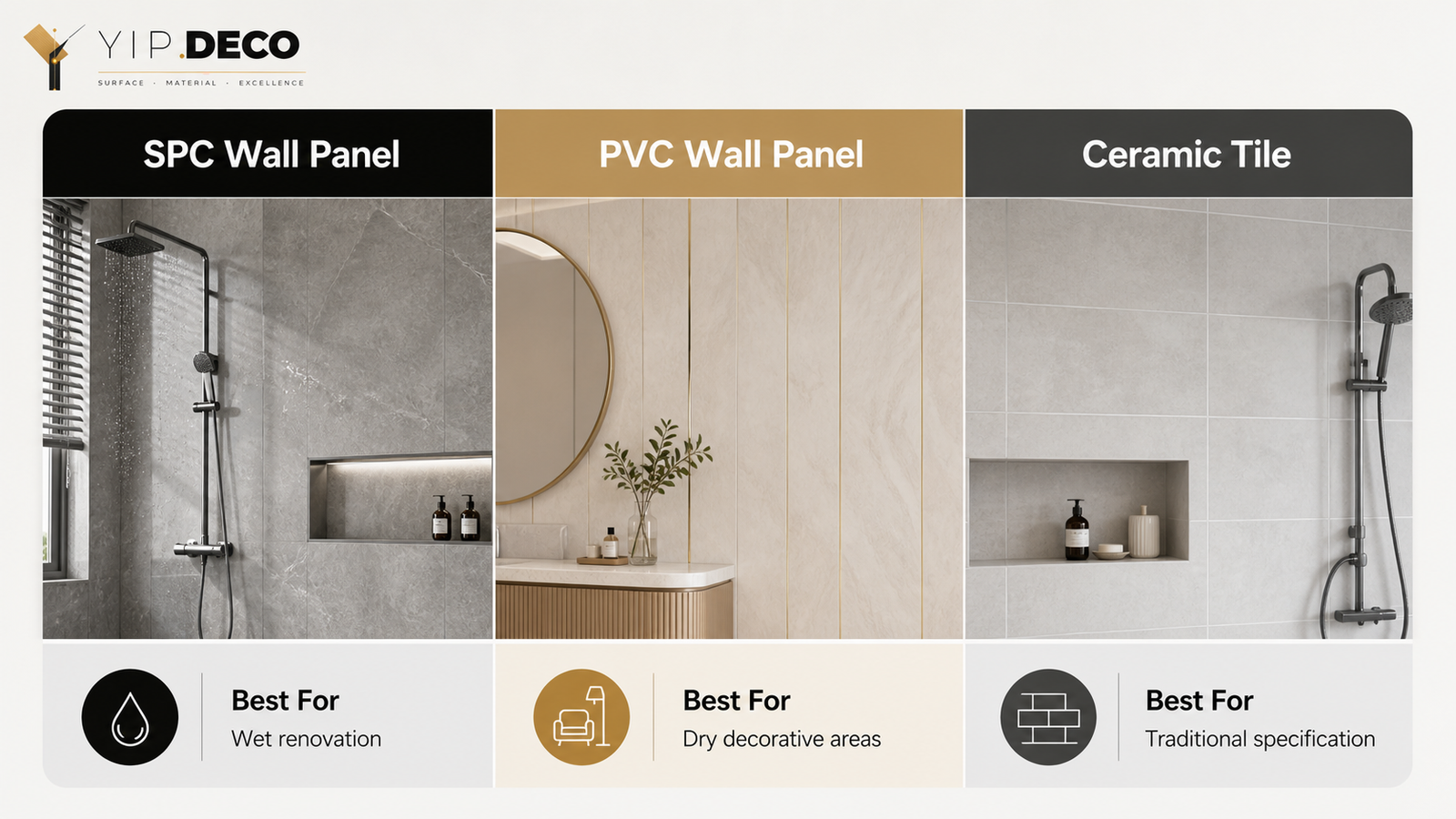
| Factor | SPC wall panels | PVC wall panels | Ceramic tile |
|---|---|---|---|
| Best use | Wet walls, bathroom renovation, tile alternative | Dry decorative bathroom zones, budget upgrades | Traditional bathroom walls, specification-driven projects |
| Moisture risk | Stronger for wet zones when installed correctly | Scene-dependent; should be used carefully in high moisture | Tile body is strong, grout needs maintenance |
| Installation speed | Usually faster than tile | Fast in suitable areas | Slower due to adhesive, leveling, grout, curing |
| Maintenance | Fewer joints, easier daily cleaning | Depends on surface and joint detail | Grout cleaning and repair may be required |
| Appearance | Stone, terrazzo, marble, wood grain, slat, grid styles | Decorative colors and textures | Broad traditional tile design options |
| Renovation disruption | Lower when substrate is suitable | Low in dry-zone decorative use | Higher demolition, dust, curing, skilled labor |
| Buyer risk | Wrong substrate or poor trims can create issues | Wrong wet-zone use can cause lifting or deformation | Grout and waterproofing details can fail |
Internal Link Guide for Buyers
If you are comparing wall panel systems, it helps to review the full product path rather than one panel alone:
- For the overall product structure, start with YipDeco Wall Solution.
- For wet-area and tile-alternative interest, review SPC Wall Panels.
- For decorative dry-zone wall use, compare PVC Wall Panels.
- For corners, trims, joints, and finishing, check Wall Connection Accessories.
- For sample planning, visit Sample Kits.
Five Common Bathroom Wall Panel Sourcing Mistakes
Mistake 1: Choosing by picture only
A bathroom wall panel can look attractive online, but the actual decision should include thickness, core material, surface texture, gloss, panel rigidity, accessories, and installation environment. A product photo cannot show whether the panel is suitable for a wet wall.
Mistake 2: Treating all "waterproof panels" as the same
"Waterproof" is often used too loosely in marketing. Buyers should ask what the core material is, how the edges are treated, what accessories are used, and whether the panel is intended for direct wet wall use or only decorative humid-area use.
Mistake 3: Ignoring ventilation
Even a good wall material cannot compensate for a bathroom that stays damp all day. EPA guidance repeatedly connects moisture control and ventilation with mold prevention. Material choice and bathroom ventilation should be considered together. Reference: EPA mold and moisture resources.
Mistake 4: Forgetting corner and edge details
Many bathroom wall failures start at transitions: inside corners, outside corners, shower niches, window edges, vanity edges, ceiling lines, and floor lines. A buyer who approves only the panel surface has not approved the complete wall system.
Mistake 5: Not confirming samples before bulk order
Samples help confirm color, gloss, texture, rigidity, cutting quality, and accessory matching. For export orders, sample records also help reduce disputes when repeat orders are needed.
What Information Should Buyers Send Before Asking for a Quote?
The fastest way to get a useful recommendation is to send enough project context.
For bathroom renovation inquiries, we suggest sending:
- project type: hotel, apartment, villa, public restroom, retail washroom, office bathroom, or distributor stock;
- application zone: shower wall, wet wall, dry wall, vanity wall, ceiling, or full bathroom;
- existing wall condition: old tile, cement wall, gypsum board, plaster wall, or unknown;
- moisture condition: direct water, high humidity, semi-dry, or dry decorative;
- required panel size and thickness if known;
- preferred surface: marble, terrazzo, stone, wood grain, white grid, colored slat, or custom design;
- color matching requirement with cabinets, doors, floors, or trims;
- installation plan: adhesive, connector, trim system, or local installer preference;
- target quantity and delivery timeline;
- photos, drawings, or rough measurements.
This information allows the supplier to respond with material advice instead of only a price. For serious B2B buyers, that difference matters. A fast price for the wrong material is not a good quotation.
How We Usually Help Buyers Decide
When a buyer sends us a bathroom renovation inquiry, we do not begin by pushing one product. We usually ask for the environment first.
Typical questions include:
- Is the panel for a shower wall or a dry decorative wall?
- Is the existing wall tile, cement, gypsum board, or another substrate?
- Is the wall flat and stable?
- Is the project a hotel, apartment, villa, retail washroom, or public restroom?
- What size and thickness are required?
- Does the buyer need stone, terrazzo, wood grain, white grid, green slat, or another finish?
- Are matching trims and corner accessories required?
- Will the buyer approve physical samples before bulk order?
This is where YipDeco's practical advantage matters. We are not only matching a catalog color. We are checking the application environment, the panel type, the trim system, the sample record, and the export order details together. That mechanical and project-support background helps reduce mistakes before production begins.
Recommended Product Direction by Buyer Type
For importers and distributors
Carry SPC bathroom wall panels as a tile-alternative product for wet-area renovation, but prepare clear selling rules. Your customers should understand where SPC is suitable, where substrate repair is required, and why trims are part of the system.
PVC wall panels can remain in the range for dry decorative and budget projects. Do not present PVC and SPC as only a price difference. Present them as different answers for different wall environments.
For contractors
Check the wall before promising fast installation. If the substrate is unstable, fix it first. If corners and joints are not planned, the finished bathroom will look incomplete even if the panel surface is beautiful.
For hotel and apartment renovation buyers
SPC wall panels can be attractive because downtime matters. A bathroom that can be renovated faster, with fewer grout lines and easier cleaning, may reduce long-term maintenance pressure. But mock-up approval and installer training should be handled before bulk installation.
For designers and project owners
Think about the finished system: wall panel, edge trim, corner, transition, ceiling line, vanity area, and color matching. A bathroom wall is not only a surface. It is a visual and installation package.
Sample Approval Matters More Than the Online Picture
Bathroom wall panels are visual products, but they are also physical materials. Buyers should confirm:
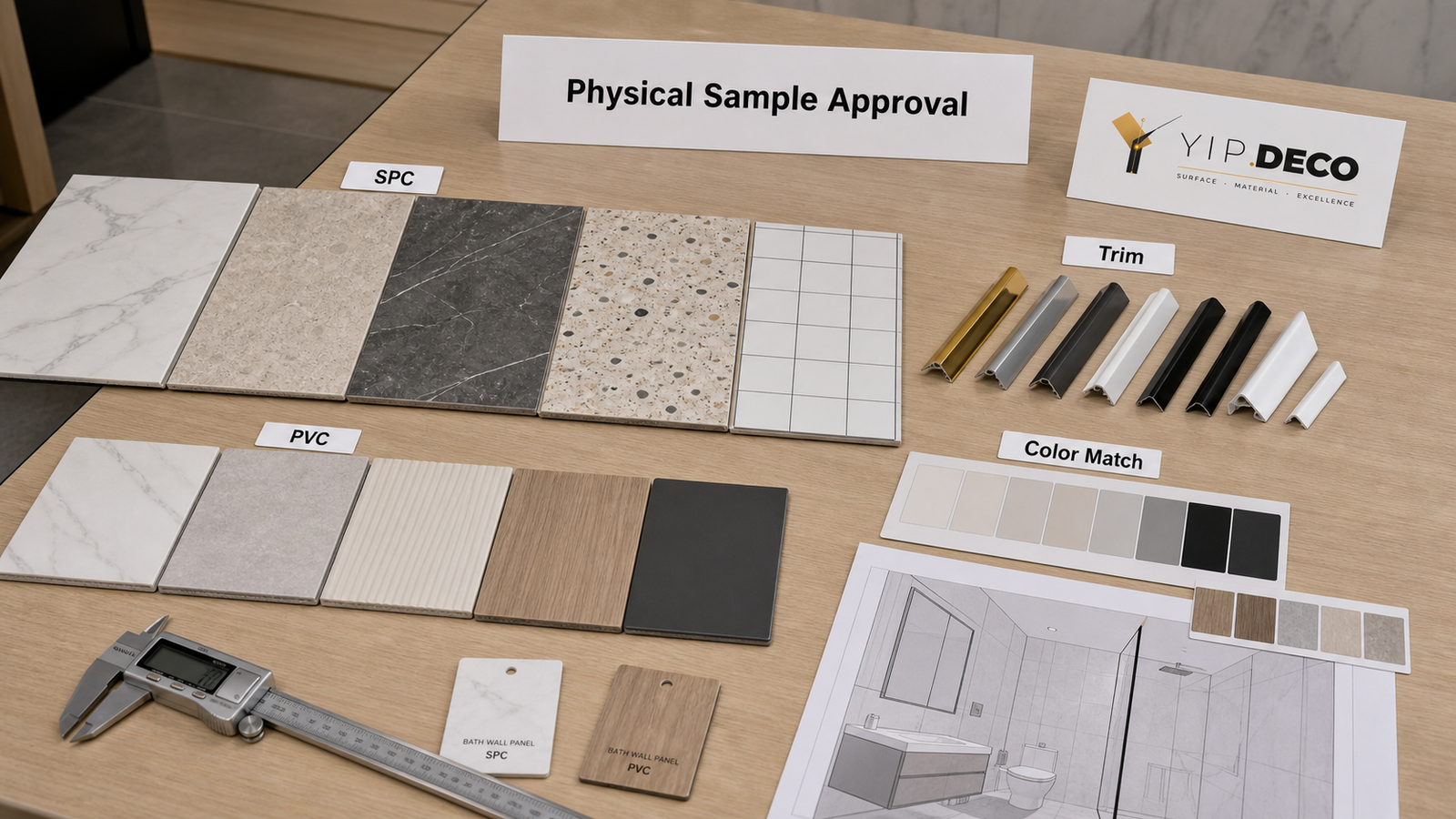
- surface texture;
- gloss level;
- color under warm and cool light;
- panel thickness;
- core rigidity;
- edge treatment;
- corner accessory color;
- carton protection;
- installation method.
This is especially important when the project includes stone, terrazzo, marble, wood grain, or colored vertical-slat patterns. A digital image can show the style direction, but a physical sample confirms the real color, gloss, and touch.
For repeat orders, keep the sample record. Color and surface consistency should be checked before bulk production, especially when the same bathroom style will be installed across many rooms.
Final Recommendation
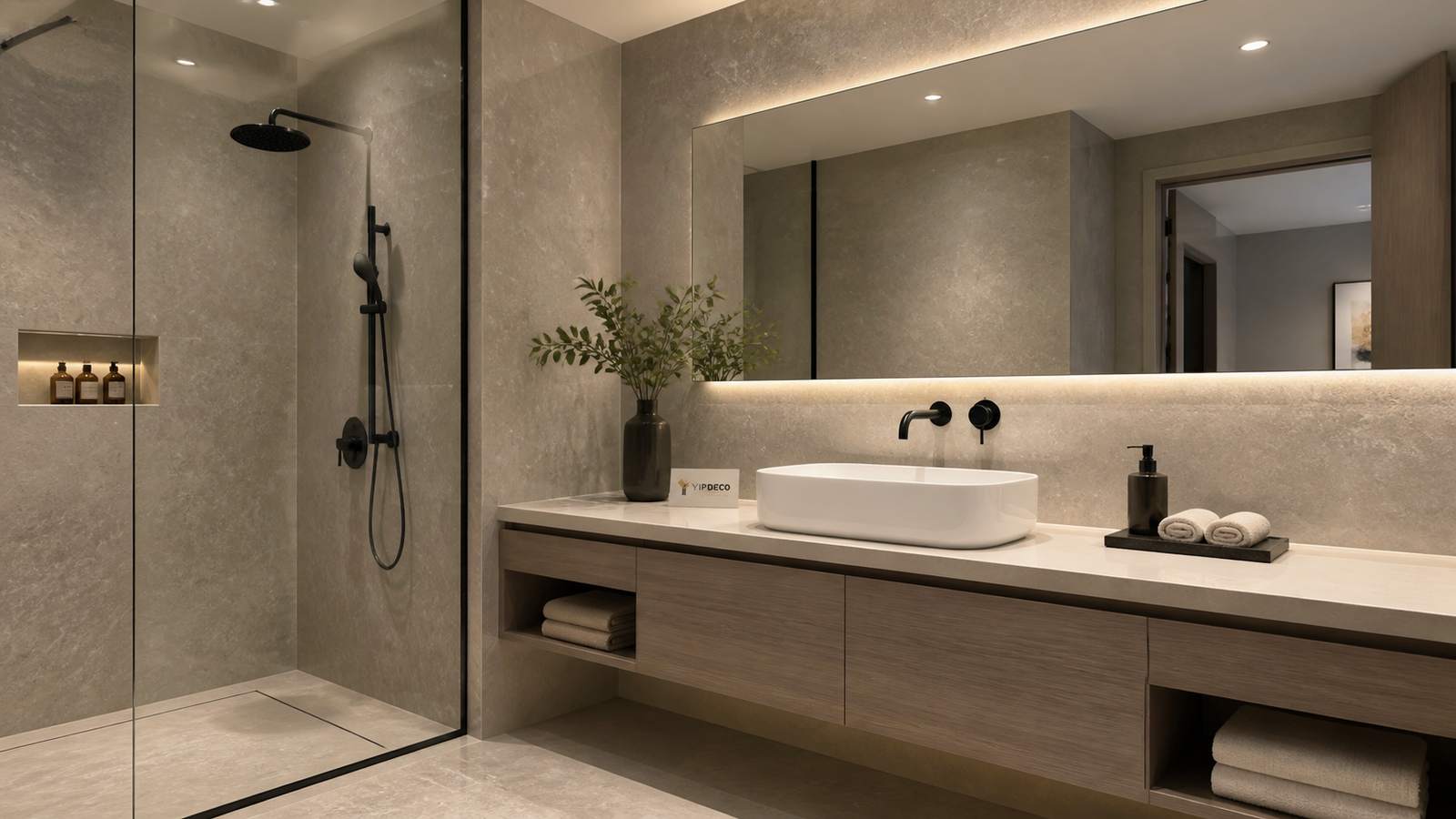
If your bathroom renovation project includes direct wet walls, shower areas, or tile-replacement requirements, start by evaluating SPC wall panels. If the project is mainly a dry decorative upgrade, PVC wall panels may be suitable and more cost-effective. If the local specification, contractor base, or customer expectation strongly favors traditional systems, ceramic tile may still be the practical answer.
The wrong approach is choosing only by price or by a product photo.
The right approach is to map the material to the bathroom zone, inspect the wall condition, confirm trims and sealing, approve physical samples, and then plan the order. That is how renovation buyers avoid the most expensive mistake: installing a surface that looks right on day one but fails in the actual environment.
If you are comparing bathroom wall panels for a renovation project, send your wall photos, target area, preferred style, and installation conditions. We can help you compare SPC, PVC, and ceramic tile alternatives from the application environment first, then match the panel and accessories to the project.
Next step: Request bathroom wall panel samples or send your project details.