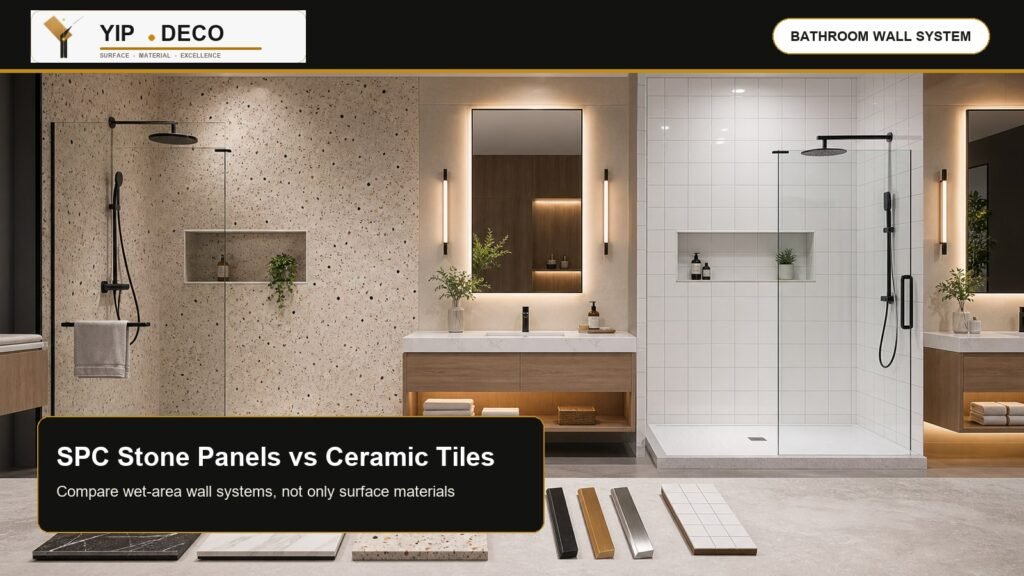
SPC stone wall panels are becoming a serious alternative to ceramic tiles in bathrooms and wet areas, but the right choice depends on the whole wall system, not only the surface material. Ceramic tile is still strong and familiar, yet the grout lines, waterproofing layer, installation time and future maintenance often create the real project risk. For hotel bathrooms, apartment renovations and distributor product lines, SPC stone wall panels can reduce grout-related problems, speed up installation and simplify wet-wall upgrades when the substrate, trims and edge details are specified correctly.
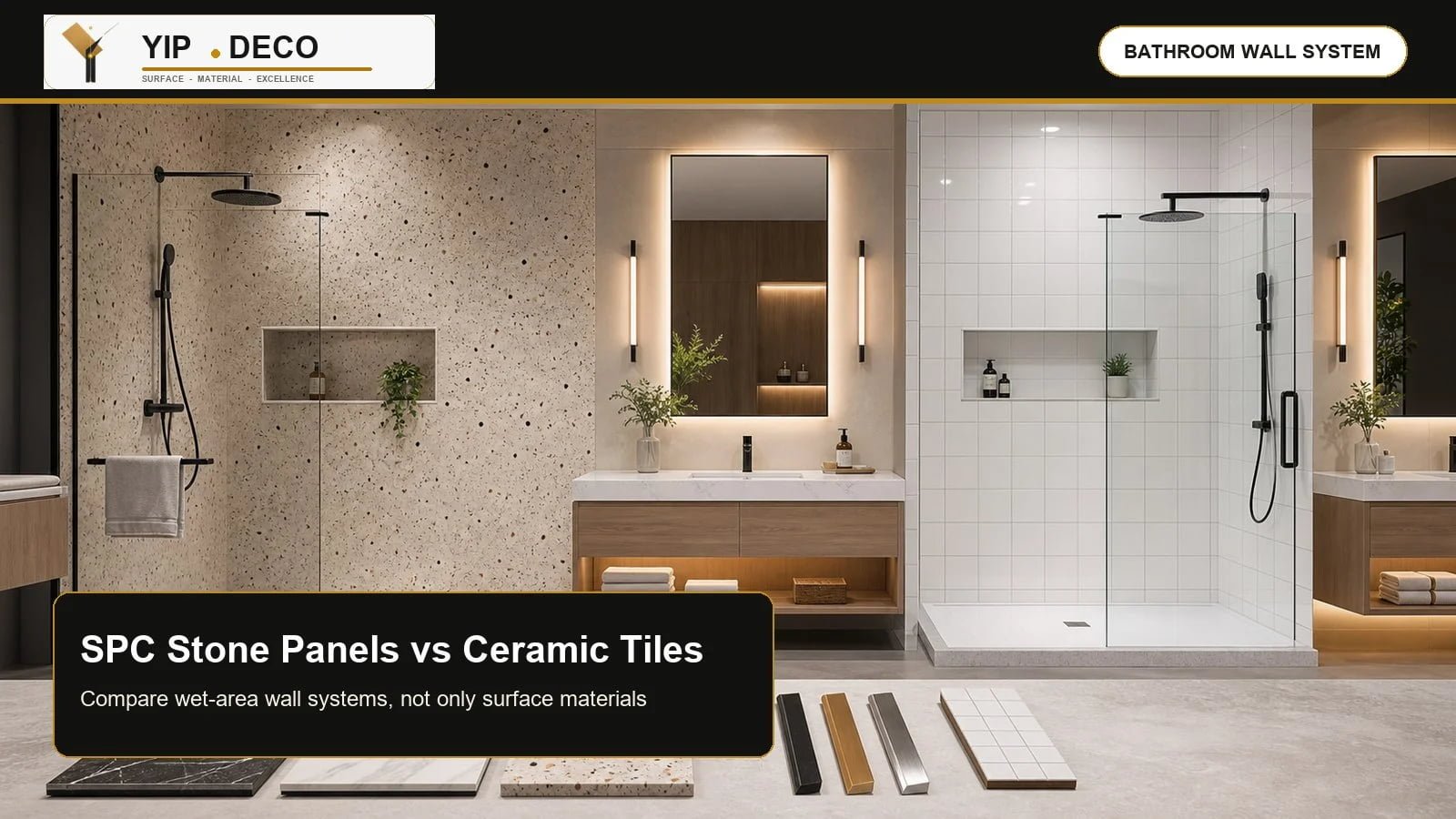
When buyers ask us whether SPC stone wall panels can replace ceramic tiles, the first answer is: sometimes yes, but not because ceramic tile is a weak material.
Ceramic tile itself is hard, durable and widely accepted. In many countries, installers and project owners already understand how to specify it. The problem is that bathroom walls do not fail only at the tile surface. They fail at joints, corners, grout lines, uneven substrates, waterproofing gaps, and poorly finished edges.
That is why we treat this as a system comparison.
For a distributor, importer or fit-out contractor, the practical question is not "which material sounds more premium?" The better question is:
Which wall system is easier to install correctly, keep clean, ship safely, replace when needed, and explain to the end customer?
This article compares SPC Stone Crystal Wall Panels and ceramic tiles from that project perspective.
If you are already evaluating bathroom wall materials, you may also want to review YipDeco's SPC Wall Panels and Wall Connection Accessories pages while reading this guide, because the panel and trim system should be considered together.
What Are SPC Stone Wall Panels?
SPC stone wall panels are rigid decorative wall panels made with a stone-plastic composite core and a decorative surface layer. In bathroom and wet-area applications, they are designed to create a large-format wall surface with fewer visible joints than traditional ceramic tile.
For buyers who are new to the category, one clarification is important:
SPC wall panels are not SPC flooring.
SPC flooring and SPC wall panels may share a similar base concept, but they are not the same product. Flooring is designed for foot traffic, locking systems and floor load. Wall panels are designed for vertical installation, wall coverage, panel connection, corner finishing and wet-wall decoration.
Another common misunderstanding is that SPC wall panels are just a thin PVC decorative sheet. That is also not accurate. A proper SPC stone wall panel should be evaluated as a rigid wall material with its own core structure, surface finish, panel thickness, trim system and installation method.
When we discuss SPC Stone Crystal Wall Panels for bathrooms, we usually check:
| Buyer Question | Why It Matters |
|---|---|
| Is this wall panel or flooring material? | The installation system and thickness logic are different. |
| What wall surface will it be installed on? | Flatness and substrate condition affect bonding and final appearance. |
| How will inside corners, outside corners and edges be finished? | Wet-area performance depends heavily on edge detail. |
| Are matching trims and connectors available? | A good panel without the right accessory system can still fail visually. |
| Is the style confirmed by physical sample? | Stone, terrazzo, grid and woodgrain effects must be checked in real light. |
| How will panels be packed for export? | Large panels need carton protection and stable handling. |
From our inquiry experience, many buyers first compare SPC wall panels and ceramic tiles by appearance. They ask whether the surface looks like stone, marble or terrazzo. That is understandable, but it is not enough. Wet-area projects require a material decision and an installation decision at the same time.
> YipDeco Insight: In real buyer conversations, we often find that the first question is about design, but the final risk is usually installation detail. For bathroom wall panels, we prefer to confirm the wall condition, trim color, corner treatment and sample approval before talking about bulk order volume. This makes the discussion more practical for distributors and contractors.
Why Ceramic Tile Still Feels Safer to Many Buyers
Ceramic tile has a strong market position for good reasons. It is hard, familiar, heat-resistant, widely available, and accepted by most contractors. In traditional bathroom projects, designers, installers and homeowners often trust tiles because they have used them for decades.
Ceramic tiles are also strong in situations where:
- Local project specifications require ceramic or porcelain tile.
- The installer team is already experienced with tile systems.
- The project needs high scratch resistance on small exposed surfaces.
- Fire or high-temperature exposure is a concern.
- The client prefers traditional tile texture and grout-line design.
- Replacement tiles are available locally over a long period.
For these reasons, this article should not be read as "SPC is always better than tile." That would be an exaggerated and weak argument.
The stronger argument is narrower and more useful:
In many bathroom and wet-wall projects, the tile body is not the main failure point. The grout and joint system often create the maintenance problem.
That point changes how buyers should compare the two options.
The Hidden Weak Point: Grout Lines
When someone says ceramic tile is waterproof, they are usually thinking about the tile body. A glazed ceramic or porcelain tile surface can resist water very well.
But bathroom walls are not made from tile body alone.
They include:
- grout lines between tiles
- adhesive or mortar behind the tile
- waterproof membrane or treated substrate
- inside and outside corners
- penetrations around fixtures
- silicone sealing at edges
- installer workmanship
In real bathrooms, the grout lines are often the weak point. Grout can absorb moisture, collect soap residue, develop mold staining and become difficult to clean over time. If the wall system behind the tile is not properly waterproofed, water can also move behind the surface.
This is the reason SPC stone wall panels are gaining attention. Large-format panels reduce the number of joints. In many shower wall and bathroom wall applications, fewer joints mean fewer places for dirt, moisture and mold staining to accumulate.
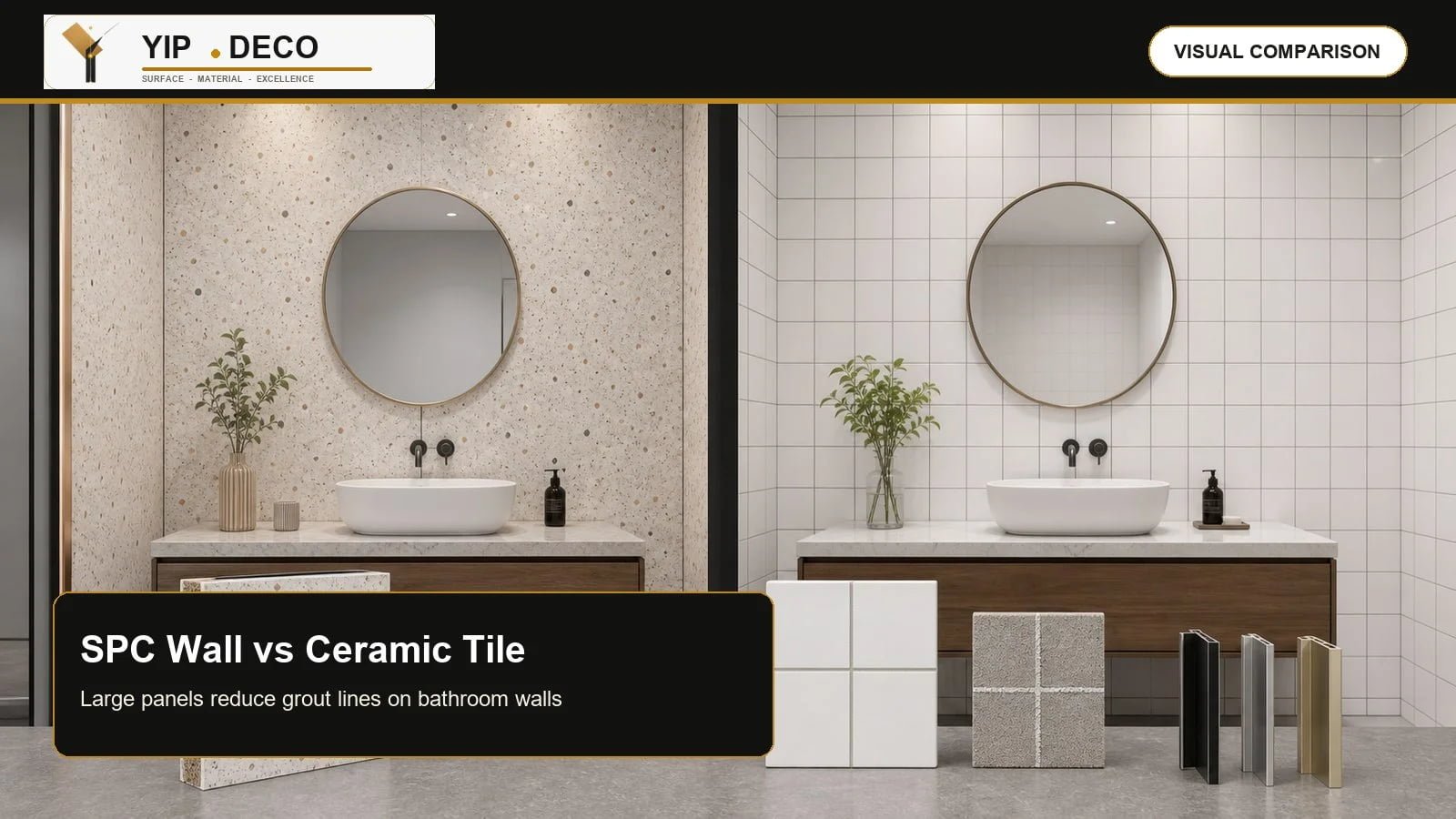
The U.S. EPA notes that moisture control is central to mold control in buildings. That supports the practical point: wet-area material decisions should be evaluated by how well the system reduces moisture traps, not only by how strong the decorative face looks.
External reference: U.S. EPA mold and moisture guidance
SPC Stone Wall Panels vs Ceramic Tiles: Quick Comparison
| Decision Factor | SPC Stone Wall Panels | Ceramic Tiles |
|---|---|---|
| Wet wall surface | Large panels with fewer joints | Many small joints and grout lines |
| Installation speed | Usually faster when wall is flat and accessories are prepared | Slower due to layout, adhesive, grout and curing time |
| Installer skill | Can be easier for renovation teams after training | Needs skilled tile setter for best result |
| Weight | Usually lighter than tile systems for wall renovation | Heavier, especially with mortar/adhesive system |
| Maintenance | Fewer grout lines to clean | Grout needs ongoing cleaning and may stain |
| Breakage risk in shipping | Large panels need careful carton protection | Tiles can chip or break; heavy cartons add handling risk |
| Design options | Stone, terrazzo, marble, grid, slat, woodgrain looks | Very broad global tile design library |
| Edge finishing | Needs trims, corner profiles and sealant detail | Needs grout, corner trim or tile edge finish |
| Repair | Panel replacement depends on installation method and available batch | Single tile replacement may be possible if spare tile remains |
| Market acceptance | Growing, but still needs buyer education | Very high and familiar |
For distributors, this table should not be used as a simple sales ranking. It is a starting point for discussing project conditions.
Where SPC Stone Wall Panels Are Strongest
SPC Stone Crystal Wall Panels are most convincing where the buyer needs a clean wet-wall upgrade without slow tile work.
Strong applications include:
- hotel bathroom renovation
- apartment bathroom upgrades
- rental property wet-wall renovation
- shower surrounds
- commercial washroom walls
- light commercial restrooms
- bathroom feature walls
- wet-area wall replacement where grout maintenance is a complaint
In these cases, the buyer is often trying to solve several problems at the same time:
- reduce installation time
- avoid messy wet trade work
- make the bathroom easier to clean
- avoid grout discoloration complaints
- improve visual style quickly
- simplify material handling for renovation teams
- reduce disruption during project turnover
This is especially relevant for hotel and apartment projects. A room that stays closed for longer has a real cost. If a wall system can reduce work time without creating quality risk, the material decision becomes a project schedule decision, not only a material price decision.
Where Ceramic Tiles Still Make More Sense
Ceramic tile remains a better choice in several situations.
Use ceramic tile when:
- the project specification already requires tile
- local code, consultant or client preference strongly favors tile
- the installer team is highly experienced with tile but not trained in panel installation
- the wall includes complex small curves or many irregular penetrations
- high heat exposure is possible
- the owner wants traditional grout-line styling
- long-term local replacement supply is more important than faster installation
This point is important for credibility. A buyer will not trust a supplier who says one product solves every project.
Our practical view is that SPC stone wall panels are not replacing ceramic tile everywhere. They are becoming a useful alternative in the specific zones where grout, installation speed, weight and maintenance are the main concerns.
Bathroom and Wet-Area Decision Framework
Before choosing between SPC stone wall panels and ceramic tiles, buyers should define the wall zone.
| Wall Zone | Main Risk | Better Starting Option |
|---|---|---|
| Shower wall | Constant water exposure, corner sealing, cleaning | SPC stone wall panel if trims and sealant details are correct; tile if local waterproofing team is stronger |
| Vanity backsplash | Splash water, cleaning chemicals, visual style | Either option; SPC is faster, tile is more traditional |
| Full bathroom wall | Humidity, style consistency, installation time | SPC wall panel for fast renovation; tile for traditional specification |
| Commercial restroom wall | Cleaning, impact, maintenance | SPC can be practical if impact and cleaning requirements are confirmed |
| Wet room ceiling | Humidity, condensation, panel fixing | SPC may be useful if ceiling installation system is confirmed |
| High-heat wall area | Heat exposure | Ceramic tile is usually safer |
The decision should start with environment. Is the wall directly exposed to water? Is the space only humid? Does the project require fast turnover? Will cleaners use strong chemicals? Is there a trained installer?
Those questions are more useful than asking which material is "better" in a general sense.
Installation Speed Is a Commercial Advantage
In ceramic tile work, installation often includes:
- wall preparation
- layout and leveling
- adhesive or mortar application
- tile placement
- cutting and alignment
- grout filling
- curing and cleaning
- silicone sealing around edges
Each step depends on installer skill and site conditions.
SPC stone wall panels can simplify the process when the wall substrate is flat and the installation accessories are prepared. Large panels cover more area quickly. Fewer joints reduce alignment work. Trims and connectors can help finish corners and edges cleanly.
For a single private bathroom, the time difference may feel like convenience. For a hotel, apartment renovation or multi-room project, it affects labor planning and project turnover.
This is one of the reasons distributors are paying attention to the category. The product is not only a new wall surface. It can also become a faster renovation package for contractors.
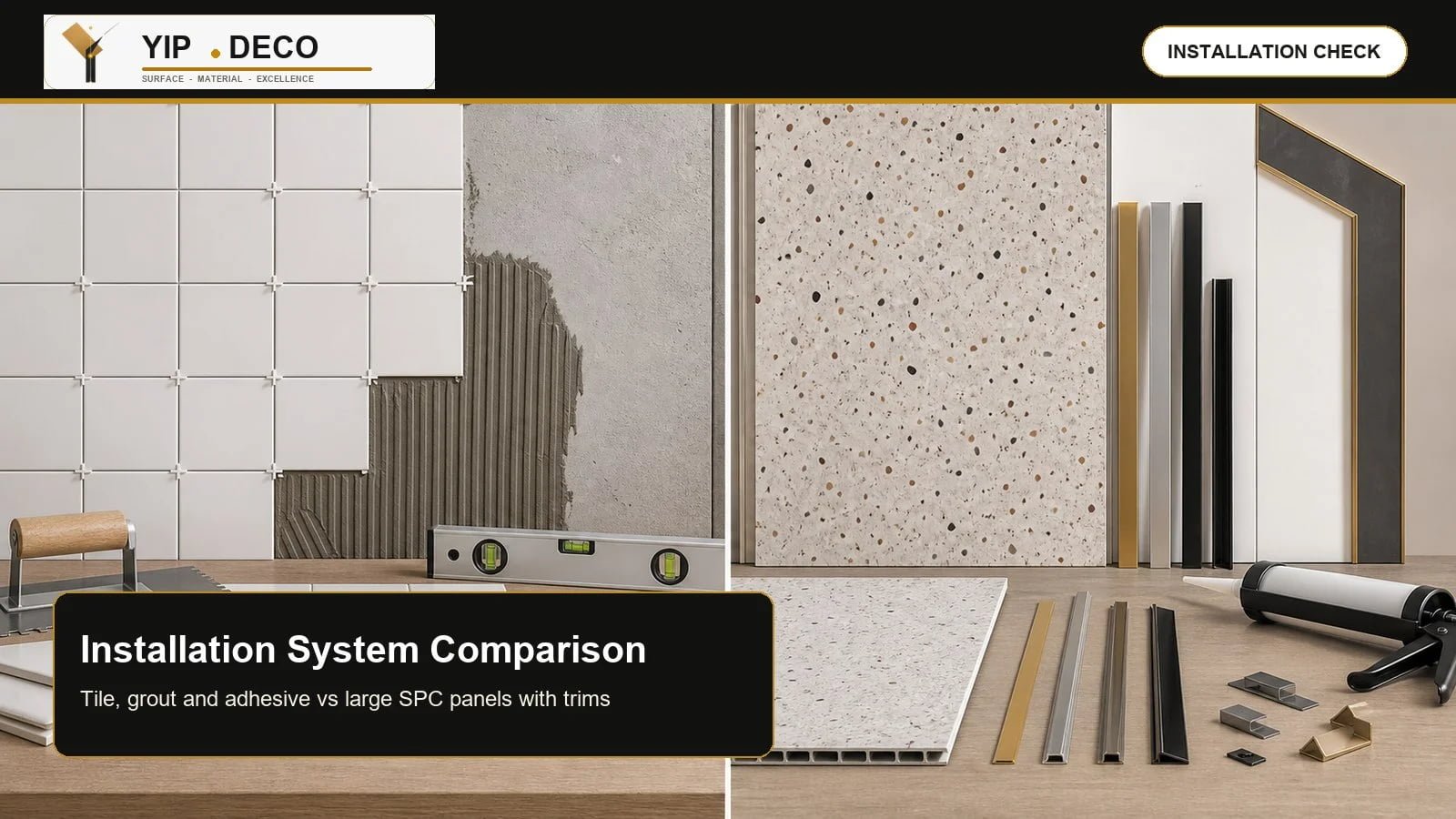
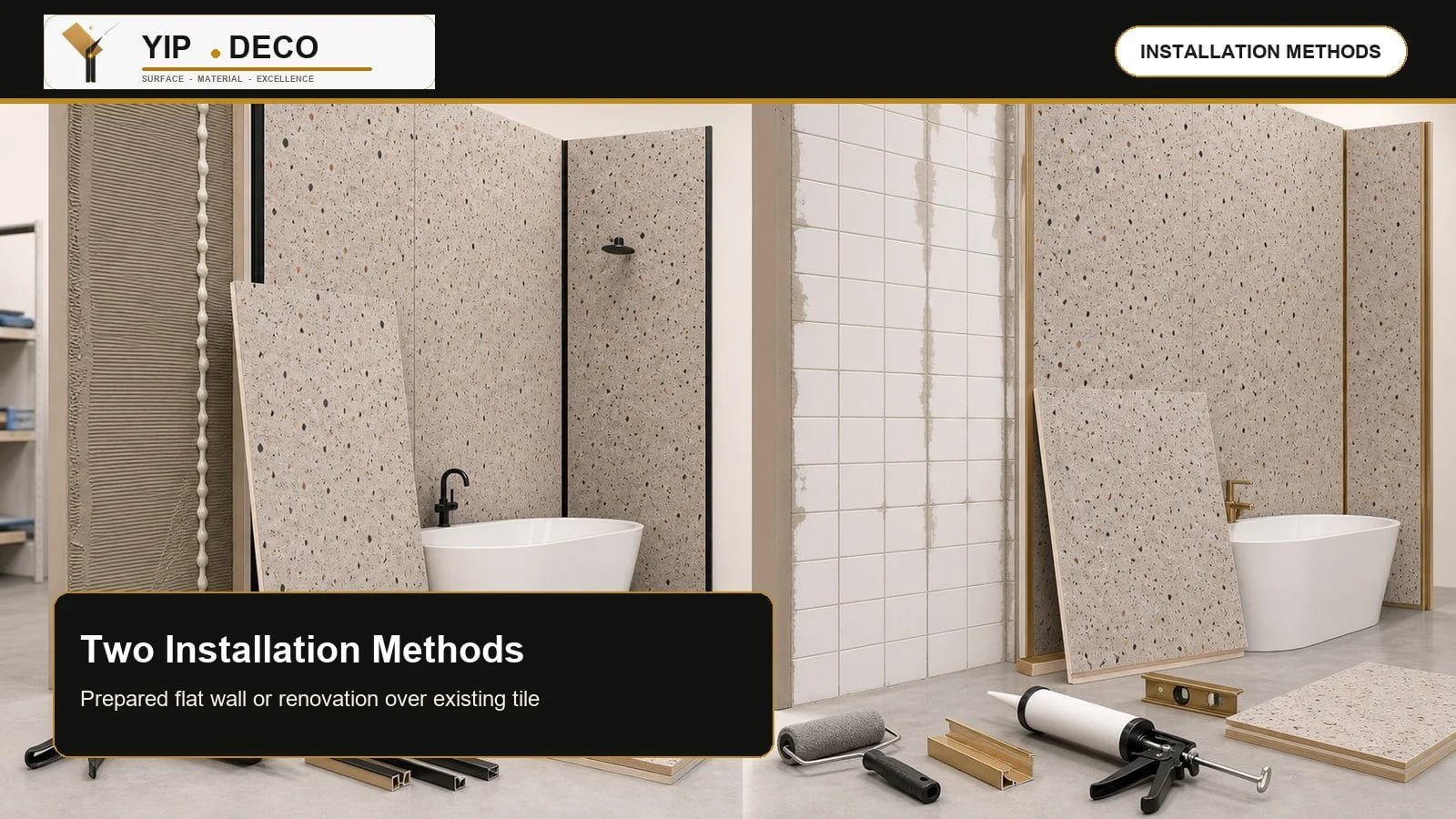
In renovation projects, buyers often ask whether SPC wall panels must be installed only on a new wall. The practical answer is that installation depends on the condition of the existing surface. Some projects use a prepared flat wall or board substrate. Some renovation projects may install panels over existing tile after the old surface is checked, cleaned and prepared. The key is not the shortcut itself; the key is whether the substrate can support stable bonding and clean edge finishing.
Substrate Flatness: The Detail Buyers Often Miss
SPC stone wall panels are not magic boards that can hide every wall problem.
Before installation, the wall should be checked for:
- flatness
- moisture condition
- dust and loose surface material
- old tile bonding strength if installed over existing tile
- corner straightness
- fixture positions
- height and width planning
- expansion or movement considerations
If the substrate is uneven, a large panel may show gaps, uneven bonding or visible shadow lines. Ceramic tile can also fail on a bad substrate, but small tiles may hide unevenness differently. Large panels demand better planning.
For importers and distributors, this means installation instructions matter. A product catalog is not enough. Downstream contractors need a clear substrate checklist and accessory recommendation.
Corners, Trims and Edge Details Decide the Final Result
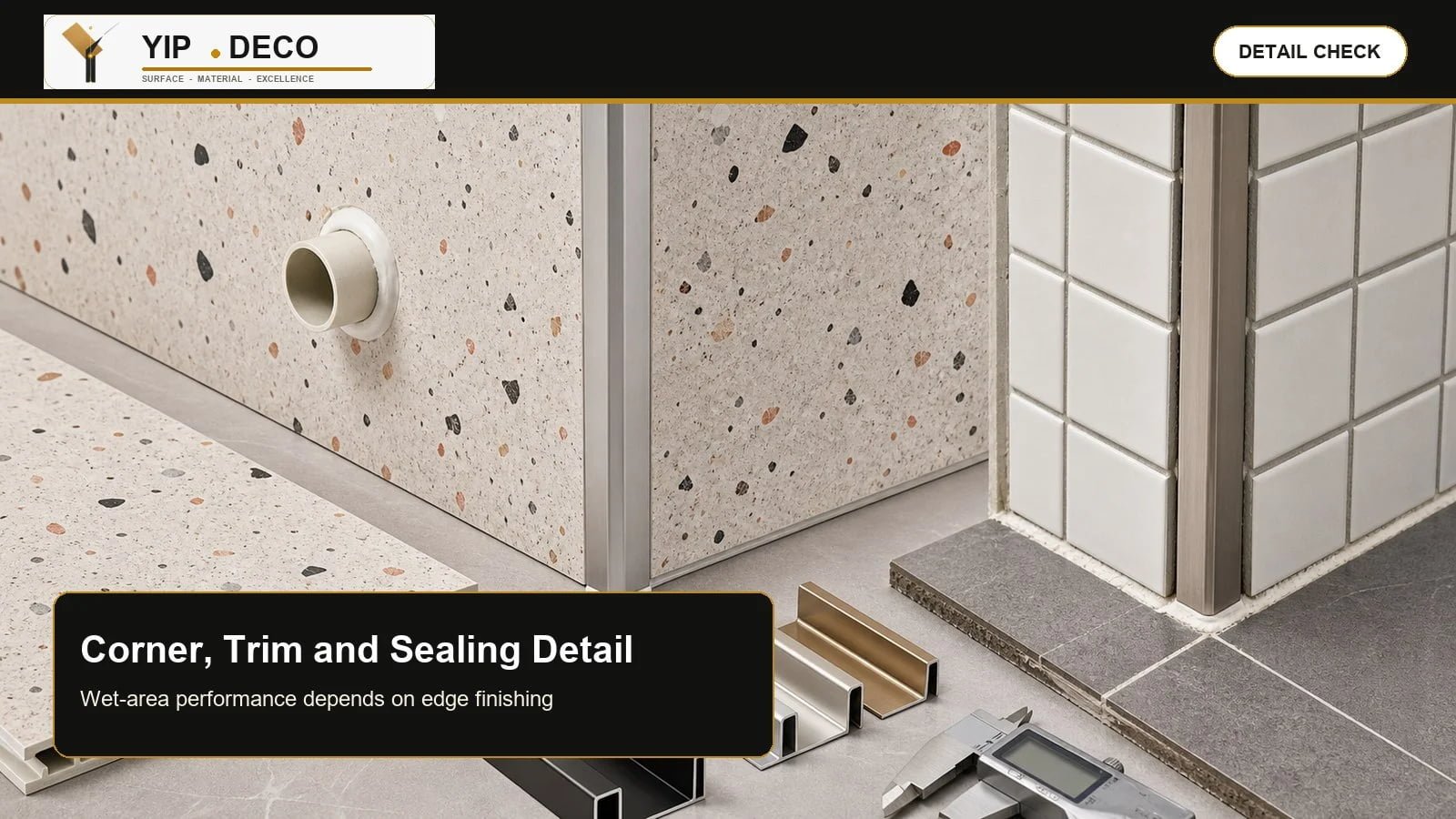
In wet-area wall projects, corners and edges often decide whether the finished wall looks professional.
For SPC stone wall panels, buyers should ask:
- What inside corner trim is available?
- What outside corner trim is available?
- Can trims match black, gold, silver, champagne or panel color?
- How are vertical joints finished?
- How are shower edges sealed?
- How are pipe penetrations handled?
- Is there a wall edge guard or end cap?
- Can skirting or transition trims be matched?
This is where YipDeco's broader wall solution experience becomes useful. A wall panel project is rarely only about the panel. The buyer also needs matching profiles, connectors, trims and sometimes same-color accessories.
For wet areas, a beautiful panel without edge detail can still create buyer complaints. A simpler panel with the right trims may perform better in the actual project.
Design: SPC Stone Panels Are Not Only Marble Looks
Many buyers first imagine SPC stone wall panels as marble-look panels. Marble is important, but it is not the whole category.
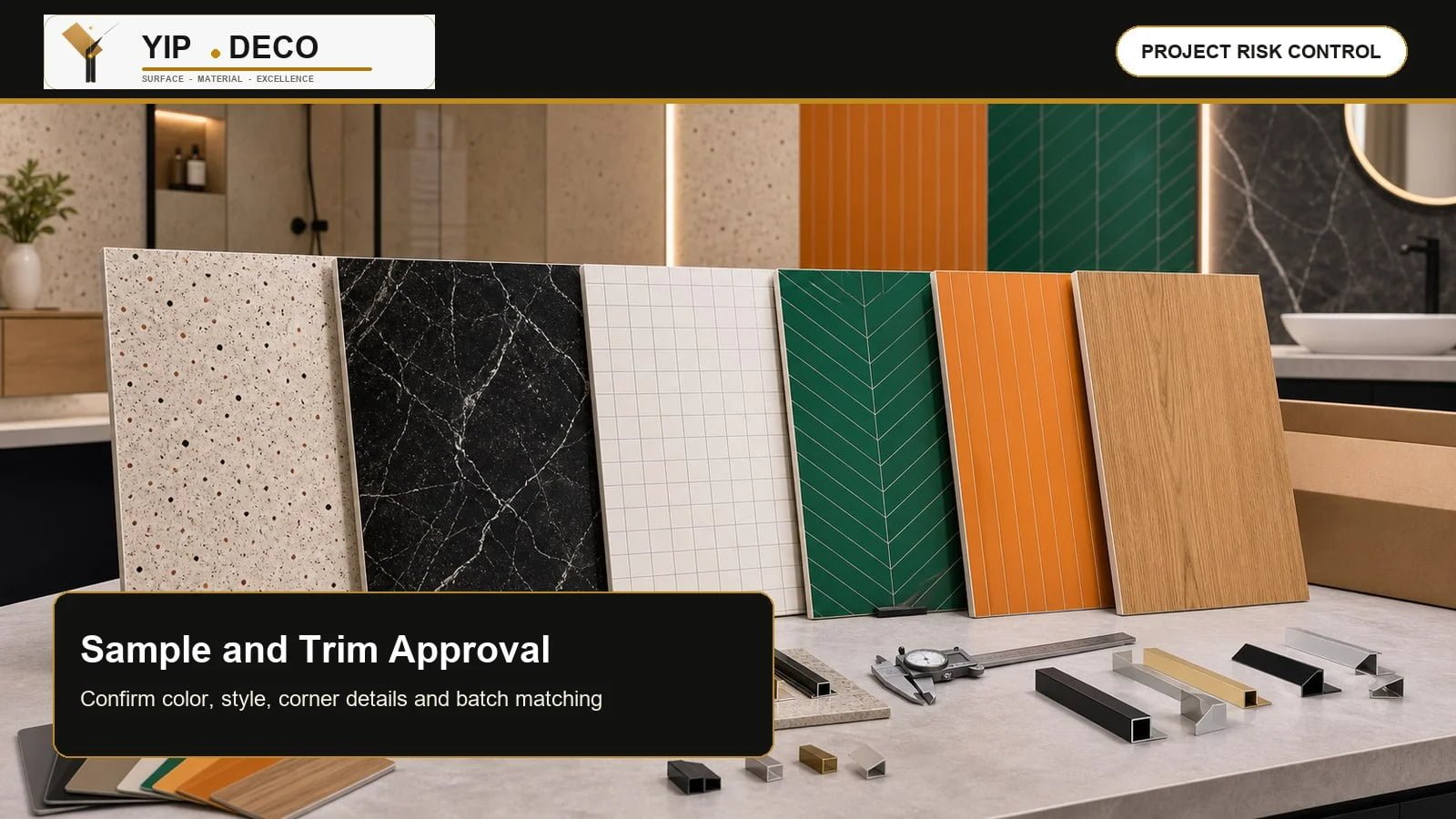
Based on the SPC Stone Crystal Wall Panel style direction, bathroom and wet-area buyers may consider:
- oak wood grain for warm hotel bathrooms
- vertical green slat for bold design accents
- terrazzo stone for modern washrooms
- northern light terrazzo for softer bathroom interiors
- white small grid for tile-like visual familiarity
- green fish-scale pattern for feature walls
- blue cube for boutique bathroom design
- orange vertical slat for retail or hospitality accents
- black marble for premium vanity walls
The important point is not to choose from a screen only. Physical samples should be checked under real bathroom lighting. A terrazzo pattern may look soft in one photo and too busy in another space. A black marble finish can look premium, but it may show water marks more clearly depending on surface gloss and cleaning behavior.
For distributors, sample kits are part of the sales system. The more the buyer can touch and compare before ordering, the less risk there is after bulk shipment.
Shipping and Handling: Tiles and Panels Have Different Risks
Ceramic tiles are heavy and can chip or break during handling. For distributors, this affects carton strength, pallet loading, claims and replacement stock.
SPC stone wall panels are usually lighter than a full tile-and-mortar wall system, but large panels still require careful export packaging. Corners, surface finish and long panel edges need protection. If the panel is bent, scratched or compressed during shipment, the project schedule may be affected.
For export orders, we normally pay attention to:
- carton strength
- corner protection
- pallet stability
- moisture protection during transport
- surface film protection
- batch and color marking
- sample reference for repeat orders
This is not the most exciting part of a blog article, but it is very important for B2B buyers. A bathroom wall panel is not useful if it arrives damaged or if a replacement batch does not match the first delivery.
Cleaning and Maintenance
Cleaning is another system-level comparison.
Ceramic tile walls often require grout cleaning. The tile face may be easy to wipe, but grout lines can hold dirt and moisture. In hotel bathrooms or commercial restrooms, cleaning time matters because staff repeat the same work every day.
SPC stone wall panels reduce the number of grout lines, so the surface can be easier to wipe in many applications. However, buyers should still confirm:
- surface scratch resistance
- acceptable cleaning chemicals
- gloss or matte finish behavior
- stain resistance
- whether abrasive cleaners are allowed
- corner and sealant maintenance
Do not oversell any wall material as maintenance-free. Bathrooms are wet, humid and cleaned frequently. The better message is that SPC wall panels can reduce grout-related cleaning work when installed correctly.
Moisture, Mold and Indoor Air Considerations
Wet-area material choices also connect to indoor environment quality. The EPA's indoor air quality guidance discusses common indoor pollution sources and the role of moisture control. In bathrooms, poor ventilation and trapped moisture can increase maintenance problems.
External reference: U.S. EPA indoor air quality guide
For SPC stone wall panels, buyers should ask suppliers for available documentation relevant to their market, such as emission-related documents or material safety information when applicable. For ceramic tile projects, buyers should also consider cutting dust during installation. OSHA provides information about respirable crystalline silica exposure in construction and related work activities.
External reference: OSHA crystalline silica guidance
These references do not mean one product automatically passes all project requirements. They simply show why wall material selection should include installation method, indoor environment, worker safety and documentation.
Cost: Do Not Compare Only Material Price
Ceramic tile may look cheaper when comparing only the unit material price. SPC stone wall panels may look more expensive at first glance.
But project buyers should compare total cost:
- wall preparation
- material price
- adhesive or mortar
- grout
- waterproofing layer
- trim accessories
- labor cost
- installation time
- cleaning and maintenance
- breakage allowance
- project downtime
- replacement planning
For distributors, the right sales argument is not always "SPC is cheaper." Sometimes it is not. The stronger argument is that SPC wall panels can reduce installation complexity and maintenance risk in the right project.
This is especially useful when selling to contractors who are under schedule pressure.
How Distributors Can Explain the Switch to Customers
For importers and distributors, a new material category only works if it can be explained simply to downstream buyers. If a contractor, showroom customer or project owner needs a long technical lecture before understanding the product, the sales path becomes slow.
The most practical explanation is:
SPC stone wall panels are large-format bathroom wall panels designed to reduce grout lines, speed up wall renovation and create stone or tile-style surfaces with a simpler installation system.
That sentence does not overclaim. It does not say SPC is stronger than ceramic tile in every condition. It explains the category through the buyer's problem.
When distributors train sales teams or local installers, we suggest separating the message into three levels.
| Sales Level | Message | Purpose |
|---|---|---|
| Basic customer explanation | Fewer grout lines, faster installation, easier daily cleaning | Helps end customers understand the benefit quickly |
| Contractor explanation | Large panel coverage, trims, substrate check and sealant details | Helps installers know what must be controlled |
| Distributor explanation | Styles, packaging, sample system, repeat-order control and documentation | Helps the importer build a stable product line |
This structure avoids a common mistake: selling SPC wall panels only as "cheaper tile." If the buyer only hears a price argument, they may compare it with the cheapest local ceramic tile and ignore the system value. The better discussion is renovation speed, grout maintenance, modern surface styles, lighter handling and accessory matching.
For bathroom renovation channels, before-and-after photos and physical samples can be more persuasive than long specification sheets. For wholesale distributors, however, the sample kit should include trims and corner pieces, not only flat panels. Customers need to see how the wall ends, how corners are finished and how colors look beside faucets, glass doors, mirrors and vanity materials.
Sample Approval Should Include the Whole Wall System
Before a bulk order, sample approval should not stop at the decorative face.
For SPC stone wall panels, a proper sample approval package should include:
- at least one large enough panel sample to judge texture and pattern scale
- trim samples in the preferred color
- inside and outside corner options if available
- edge finishing samples
- installation guidance or recommended adhesive/sealant direction
- carton and surface protection reference when possible
- batch, color and style code marking
This is especially important for stone and terrazzo designs. Small swatches can show color, but they may not show pattern repeat, large-scale visual movement or how the surface looks across a full shower wall. A black marble style may look impressive in a small sample but too dark in a compact bathroom. A white grid style may feel familiar to tile buyers, but the customer still needs to understand that it is a panel surface, not traditional small ceramic pieces.
In our experience, the best buyer conversations happen when the customer sends photos or drawings of the actual bathroom scene. Then the discussion can move from "which color is nice?" to more useful questions:
- Is this a shower wall or only a vanity wall?
- Does the buyer want a tile-like grid or a seamless stone look?
- Are black trims acceptable, or does the project need champagne/gold/silver?
- Will the installer cut panels around fixtures on site?
- Does the project need spare panels for future replacement?
- Is this one project order or a distributor stock program?
These questions make the supplier response more accurate. They also make the buyer feel that the product is being matched to the project, not just sold from a catalog.
> YipDeco Insight: For export orders, one sample board is not enough when the buyer wants to build a repeat product line. We normally suggest confirming the panel face, matching trims, corner accessories, packing method and batch code together. This is especially important for stone and terrazzo designs, because the customer is not buying a single board; they are buying a bathroom wall system.
When SPC Can Replace Tile in Bathrooms
SPC stone wall panels can be considered as a ceramic tile replacement when:
- the wall is vertical, not a floor
- the project wants a large-format seamless look
- the buyer wants fewer grout lines
- the substrate can be prepared flat
- the installer can follow panel installation guidance
- suitable trims and sealants are available
- the bathroom is mainly a wall renovation project
- speed and clean installation matter
- the design style can be confirmed by sample
This is a realistic replacement scenario.
It does not mean every tile surface should be changed to SPC. Floors, high-heat zones, heavily specified public projects and traditional tile-driven designs may still use ceramic tile.
Questions Importers Should Ask Before Ordering
Before adding SPC Stone Crystal Wall Panels to a product line, importers and distributors should ask:
| Question | Why It Matters |
|---|---|
| What thickness and size are available? | Determines carton planning and installation handling. |
| What styles are stable for repeat orders? | Helps distributors avoid one-off colors that cannot be restocked. |
| Are trims and accessories supplied together? | Reduces installation mismatch and complaint risk. |
| Can samples be provided before bulk order? | Allows local buyer approval before container shipment. |
| How are panels packed? | Large panels need corner and surface protection. |
| What installation method is recommended? | Prevents misuse as flooring or decorative film. |
| What documents are available? | Supports import, project approval and customer confidence. |
| What cleaning guidance can be provided? | Helps downstream customers avoid surface damage. |
This is also where a supplier's real experience matters. A low price quote is easy. A stable wet-area wall solution needs material, trims, samples, packaging and communication.
Explore Our Range
For buyers comparing SPC stone wall panels and ceramic tiles, the most useful next step is to review the complete wall system, not only one panel style.
| Need | Recommended Page |
|---|---|
| Wet-area and bathroom wall panel options | SPC Wall Panels |
| Full wall panel and interior decoration category | Wall Solution |
| Trims, connectors and edge finishing | Wall Connection Accessories |
| Project inquiry, samples and matching support | Contact YipDeco |
If your project also needs decorative wall panels, grilles, light strips or profile matching outside the bathroom, you can also review Mouldings & Grille as part of the full wall solution.
For a complete product path, use these internal pages together:
| Project Step | Internal Link |
|---|---|
| First understand the wall category | Wall Solution |
| Select wet-area SPC wall panels | SPC Wall Panels |
| Match corners, trims and connectors | Wall Connection Accessories |
| Coordinate decorative grille or ceiling details | Mouldings & Grille |
| Send drawings, bathroom photos or sample requests | Contact YipDeco |
Practical Specification Checklist
For a bathroom or wet-area SPC wall panel inquiry, send these details as early as possible:
- project country and market
- bathroom type: hotel, apartment, home renovation, commercial restroom, shower room
- wall dimensions and ceiling height
- whether the wall is new substrate, cement wall, gypsum board, old tile or another surface
- expected panel style: terrazzo, marble, grid, slat, woodgrain or custom direction
- preferred trim color: black, silver, gold, champagne, white or matched color
- installation zone: shower wall, vanity wall, full bathroom wall, ceiling or corridor
- quantity and shipment schedule
- sample requirements
- local document requirements
This makes supplier communication faster and more accurate. It also helps avoid a common mistake: selecting the design first and discovering later that the installation detail is incomplete.
Final Recommendation
If the project is a traditional tile specification with strong local installers and no schedule pressure, ceramic tile remains a reliable choice.
If the project is a bathroom renovation, hotel room upgrade, apartment wet-wall replacement or distributor product line where installation speed, grout maintenance, lighter handling and modern styles matter, SPC Stone Crystal Wall Panels deserve serious evaluation.
The best decision is not based on material prestige. It is based on project risk.
For wet walls, the real question is:
Do you want to manage many grout lines, or do you want a large-format wall panel system with fewer joints and planned trims?
That question is where SPC stone wall panels become valuable.
Contact YipDeco to request SPC stone wall panel samples and trim-matching support