Most buyers sourcing wall panels focus almost entirely on the panels themselves — dimensions, surface finish, color. But the accessories are what make installation actually work. Order them from a mismatched source and you may not discover the problem until panels are already on the wall.
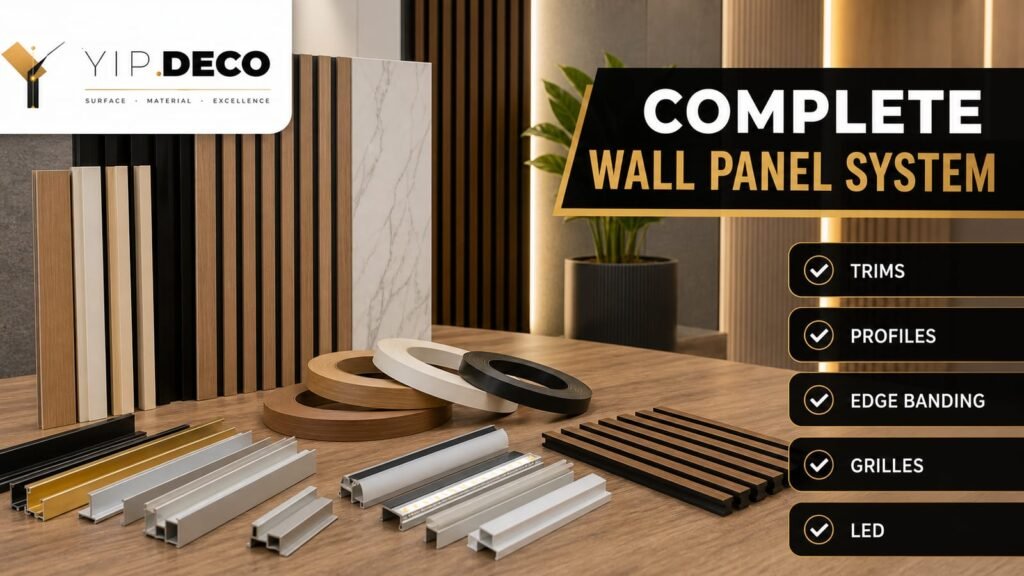
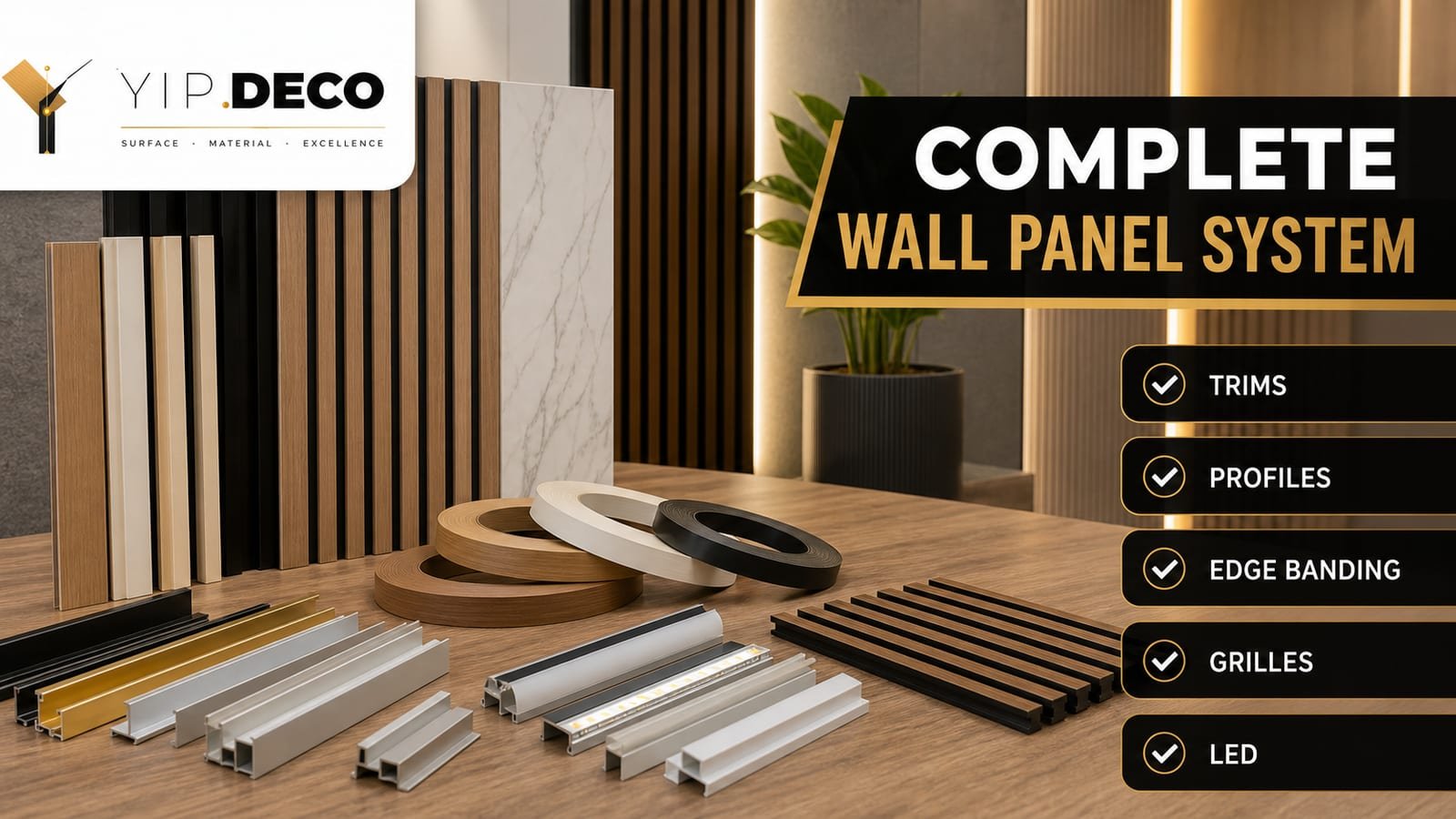
A complete wall panel system requires four accessory categories: trims and corner profiles for clean terminations and transitions, edge banding for exposed cabinet and panel edges, grille panels for decorative layering, and LED profiles for integrated lighting. Each category solves a specific installation problem. In commercial interiors, incomplete accessory planning can create the same kind of material coordination risk that often contributes to construction rework and delay.
Understanding why each accessory exists — and what installation failure it prevents — changes the way you build a sourcing checklist. The sections below break each category down by the problem it solves, the selection decisions that matter, and the procurement risk buyers most often overlook.
YipDeco Insight: Accessories Decide Whether the Project Can Be Finished Cleanly
In real inquiry communication, buyers often send us the main wall panel size, color and quantity first. That is normal, but it is not enough for a commercial interior order. The real project questions usually appear later: how to finish the outside corner, whether the grille panel has a matching trim, whether the edge banding can match the wall panel color, and whether the installer will receive all profiles together with the panels.
This is where our mechanical and material-matching background matters. We do not look at trims, profiles, grilles and edge banding as isolated products. We check how they fit the panel thickness, how they meet the installation environment, how the color is confirmed by physical samples, and whether the order can be packed as one usable wall system. For importers and distributors, this reduces the risk of selling a panel that looks good in a catalog but becomes difficult to finish on site.
Are Trims and Corner Profiles Actually Installation Dependencies?
Buyers we work with often ask whether trims and corner profiles are finishing details or structural requirements. The honest answer is: they are both, and treating them as optional extras is one of the most common sourcing mistakes we see at the inquiry stage.
Trims and corner profiles are functional components that determine how a wall panel terminates at edges, corners, doorframes, and ceiling lines. Without them, panels cannot be cleanly ended or joined. They prevent raw edge exposure, protect against moisture infiltration at junctions, and give the installation a finished, professional appearance.
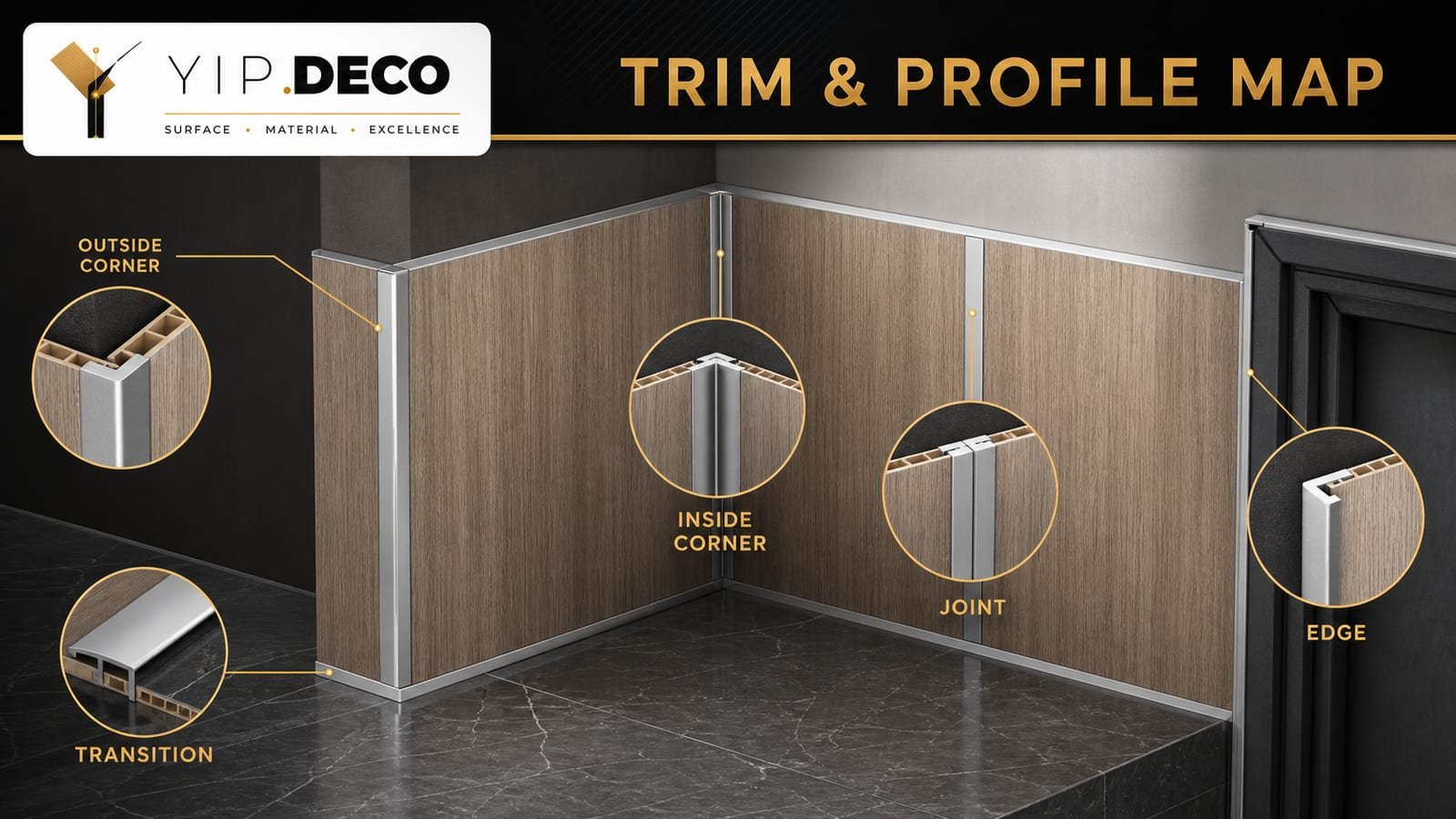
Think about what happens when a panel meets an inside corner, an outside corner, or a doorframe. The panel itself has no designed answer to that transition. Something has to bridge the gap, protect the exposed edge, and make the junction look intentional. That something is a profile.
What Happens Without the Right Profile?
The failure mode is predictable. A panel edge left raw will:
- Expose the substrate cross-section, which is visually unacceptable in any finished space
- Create a water-entry point in bathrooms, kitchens, and humid environments
- Chip or delaminate at the unprotected edge over time
- Force installers to improvise with caulk or filler — which never looks the same as a designed component
Buyers sourcing panels without a concurrent accessories order routinely hit this wall (literally) when installation begins. The panels arrive; the trims don't. The job stops while a second order is placed.
Selecting the Right Profile Type
The profile you need depends on the junction type:
| Junction Type | Profile Required |
|---|---|
| External (outside) corner | Corner angle profile or L-trim |
| Internal (inside) corner | J-channel or inside corner strip |
| Panel-to-ceiling or panel-to-floor | U-channel or capping strip |
| Panel-to-panel vertical join | H-profile or snap connector |
| Panel-to-doorframe | Architrave profile or flat trim |
| End termination (no adjacent surface) | End cap or edge strip |
At YipDeco, aluminum connectors and corner fittings are selected alongside the wall panels they serve, not treated as unrelated add-ons. The dimensional fit matters more than buyers expect. Even a small mismatch between panel thickness and profile opening can create visible gaps, loose fitting, or installation adjustment on site. A profile sourced from a different supplier may look similar in a product photo but still fail at the tolerance level.
Color is the second selection variable. I'll return to this in the same-source section, but the short version is: a chrome-finish aluminum profile against a warm champagne panel is a mismatch that no amount of lighting adjustment will hide.
Why Is Edge Banding the Highest-Risk Accessory Purchase?
Of all the accessories in a wall panel system, edge banding is where color mismatch most visibly fails — and where the sourcing error is most tempting, because edge banding is widely available locally.
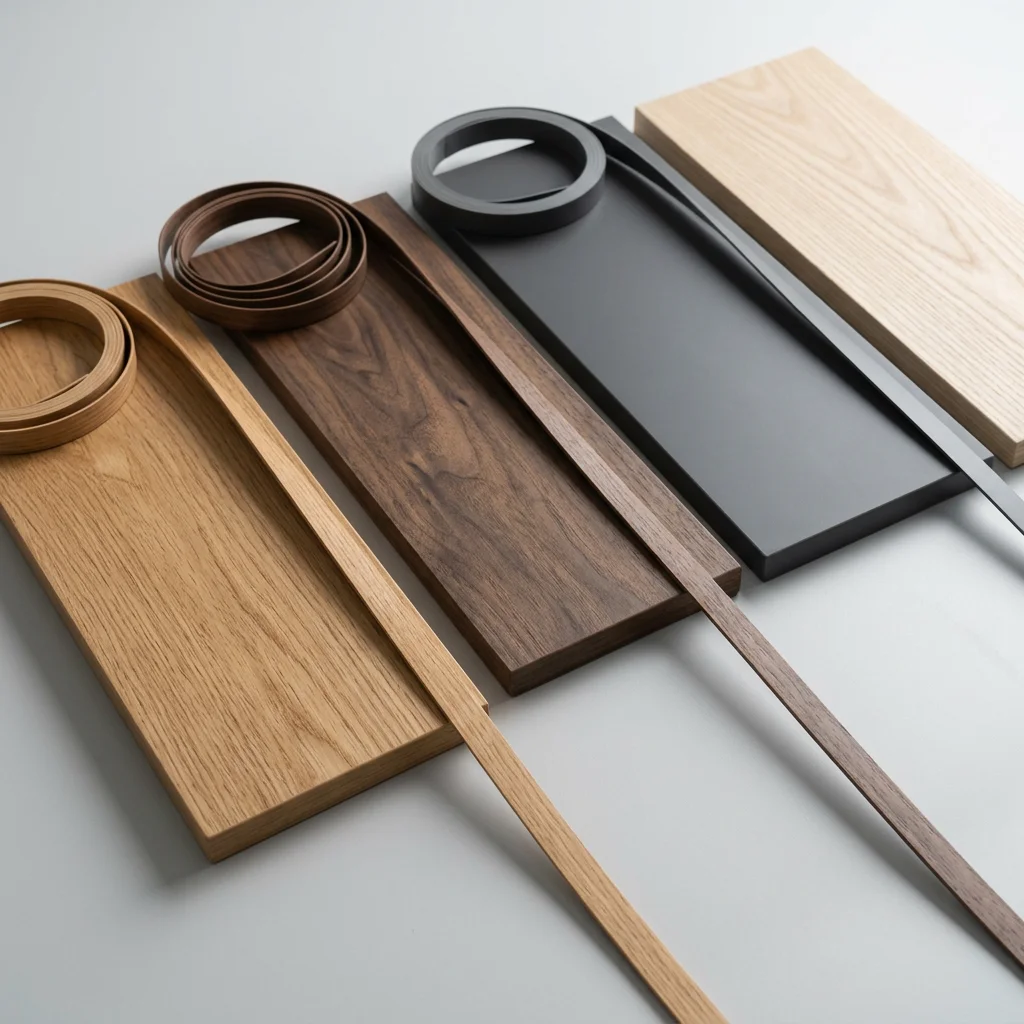
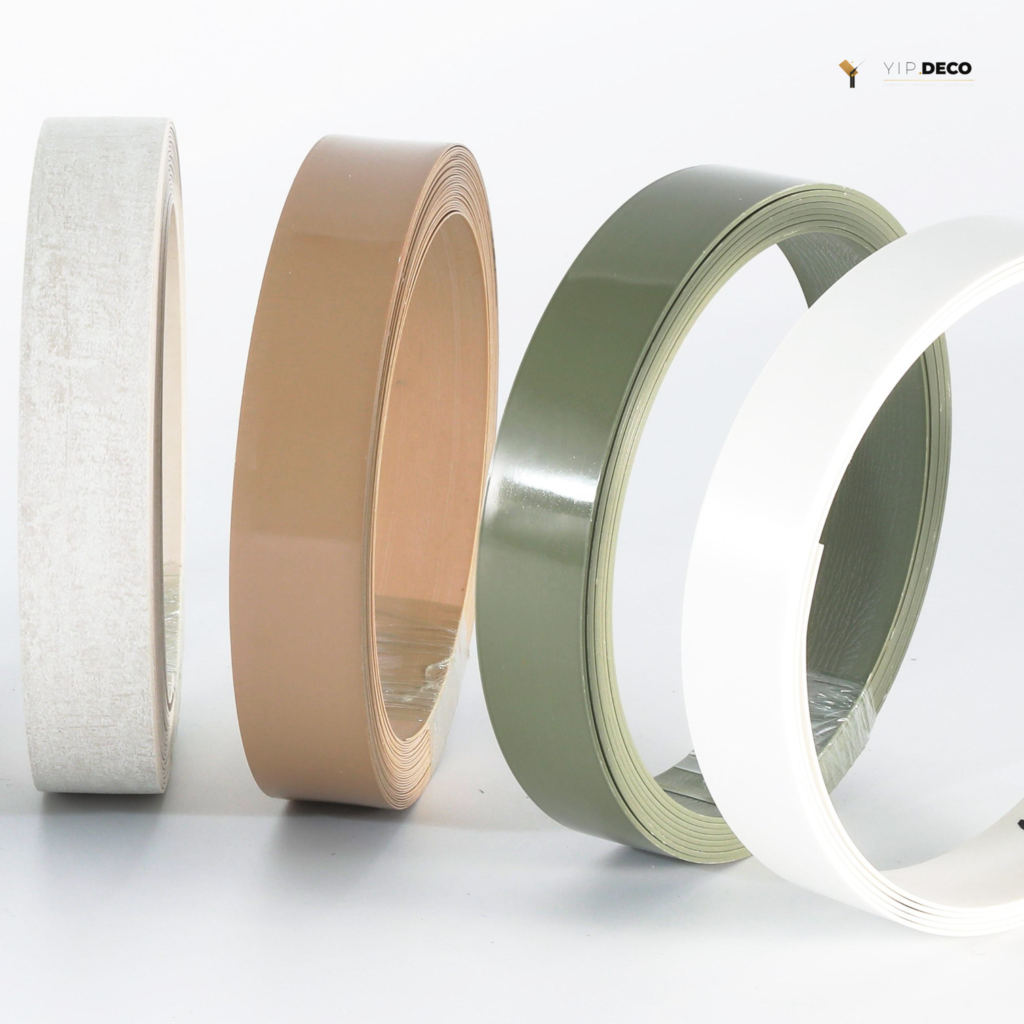
Edge banding covers the exposed substrate edges of panels and cabinet components. Without it, the raw edge of an MDF, plywood, or particleboard substrate is visible at every cut line. Sourcing edge banding locally or from a second supplier is a common procurement shortcut that frequently results in a visible color difference under site lighting — discovered only after installation has begun.
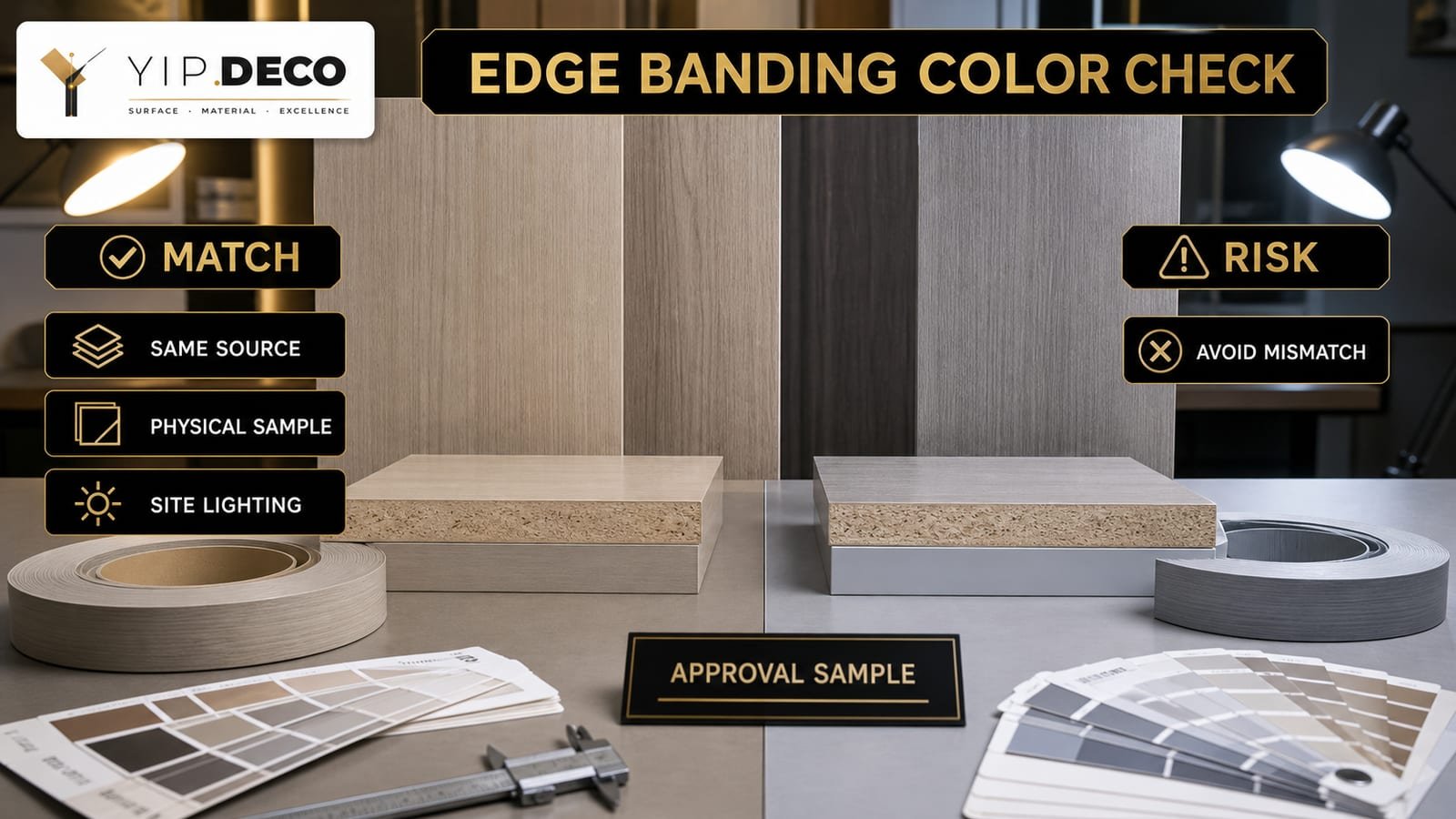
The reason this risk is so sharp is that color matching across manufacturers — even with the same color name or code — is not guaranteed. Surface texture, sheen level, and base pigment can all differ. Two components that look identical under a warehouse fluorescent light may read as clearly different tones under warm LED site lighting or direct sunlight.
PVC vs. ABS vs. PP: Which Edge Banding Material Matches the Decision?
Material choice in edge banding is not primarily an academic question. It maps to real project conditions:
- PVC edge banding is the most widely used. It bonds reliably with standard hot-melt adhesives and is suitable for most interior applications. It is the logical default for most wall panel and cabinet installations.
- ABS edge banding offers better chemical resistance and is preferred in markets where formaldehyde emissions are closely regulated (Europe, in particular). ABS is also more impact-resistant, which matters in high-traffic or commercial environments.
- PP edge banding is less common in decorative wall applications but appears in specific markets where recycling compliance or chemical sensitivity is a procurement requirement.
For buyers in Southeast Asia sourcing for humid climates, PVC with appropriate adhesive specification handles most conditions well. For European buyers dealing with emission and chemical standards, ABS is worth the conversation. The supplier should be able to confirm which adhesive type is compatible with their specific edge banding product — not all hot-melt adhesives bond equally with all substrate and banding combinations.
What YipDeco's Edge Banding Inventory Means for Buyers
I flag this not as a soft sell but as a practical procurement data point: having 600+ stock edge banding colors at a 100 m MOQ changes the risk profile significantly for buyers who need small-run or multi-color orders. The color library that runs across wall panels, cabinet surfaces, and edge banding is the same library — physical-sample confirmation before production is the process that prevents the mismatch described above.
When Do Grille Panels Belong in the Accessory Specification?
Grille panels generate more questions at the inquiry stage than almost any other wall accessory — partly because buyers aren't always sure whether they're decorative, functional, or both.
Grille panels are slatted or louvered decorative wall elements that add visual texture, rhythm, and depth to a flat panel installation. They are a design decision, not an installation requirement. Buyers choose grille panels to introduce a three-dimensional element into a wall scheme — typically for feature walls, reception areas, or high-end residential spaces.
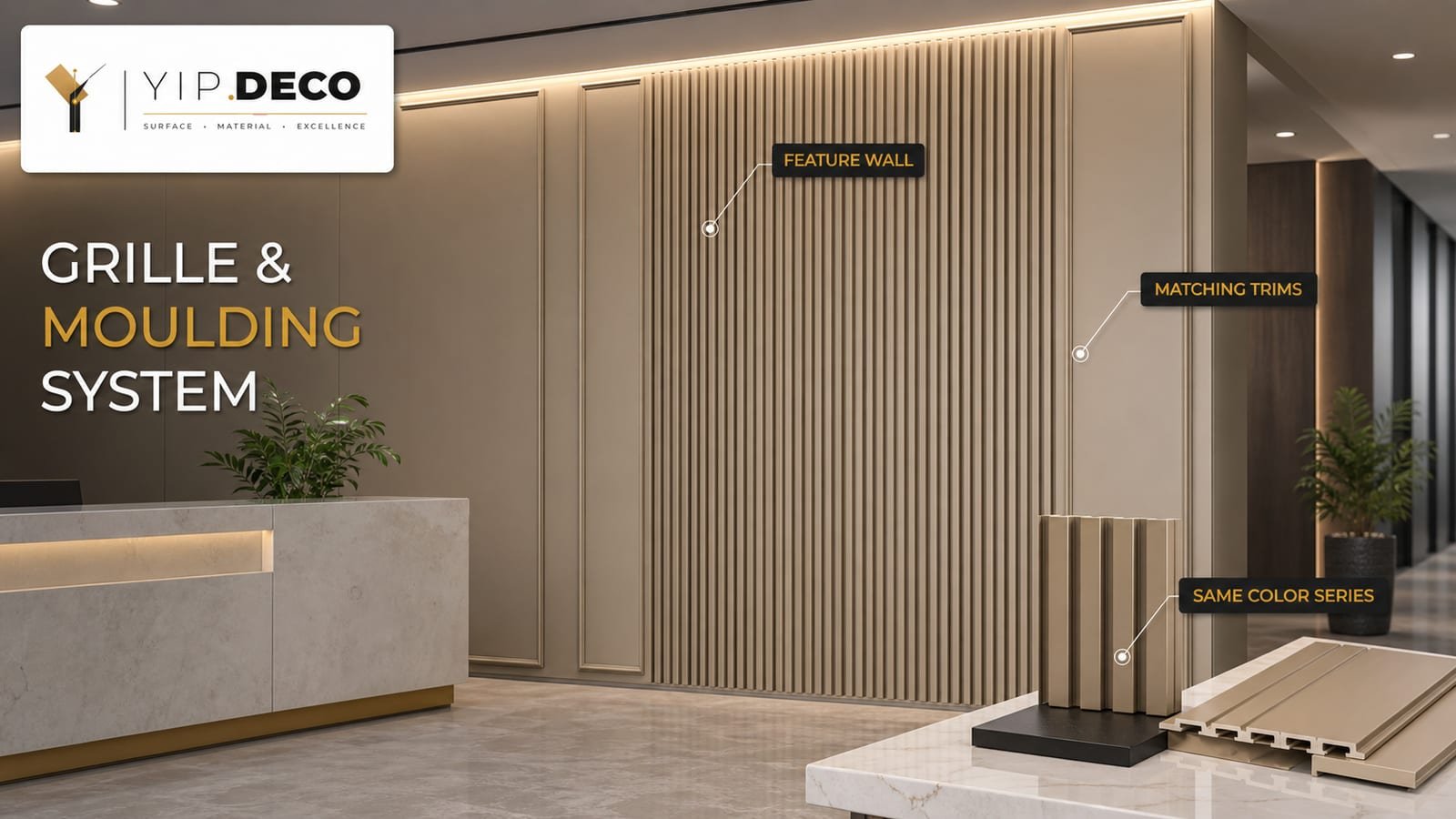
The distinction worth drawing early: grille panels are about what the wall looks like, not about whether the installation works. A contractor can complete a wall panel installation without grille panels. But a specifier or project developer who has designed for visual layering cannot substitute a flat panel at the last minute without changing the finish entirely.
Why Grille Panels Belong in the Initial Specification
The sourcing risk with grille panels is timing. Buyers who treat them as optional add-ons sometimes request them after the main panel order is placed — only to find that lead times, color availability, or profile dimensions don't align with what's already been ordered.
Mouldings and grille panels sourced from the same color library as the flat wall panels allow the designer to layer textures within a single color story. A warm-toned flat panel background with a matching slatted grille in the same color reads as intentional layering. The same grille in a near-but-not-exact color reads as a sourcing error.
Key questions a buyer should ask at specification stage:
- Are the grille panels available in the same color series as the flat panels selected?
- What substrate is used — WPC, PVC, or MDF? Does it match the humidity and installation environment?
- What are the slatting pitch and profile dimensions, and do they match the visual intent of the design?
- Are matching mounting accessories or clips included?
For buyers interested in exploring the full moulding and grille panel range alongside wall panels, YipDeco's Mouldings & Grille section provides specification details by substrate and series.
When Do LED Profiles Upgrade the Installation Rather Than Complicate It?
LED profiles attract interest from hospitality buyers and high-end residential specifiers in particular — but they also attract a common misunderstanding about what they contribute to an installation.
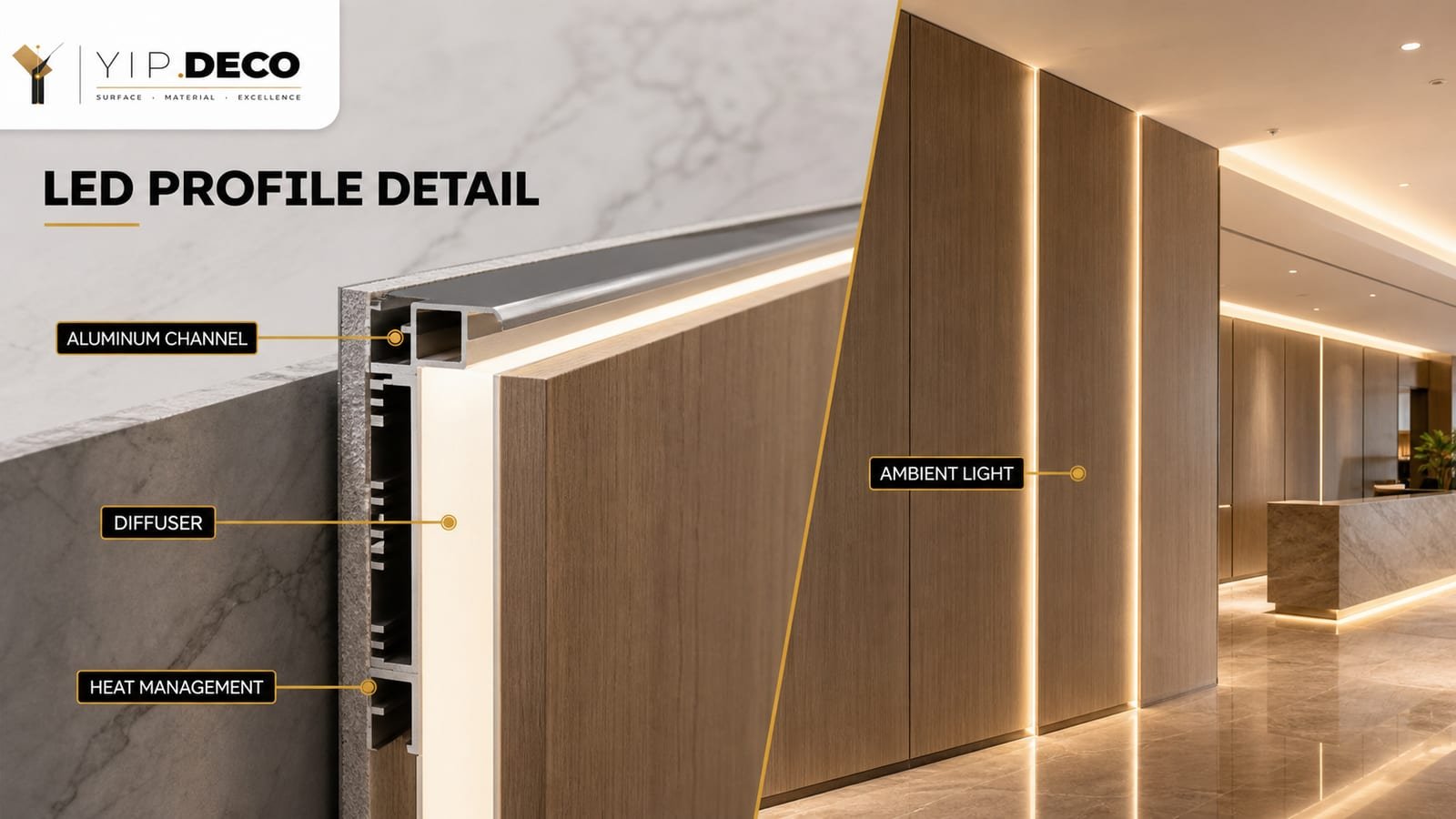
LED profiles are aluminum extrusions designed to house LED strip lighting within or behind wall panels. They serve a functional role (protecting the LED strip, directing light output, and providing a clean edge) and an ambient role (creating recessed or cove lighting effects within the wall system). They are not decorative in the same sense as grille panels — they change how the space is lit, not just how the wall looks.
The Buyer Profile for LED Profiles
Buyers sourcing LED profiles typically fall into two categories:
- Hospitality and institutional project buyers who need integrated ambient lighting as part of a complete fit-out specification. For them, LED profiles are a project requirement, not an upgrade option.
- Distributors and importers who supply to contractors or designers who may request integrated lighting as a feature. For them, stocking or offering LED profiles expands the system completeness of what they sell.
The practical installation consideration is heat management. LED strips generate heat; aluminum profiles dissipate it and extend the service life of the strip. A wall panel system that routes LED strips without proper aluminum housing risks premature LED degradation and surface discoloration on the panel above.
Dimensional compatibility matters here too. The aluminum LED profile must be specified against the panel thickness and the recess or channel depth available in the wall construction. A profile sourced from a separate supplier may not match the recess dimensions designed into the panel system.
Does Same-Source Procurement Actually Solve Three Different Problems?
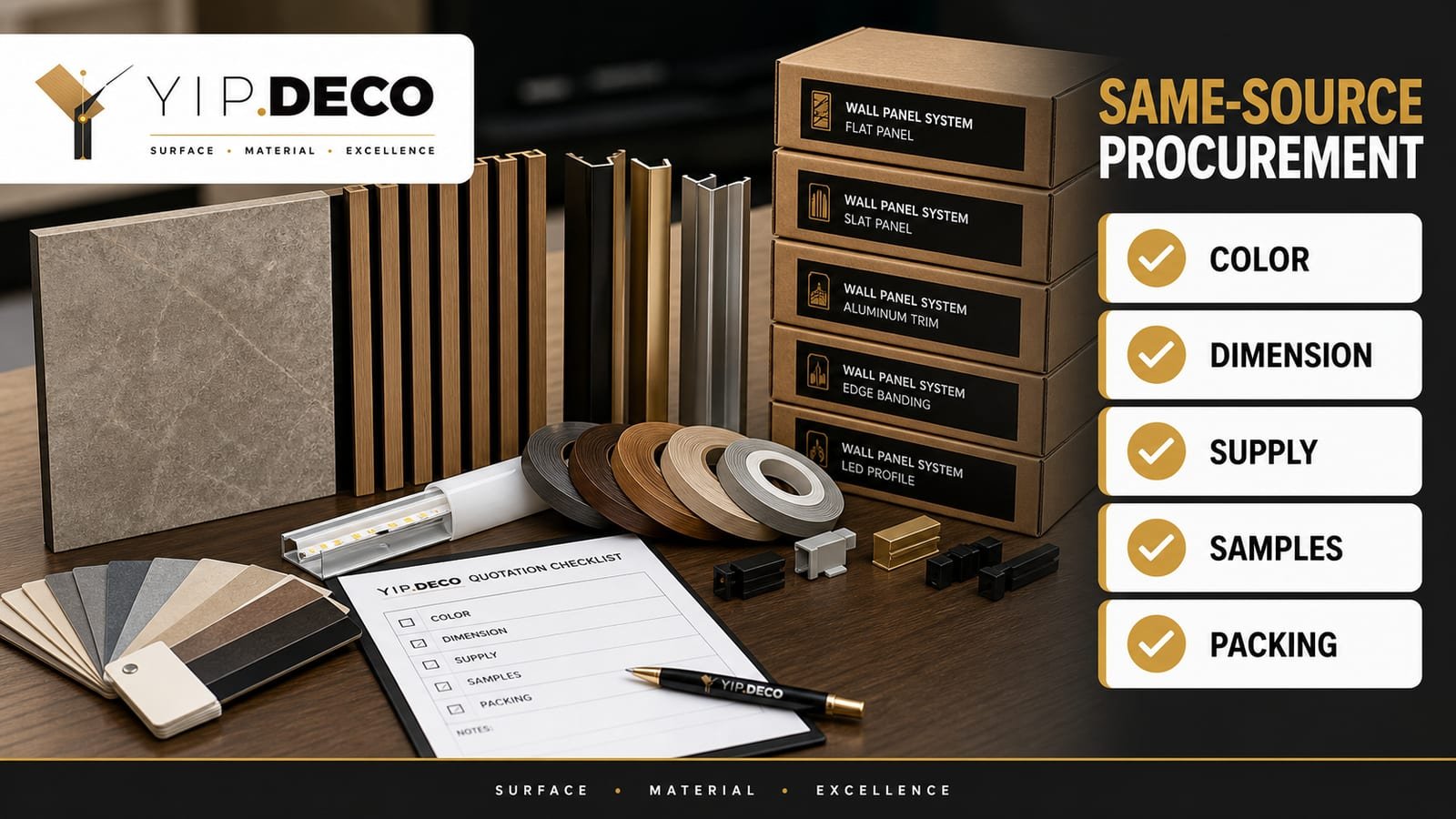
The case for sourcing all accessories from the same supplier as the panels is often compressed into a single argument: "better color matching." That's true, but it undersells the actual risk structure. There are three distinct reasons same-source procurement matters, and buyers self-identify with different ones.
Sourcing all wall panel system accessories from a single coordinated supplier addresses three separate risks: color consistency across a shared color library, supply chain accountability with one point of contact, and dimensional and process compatibility between accessories designed alongside the panels they serve.
Risk 1: Color Consistency
This is the most visible risk and the one buyers discover on-site. Color matching across manufacturers is not reliable, even with the same nominal color code. The only reliable solution is a shared color library with physical-sample confirmation before production.
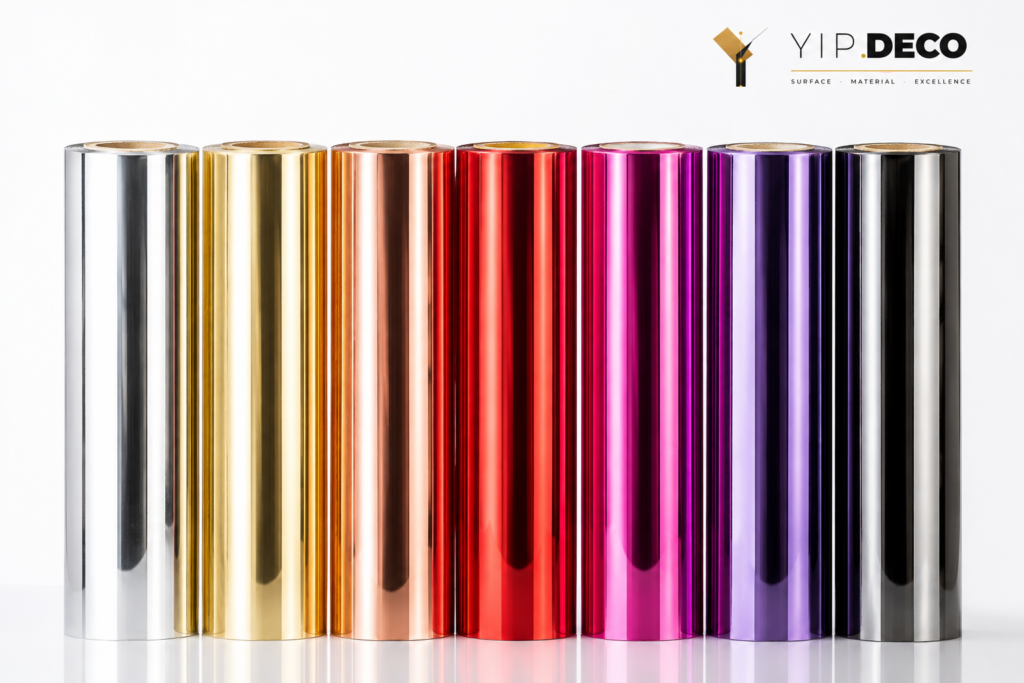
YipDeco's 264-color library across 8 series connects wall panels, cabinet surfaces, profiles, mouldings, and edge banding in a single coordinated system. The physical-sample confirmation step — before production, not after — is the process control that makes this claim real rather than promotional.
Risk 2: Supply Chain Accountability
Buyers sourcing accessories from three or four different suppliers for a single project create a coordination problem that surfaces when something goes wrong. Which supplier is responsible for the color mismatch? Who replaces the short-shipped profile? When accountability is split, answers are slow.
A single point of contact for panels, profiles, edge banding, grilles, and LED profiles means one quality conversation, one re-order process, and one coordinated document request list when compliance files are needed.
Risk 3: Dimensional and Process Compatibility
This risk is the least obvious but often the most costly. Profiles, clips, and connectors are designed to fit specific panel thicknesses and installation methods. An aluminum connector designed for a 9 mm panel does not clip cleanly onto a 12 mm panel, regardless of color match. Edge banding specified for a PVC surface may not adhere correctly to a WPC substrate.
Accessories designed and tested alongside the panels they serve eliminate a compatibility assumption that sourcing from separate vendors requires.
What Should Every Buyer Verify Before Placing a Full Accessories Order?
Buyers sourcing at project or container scale consistently tell us that the pre-order checklist is where errors get caught — not during installation. The questions below reflect what experienced importers check before committing to an accessories order.
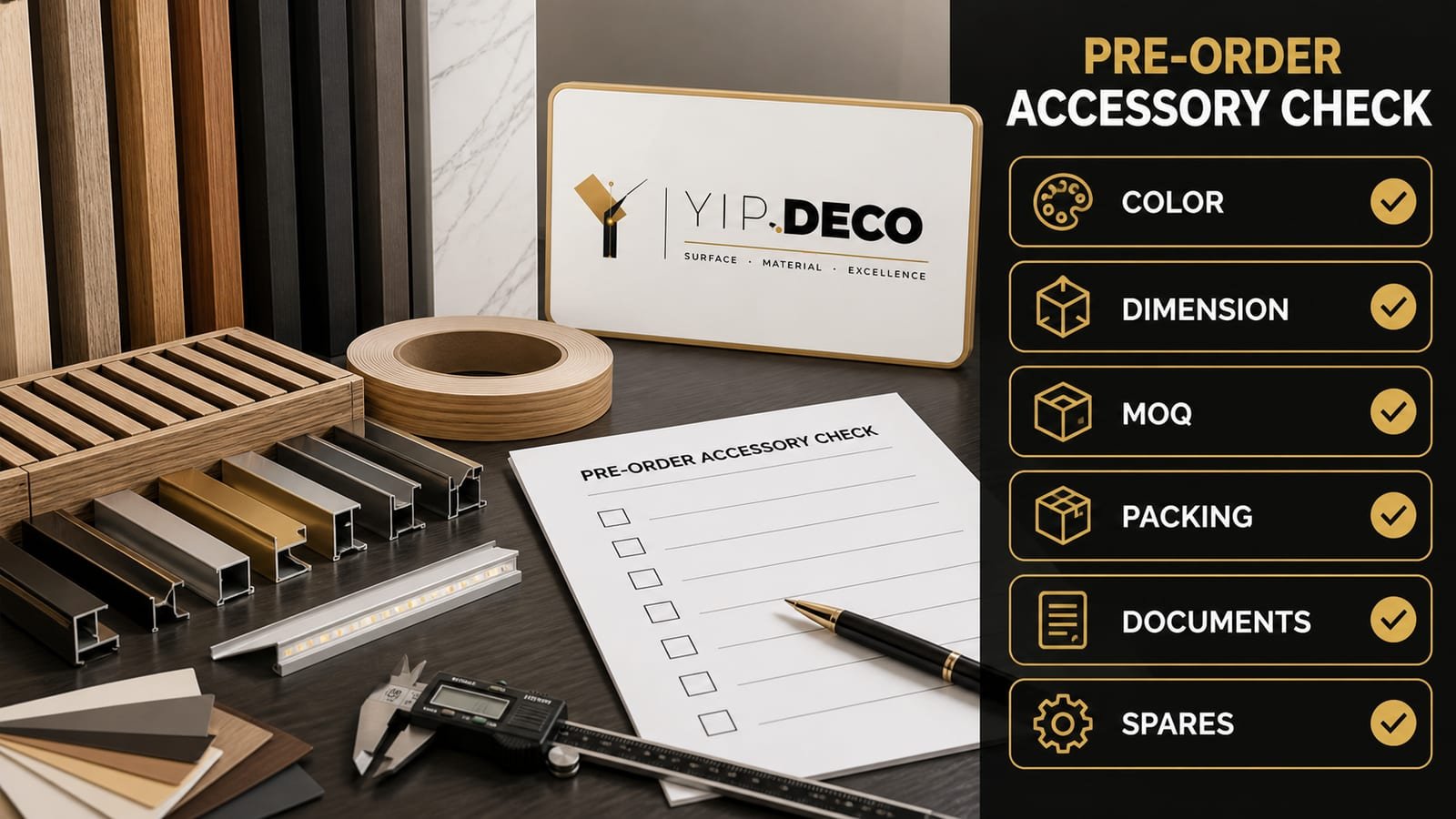
Pre-Order Accessories Checklist
Color and finish confirmation:
- Have physical samples of panels and accessories been reviewed together under site-representative lighting?
- Are panel surface finish (matte, gloss, texture) and profile finish specified consistently?
- Has edge banding been confirmed against the panel substrate and adhesive system?
Dimensional and process compatibility:
- Are profile dimensions specified against panel thickness and substrate?
- Are LED profile recess dimensions matched to the wall construction detail?
- Are grille panel mounting systems compatible with the substrate and installation method?
Supply and documentation:
- What is the MOQ per accessory SKU, and does it work for the project quantity?
- Are test reports, declarations, or other compliance documents available for the specific accessory materials and destination market?
- Are destination-market documents such as REACH declarations, fire classification reports, formaldehyde-emission documents, or RoHS documents for electrical components required for this order?
Sampling and lead time:
- Can custom color samples or accessory samples be produced before the full accessories order, and what is the confirmed lead time for this specific color and item?
- What is the production lead time for accessories relative to the main panel order?
For buyers ready to evaluate a coordinated wall system specification, YipDeco's Sample Kit process allows physical confirmation before production commitment. Buyers can also explore the full Wall Connection Accessories range and PVC Wall Panels for specification details.
Frequently Asked Questions
Can I source edge banding locally and match it to imported wall panels?
You can try, but the mismatch risk is high. Color names and codes do not transfer reliably across manufacturers. Surface texture and sheen are especially difficult to match. Buyers who have sourced edge banding locally and discovered the difference under site lighting consistently recommend same-source procurement after the first experience.
What is the minimum order quantity for wall panel accessories?
MOQs vary by accessory type and supplier. At YipDeco, edge banding stock colors are available from 100 m MOQ, which accommodates small-run and multi-color project orders. Profile and fitting MOQs depend on the specific SKU — confirm at inquiry stage with your project quantities.
Are LED profiles compatible with any LED strip, or do I need to specify the strip too?
LED profile compatibility depends on the strip width, heat output, and installation method. The profile channel width must match the strip. If you are sourcing LED strips separately, confirm the strip dimensions against the profile specification before ordering. Where possible, source both from the same supplier.
Do grille panels and flat panels need to be ordered at the same time?
They don't have to be, but ordering them together is strongly recommended. Color availability, production scheduling, and dimensional coordination are all easier when both are specified in a single order. Ordering grilles after the flat panels have shipped sometimes means color series discontinuity.
What compliance documents are typically required for wall panel accessories in European markets?
European buyers commonly ask for REACH-related declarations, fire classification information where required, and RoHS documentation for electrical components such as LED-related accessories. Formaldehyde-emission documents may also be requested depending on the product and destination market, but CARB P2 is a North American requirement rather than a European one. Document availability varies by product, so confirm requirements at the inquiry stage and specify them in your purchase order.
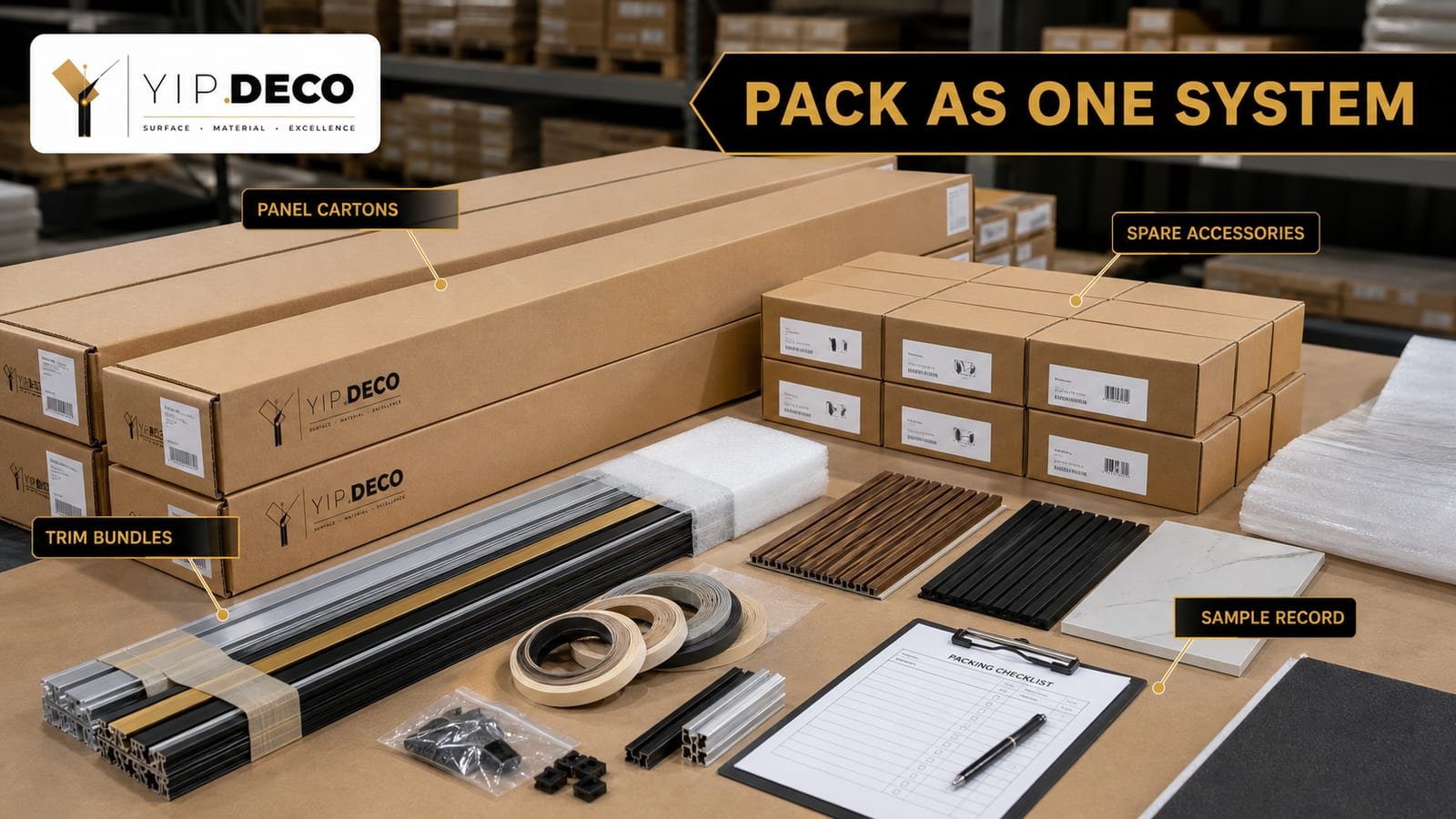
Conclusion
A wall panel system is not complete at the panel. Trims, corner profiles, edge banding, grille panels, and LED profiles are each solving a specific installation problem — and missing or mismatching any of them is a risk that shows up on-site, in front of your client, after the order is placed.
The procurement logic is straightforward: source accessories from the same supplier as the panels, confirm color with physical samples before production, and build the accessories checklist into the initial specification rather than treating them as afterthoughts. Same-source procurement isn't just about color — it's about supply accountability and dimensional compatibility too.
If you're specifying a wall panel system for an upcoming project and want to confirm that panels, profiles, edge banding, and grilles are coordinated before committing to a production order, contact YipDeco's team or request a Sample Kit to evaluate the full Wall Solution in your hands first.