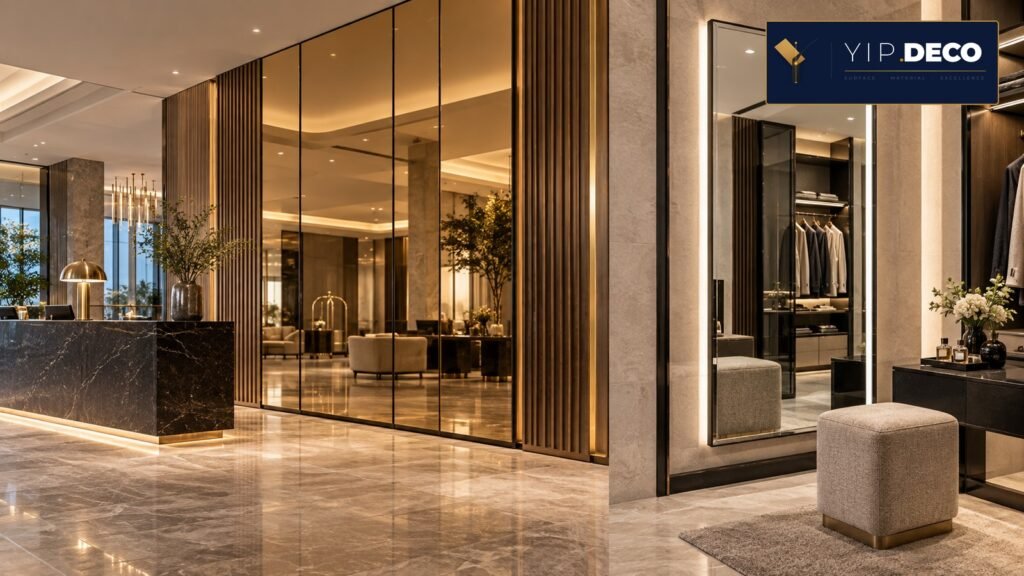
A decorative acrylic mirror wall can coordinate color, joints and profiles across a large feature area, while a glass dressing mirror remains the reference for precise close-range reflection.
Choosing between acrylic mirror panels and glass mirrors starts with the job the reflective surface must perform. Glass is usually the reference choice for close-range, highly accurate reflection and strong scratch resistance. Acrylic mirror panels can be more practical for decorative feature walls, colored mirror effects, custom-cut elements and coordinated wall systems, provided that flatness, backing, fixing and maintenance are correctly specified.
For a commercial project, the most useful question is not “Which material is better?” It is “Where will the mirror be installed, how will people view it, and what must happen around its edges?”
What Is an Acrylic Mirror Panel?
An acrylic mirror sheet is normally a PMMA sheet with a reflective layer and protective backing. It is different from ordinary clear acrylic, metallic foil, high-gloss PET and glass mirror.
An acrylic mirror panel can mean either the reflective sheet itself or a finished construction in which the mirror sheet is bonded to a rigid substrate. Project buyers should clarify this point immediately because the two products behave differently during transport, fabrication and installation.
A thin mirror sheet remains flexible. A finished panel combines the reflective surface with a selected backing, edge detail and installation method. The finished construction is often the more useful unit for commercial wall projects because reflection depends on more than the face material.
At YipDeco, we evaluate acrylic mirror as part of the broader Wall Solution: mirror surface, rigid support, matching mouldings, connection details, adjacent panels and installation requirements.
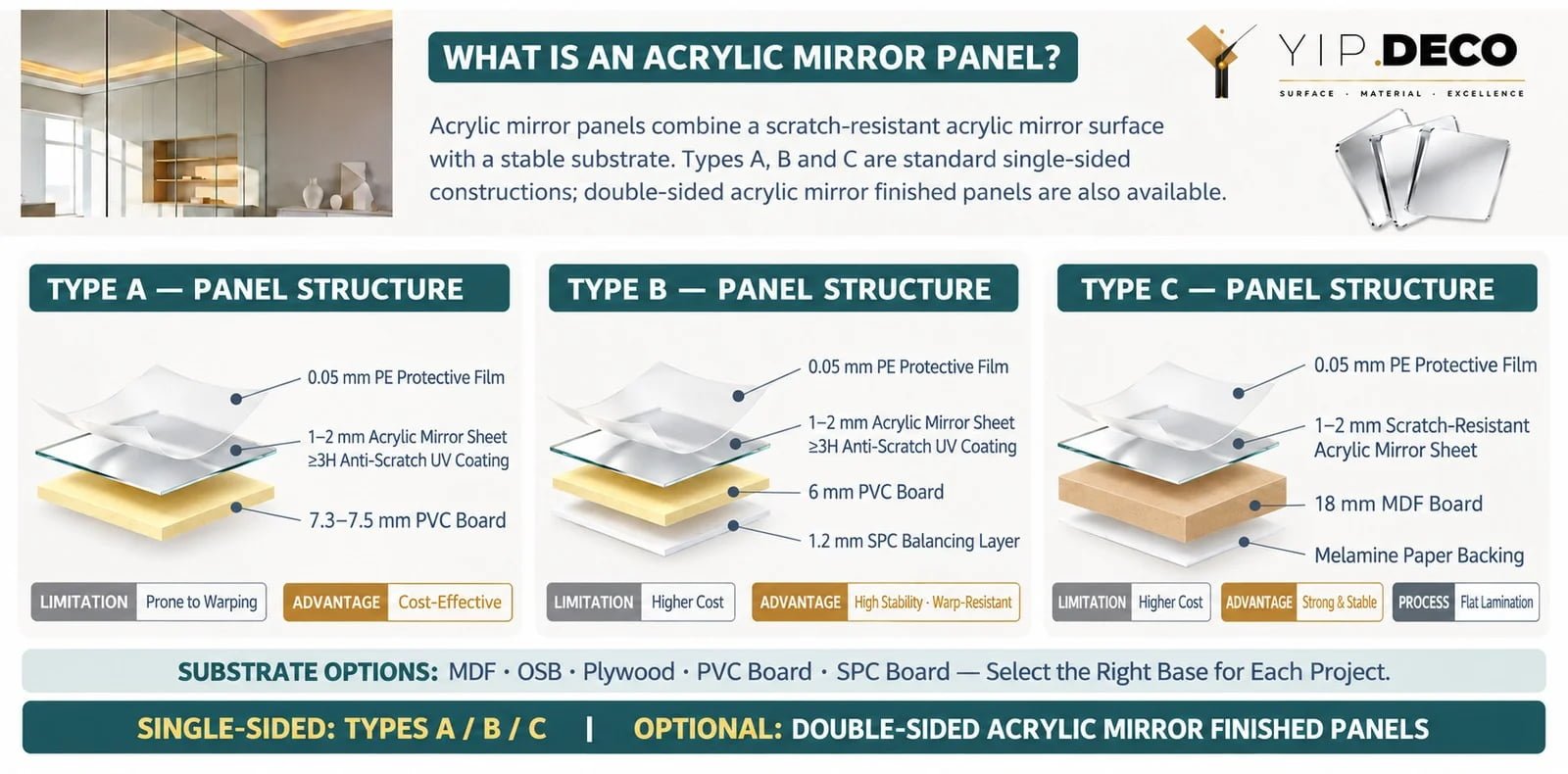
YipDeco finished-panel options combine the acrylic mirror face with different supporting constructions. Type A uses a PVC board, Type B adds an SPC balancing layer for greater stability, and Type C uses an MDF base with a backing layer. Confirm the exact construction rather than specifying “acrylic mirror panel” alone.
Acrylic Mirror Panels vs Glass Mirrors: Quick Comparison
| Decision factor | Acrylic mirror panel | Glass mirror | Buyer implication |
|---|---|---|---|
| Reflection | Suitable for many decorative applications; can show distortion if thin, unsupported or installed on an uneven surface | Usually offers the most stable and precise close-range reflection | Choose according to viewing distance and required image accuracy |
| Surface care | More sensitive to scratching, abrasive cloths and incompatible chemicals | Generally harder and easier to maintain with conventional mirror-cleaning routines | Confirm the cleaning method before project handover |
| Handling | Lower handling burden and no ordinary-glass shard pattern | Heavier and requires appropriate glass handling | Compare installation access, labor and breakage control |
| Fabrication | Can be cut, routed and drilled with suitable plastic-processing tools | Usually requires glass-processing equipment and trained fabricators | Confirm who will cut openings, shapes and edges |
| Shape and color | Useful for colored decorative mirror effects and custom-cut features | Strong choice for conventional silver mirror and precision viewing | Let the design intent lead the material choice |
| Flatness dependency | Highly dependent on thickness, rigid backing and installation flatness | Naturally more rigid at comparable project sizes | Review the wall, backing and fixing pattern before ordering |
| Fire and code | Thermoplastic behavior and the complete panel construction must be checked | Glass is non-combustible, while safety performance depends on glass type | Ask for documents that match the exact installed construction |
| System coordination | Can be supplied with matching panels, profiles and decorative finishes | Often procured as a separate glazing package | Decide whether the mirror is a standalone object or part of the wall design |
This table is a project-screening tool, not a substitute for samples, drawings or local-code review.
YipDeco Insight: Start With the Mirror's Function
From our wall-panel and project-supply experience, buyers often use one word—“mirror”—for very different applications.
A dressing-room mirror, hotel vanity, mirrored ceiling, gold reception wall, retail display, curved column and cabinet accent do not have the same performance priorities. When every application is treated as the same product, the buyer may approve the right color but the wrong construction.
We first divide the requirement into two groups:
- Precision viewing: The user stands close and expects a stable, accurate image. Dressing areas, salon stations and large studio mirrors usually belong here.
- Decorative reflection: The surface creates light, depth, color and visual rhythm as part of the interior. Hotel lobbies, restaurants, retail features, display fixtures, ceilings and wall accents often belong here.
Glass normally has the advantage in precision viewing. Acrylic mirror becomes more interesting when the design needs colored reflection, lighter handling, custom cutting or integration with a coordinated wall-and-profile package.
This distinction prevents an avoidable sourcing mistake: selecting a material because it looks attractive in a close-up photograph without checking how it performs at the actual panel size and viewing distance.
Reflection Quality: Decorative Effect vs Precise Image
Reflection quality is the biggest reason not to present acrylic mirror as a universal replacement for glass.
Glass mirror is rigid and typically provides a stable image across a correctly manufactured and installed surface. Acrylic mirror is more flexible. The sheet can follow small irregularities in the wall or backing, and those irregularities become visible as waves or localized distortion.
The Plaskolite FABBACK fabrication guide explains that distortion is affected by viewing distance, material thickness and mounting conditions. It recommends a smooth, rigid, flat backing and notes that proper installation can reduce distortion but may not eliminate it.
That does not make acrylic mirror unsuitable. It changes the approval standard.
For a decorative hotel feature wall, the buyer may prioritize warm champagne color, repeated geometric panels and coordination with metal trims. For a salon mirror, image accuracy at close range may be non-negotiable. The same sample can pass one application and fail the other.
Before confirming an acrylic mirror project, check the sample:
- at the expected viewing distance;
- under the project's actual or similar lighting;
- at a representative panel size;
- on a flat backing;
- beside the proposed adjoining materials;
- with the intended joint and edge treatment.
A small loose chip can confirm color. It cannot confirm large-format reflection.
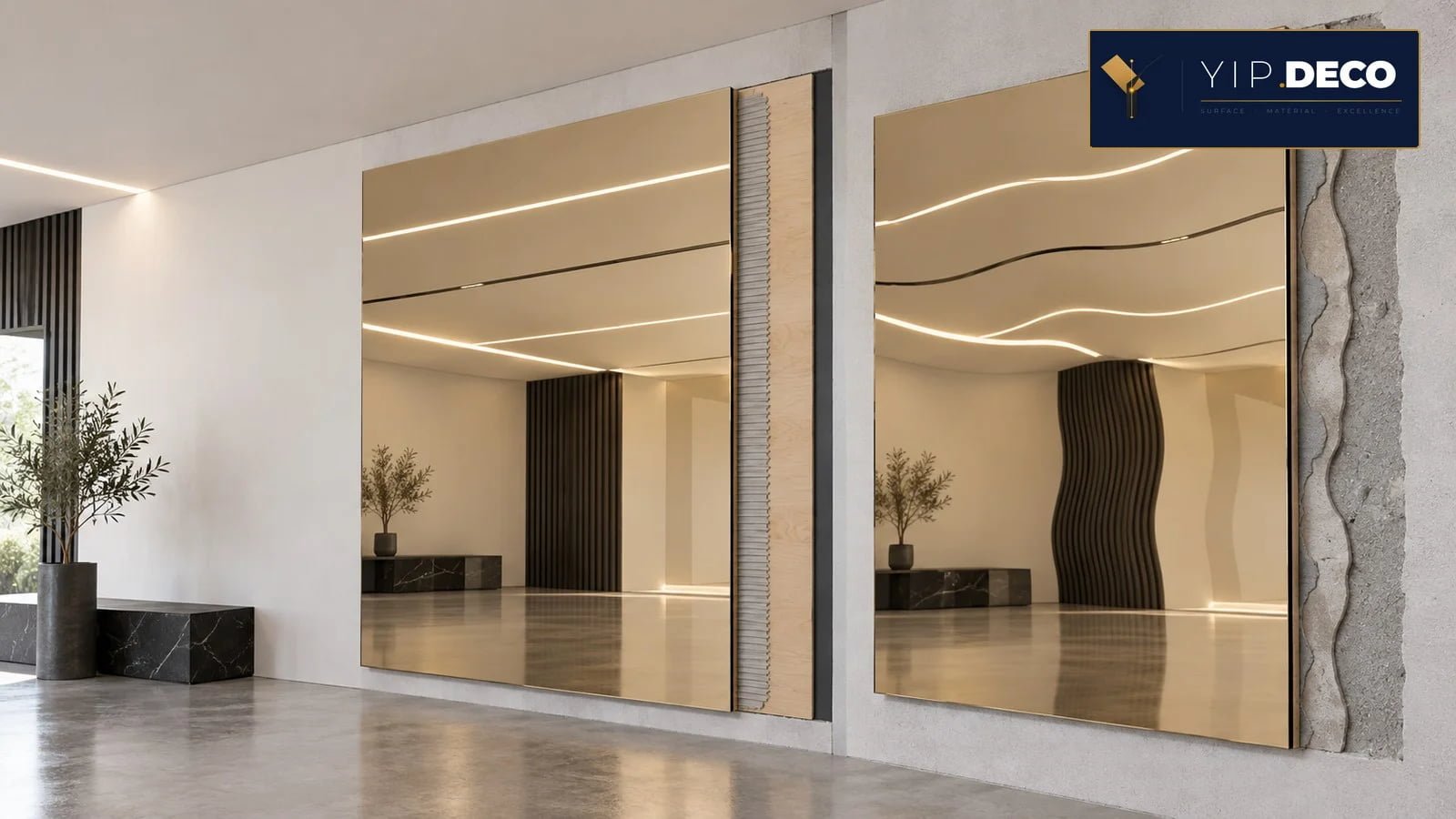
The same mirror sheet can appear stable on a flat rigid backing and visibly wavy on an uneven base. Approve the finished construction, not only a loose color chip.
<!-- YIPDECO_VIDEO_SLOT: Add the approved reflection-and-backing demonstration video URL here. Recommended placement: directly below this explanation and before the Flatness section. -->
Flatness, Substrate and Fixing Decide the Result
With acrylic mirror, the wall behind the surface becomes part of the optical system.
If the substrate has bumps, open joints, screw heads, loose plaster or localized adhesive build-up, the mirror may follow those variations. Large sheets and long sight lines make the effect easier to notice.
Check the Base Before Selecting the Sheet
The project team should report:
- substrate type;
- wall flatness and tolerance;
- moisture condition;
- whether a rigid backing board will be used;
- maximum panel size;
- proposed adhesive or mechanical fixing;
- edge-support and trim design;
- expansion allowance;
- whether the surface is vertical, curved or overhead.
For finished-panel supply, the substrate must also be identified. MDF, plywood, chipboard and PVC-based cores have different weight, moisture behavior, machining and document requirements. The surface sheet alone does not describe the finished product.
Adhesive Compatibility Is a Technical Check
An adhesive that bonds a normal wall panel may not be suitable for a mirrored acrylic backing. Solvents can attack the protective coating or acrylic, and a thick or uneven adhesive pattern can contribute to localized distortion.
Plaskolite recommends testing adhesives on expendable pieces before installation and allowing sufficient time to observe compatibility. Its guide uses a 72-hour pretest for the referenced product. This is useful process logic, but buyers should still follow the instructions for the exact mirror grade and adhesive selected for their project.
The ACRYLITE Reflections technical guide also recommends mounting to rigid, clean and dry surfaces, selecting a suitable thickness and avoiding excessive fastener pressure.
Mechanical Fixing Needs Room to Move
When mechanical fasteners are used, oversized holes, suitable washers and controlled tightening can help reduce stress and dimpling. A screw tightened directly against the face can create a local depression that becomes obvious in the reflection.
For larger sheets, edge-engaging profiles or a bottom support can carry the panel more evenly than isolated fixings. The final method must be designed for the actual size, orientation and substrate.
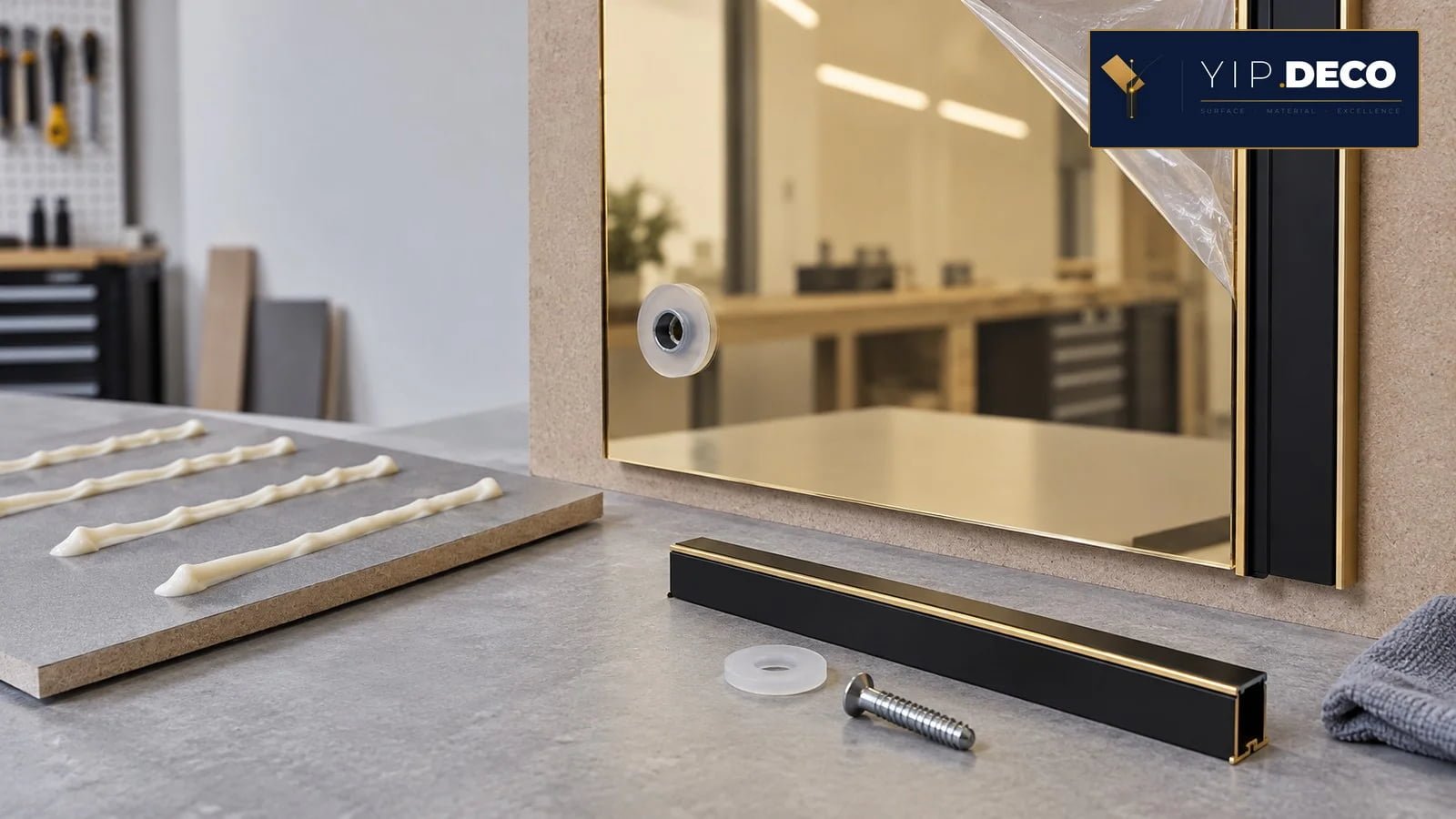
Compatible adhesive, controlled fastener pressure, soft washers and an edge-support detail help protect the reflective face and reduce localized distortion.
Handling and Fabrication: Easier Does Not Mean Careless
Acrylic mirror can simplify certain fabrication tasks because suitable grades can be saw-cut, routed, drilled or laser-cut using appropriate plastic-processing methods. This can help with geometric wall modules, signage, display fixtures, cabinet inserts and decorative openings.
However, processing quality still depends on tooling, feed rate, support and protection.
The reflective backing and face must remain protected during cutting and handling. Vibration, dull tools and poor support can cause chips or cracks at the edge. Heat from cutting can introduce stress. The fabricator should follow the technical guide for the selected material rather than treating the sheet as ordinary plywood or plain acrylic.
Project buyers should clarify:
- whether the supplier delivers full sheets or cut-to-size parts;
- who is responsible for CNC files and tolerances;
- whether holes and cut-outs are completed before shipment;
- how the front face and back coating are protected;
- how sheets are stacked and separated;
- whether spare pieces are included for installation trials;
- whether edge finishing is visible in the final design.
Glass remains the more familiar route when the project already has an experienced glazing contractor and standard rectangular mirrors. Acrylic mirror becomes attractive when the fit-out includes custom shapes, repeated modules or fabrication that aligns with panel and plastics processing.
Can Acrylic Mirror Panels Be Curved or Used on Ceilings?
This question requires careful wording because “flexible” does not automatically mean “thermoformable.”
Some mirror grades can accept gentle cold forming within defined limits. Heating a mirrored sheet may damage the reflective backing, cause blushing or create stress. The Plaskolite guide specifically states that its referenced acrylic, polycarbonate and PETG mirror sheets may be gently cold-formed but should not be thermoformed.
Therefore, a project drawing for a curved column should be reviewed against the exact material grade, radius, thickness, joint layout and support method. A supplier should not confirm a tight curve from a generic catalog description.
Overhead installation requires another level of caution. A ceiling panel must not depend on an unverified adhesive bond. The same Plaskolite guide recommends an edge-engaging frame or mechanical mounting for overhead use.
For hotel ceilings, restaurant features and retail displays, the buyer should request:
- reflected ceiling or feature drawing;
- panel dimensions and orientation;
- mechanical retention detail;
- substrate and frame information;
- access requirements above the ceiling;
- finished-system fire documents where required;
- a representative mock-up.
The visual opportunity is real, but the fixing detail must be resolved before bulk material is ordered.
Scratch Resistance, Cleaning and Handover
Surface care is one of the most practical differences between acrylic mirror and glass.
Glass usually tolerates routine mirror cleaning and resists everyday scratching better. Acrylic mirror needs a controlled cleaning method. Abrasive cloths, dry wiping, harsh chemicals and incompatible cleaners can damage the surface or cause fine marks.
The project team should agree on cleaning instructions before handover, especially in hotels, retail stores, restaurants, schools and public spaces where several cleaning teams may work on the surface over time.
Good practice includes:
- leaving protective masking in place through fabrication and most installation work;
- removing dust with a clean, non-abrasive method;
- using a soft microfiber cloth reserved for the mirror surface;
- testing the cleaner on a spare piece;
- avoiding incompatible solvents and ammonia-type cleaners unless the exact technical guide allows them;
- preventing metal tools, screws and trim edges from sliding across the face;
- giving the maintenance team written care instructions.
Hard-coated grades may improve resistance, but “hard-coated” should be confirmed as an actual product feature rather than assumed from the term acrylic mirror.
For high-touch locations where cleaning control is weak, glass or another more abrasion-resistant surface may offer a lower maintenance risk.
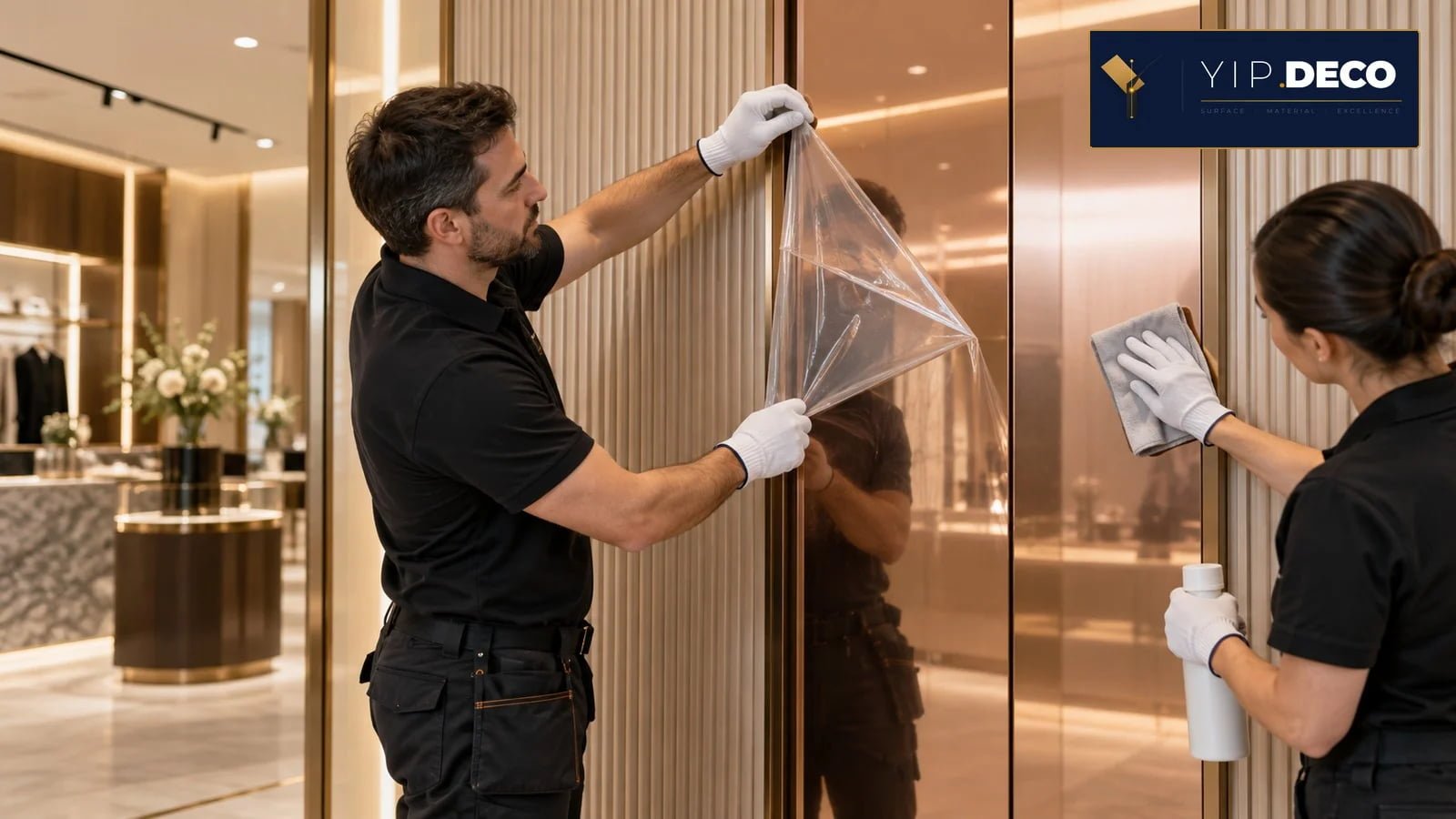
Keep the protective film in place during fabrication and most installation work, then use a clean microfiber cloth and an approved cleaner during handover.
Fire, Safety and Building-Code Questions
“Shatter-resistant” and “fire-rated” are often used too loosely in mirror marketing.
Acrylic is a thermoplastic. Its fire behavior is not the same as glass. When the mirror is bonded to MDF, plywood, PVC or another core, the project must evaluate the complete construction: surface, backing, adhesive, substrate, trims and fixing method.
Glass is non-combustible, but ordinary annealed mirror glass and safety glazing are not interchangeable. Toughened or laminated mirror options may be specified where breakage behavior is important.
Regulated locations also differ by market. In the United States, for example, the Consumer Product Safety Commission's architectural glazing standard applies to defined products such as doors and bathtub or shower enclosures. Local building codes, project specifications and the authority having jurisdiction determine what is acceptable for a particular installation.
Buyers should ask these questions before comparing certificates:
- Is the document for the mirror sheet, the backing board or the complete finished panel?
- Does the tested thickness match the proposed order?
- Does the adhesive or lamination method match the tested construction?
- Is the document valid for the target market and application?
- Does the installation location require safety glazing, mechanical retention or another specific system?
Do not use a general company certificate as proof of a finished wall assembly's fire or safety performance.
Application Guide for Commercial Interiors
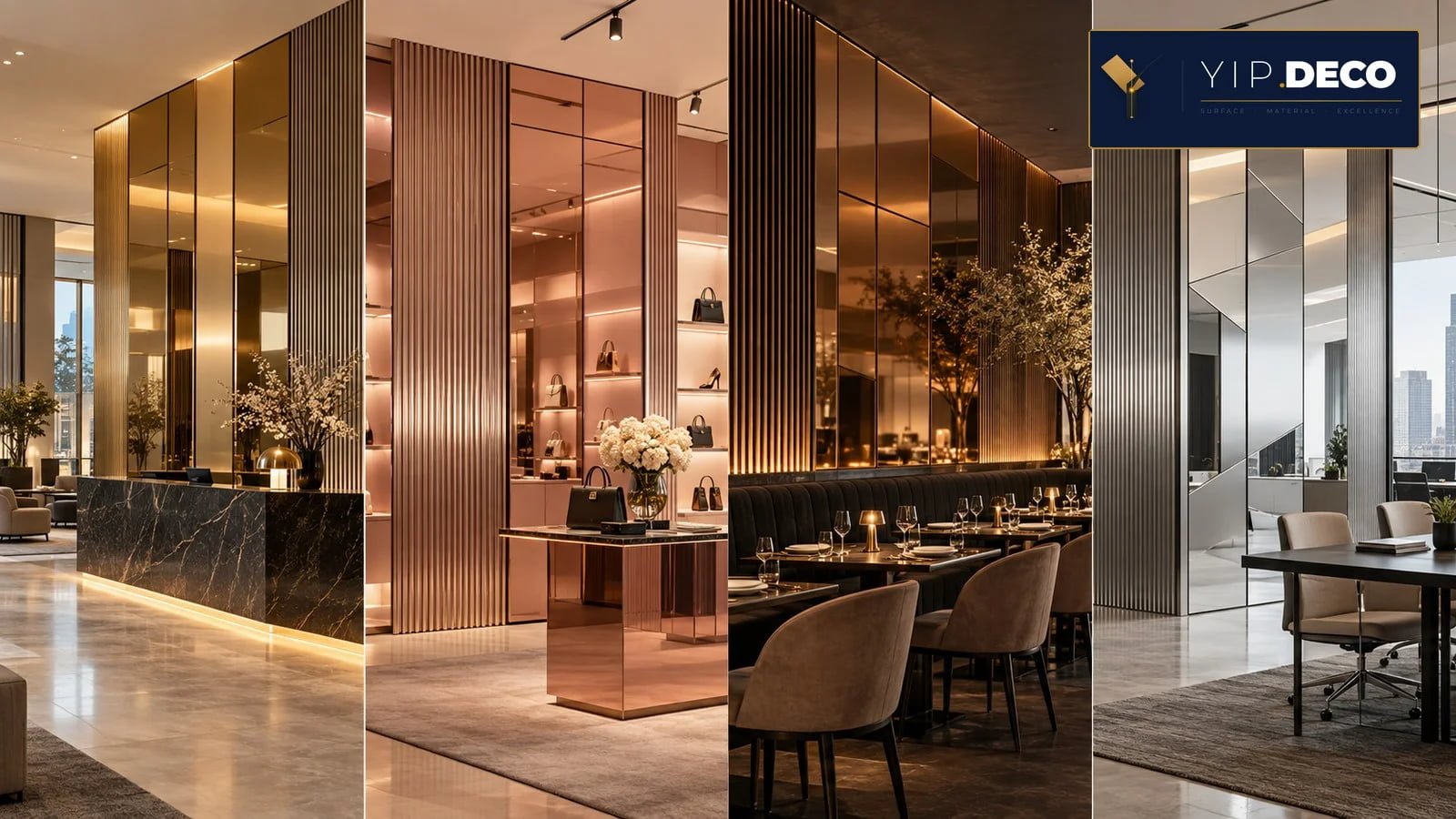
Application decides the specification: decorative reflection can suit hospitality, retail and display areas, while close-range viewing demands stricter image accuracy.
Hotel Lobbies and Reception Areas
Decorative mirror panels can add depth and light to reception walls, columns and selected ceiling features. Gold, champagne, bronze and smoked tones can coordinate with warm wall finishes and metal details.
The buyer should prioritize panel layout, sight lines, joint rhythm, lighting reflection, scratch protection during fit-out and mechanical support for overhead areas. A full-size mock-up is strongly recommended when long reflections are part of the design.
Retail and Display Fixtures
Retail projects often need repeated shapes, routed details, brand-specific colors and fast replacement of damaged modules. Acrylic mirror can suit these needs when the surface is protected from abrasion and the cleaning method is controlled.
For counters and high-touch zones, check whether glass or a hard-coated mirror grade provides better lifecycle value.
Restaurants and Entertainment Interiors
Colored mirror accents can strengthen an atmosphere without turning every reflective area into a functional mirror. The design team should consider heat sources, cleaning chemicals, food-service maintenance and flame-spread requirements before confirming the construction.
Offices and Showrooms
Mirror strips, geometric panels and integrated display walls can expand the visual depth of reception and presentation areas. Panel edges, lighting glare and maintenance access matter more than catalog color alone.
Schools, Gyms and Public Spaces
Do not make a material choice using the word “safe” alone. Determine whether the surface is for decoration, training, close-range viewing or a regulated impact location. Confirm the required reflection accuracy, abuse resistance, fixing design and local safety requirements.
Dressing Areas, Salons and Precision-Viewing Zones
Glass is usually the starting point when users stand close and depend on accurate reflection. Acrylic mirror should be considered only after a representative sample demonstrates acceptable image stability for the intended size and mounting condition.
How Mirror Panels Connect With the Rest of the Wall
The commercial value of an acrylic mirror panel is stronger when it is specified as one element in a coordinated interior surface system.
A reflective feature may meet:
- flat PVC or SPC wall panels;
- fluted or grille panels;
- corner mouldings;
- metal connection profiles;
- LED light profiles;
- skirting and edge closers;
- cabinet doors and matching surface foil;
- edge banding on adjacent furniture.
If these items are sourced separately, small differences in gold, champagne, bronze, gloss and texture can make the feature look unplanned. The joint may also fail if the profile was selected before the finished panel thickness was confirmed.
YipDeco's approach is to review the reflective area together with Mouldings & Grille, Wall Connection Accessories and, where furniture is involved, Surface Foil.
The specification should show:
- which material finishes each outside corner;
- how two mirror panels meet;
- how the mirror meets a grille or flat panel;
- whether an LED line is recessed or surface-mounted;
- where the installer can hide cut edges;
- how damaged modules can be replaced;
- whether adjacent cabinet finishes need the same color reference.
This turns a reflective sheet into an installable wall package.
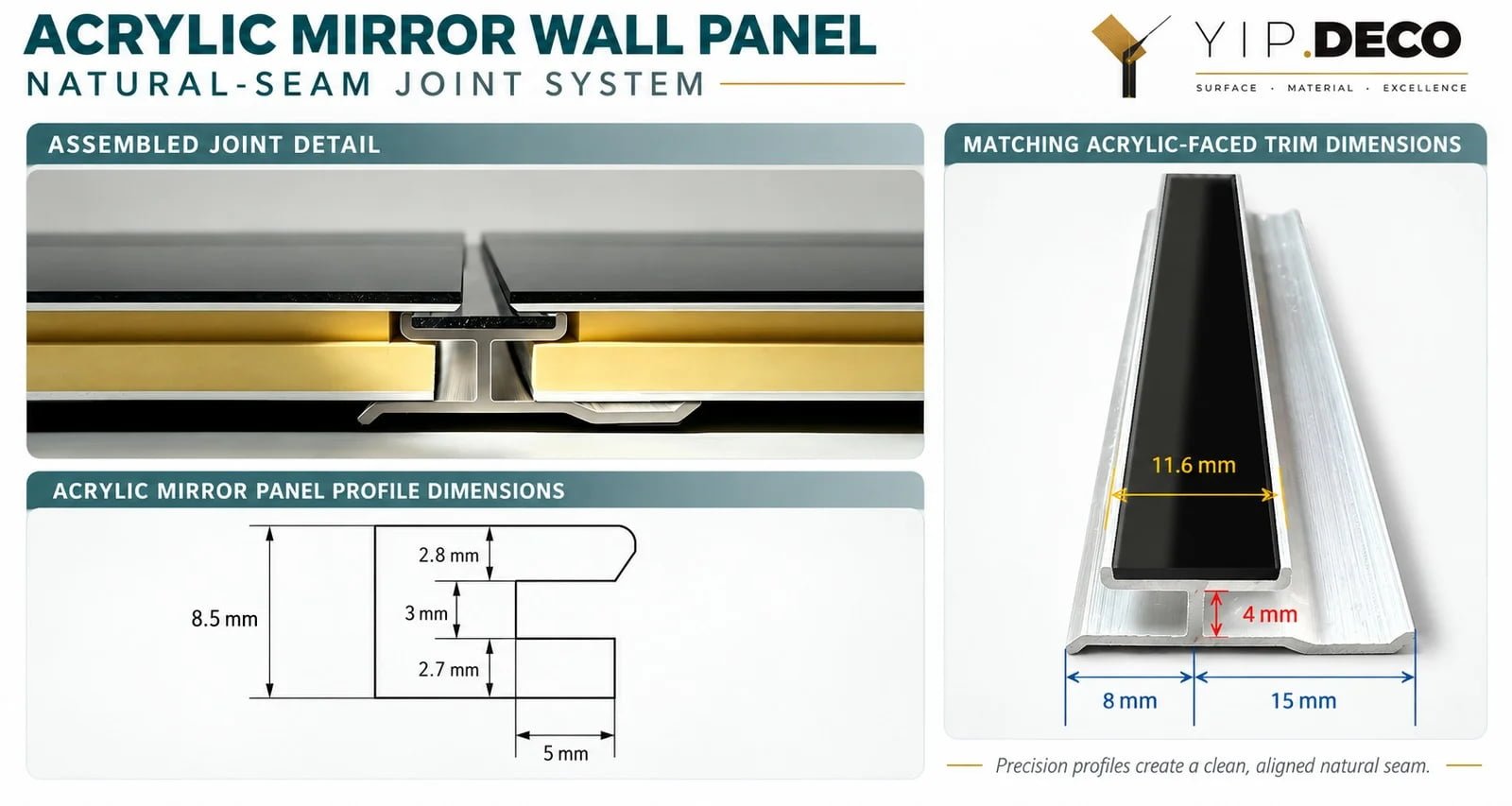
The natural-seam system uses a matching acrylic-faced profile to align adjoining panels and control the visible joint. Profile dimensions, panel thickness and installation tolerance should be approved together before cutting or bulk production.
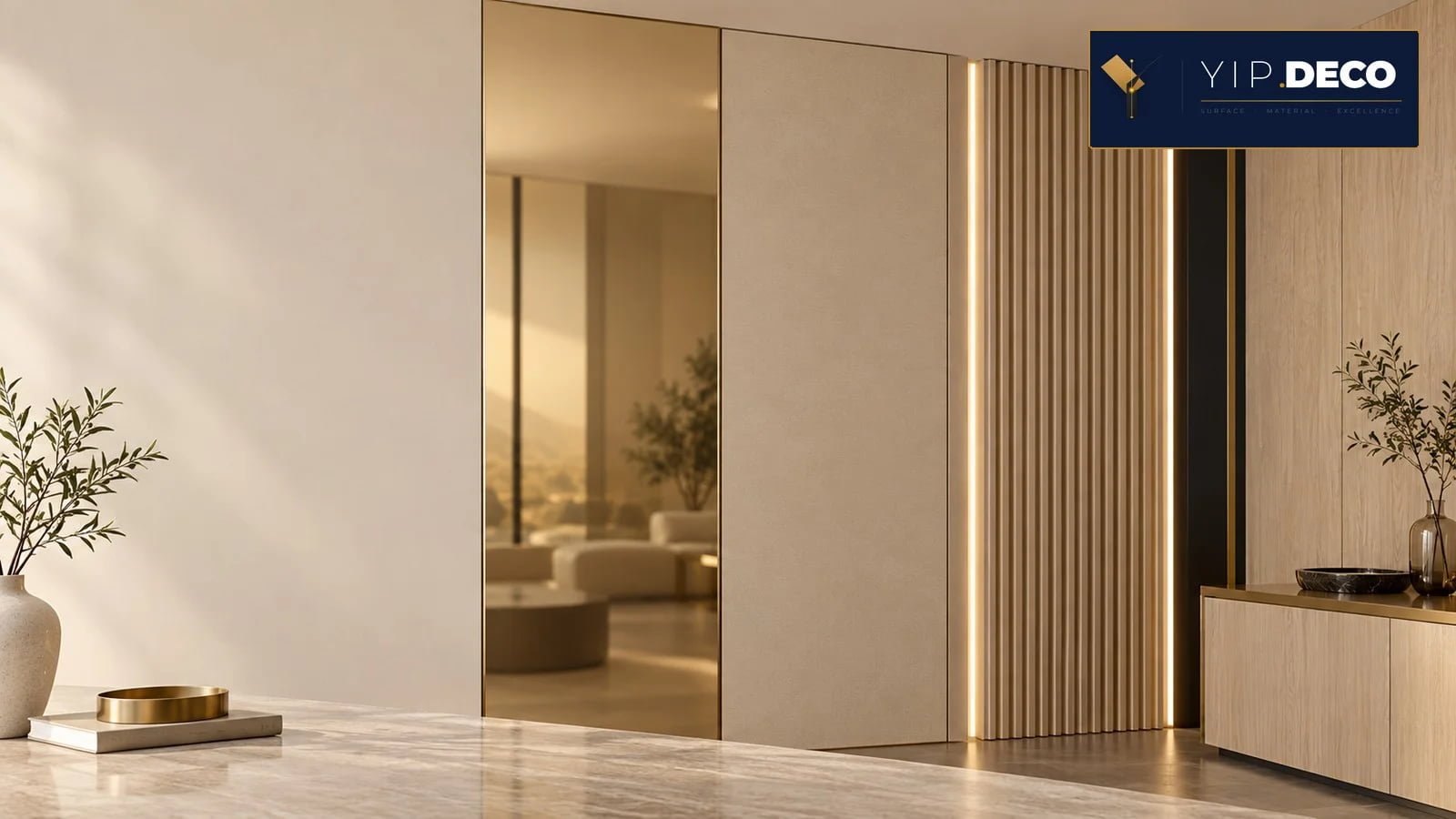
Mirror panels, flat panels, grille elements, trims and lighting profiles should be approved as one wall system so that thicknesses, colors and joints work together.
Sample and Mock-Up Approval Checklist
A serious project sample should include more than one polished color chip.
Request the following where relevant:
- mirror sheet in the proposed tint and thickness;
- actual protective masking;
- proposed rigid backing or finished-panel construction;
- edge detail or finished sample edge;
- one connection profile or moulding;
- proposed adhesive information;
- representative joint between the mirror and adjoining panel;
- current technical and compliance documents for the exact construction;
- care and cleaning instructions;
- packaging example for finished parts.
Evaluate the sample under project lighting and from the intended viewing distance. Check surface waviness, color, edge quality, backing stability, cleaner compatibility and the way profiles cover the joint.
For large walls, ceilings or repeated modules, build a mock-up at a meaningful size. Photography alone can hide distortion, joint lines and color shifts.
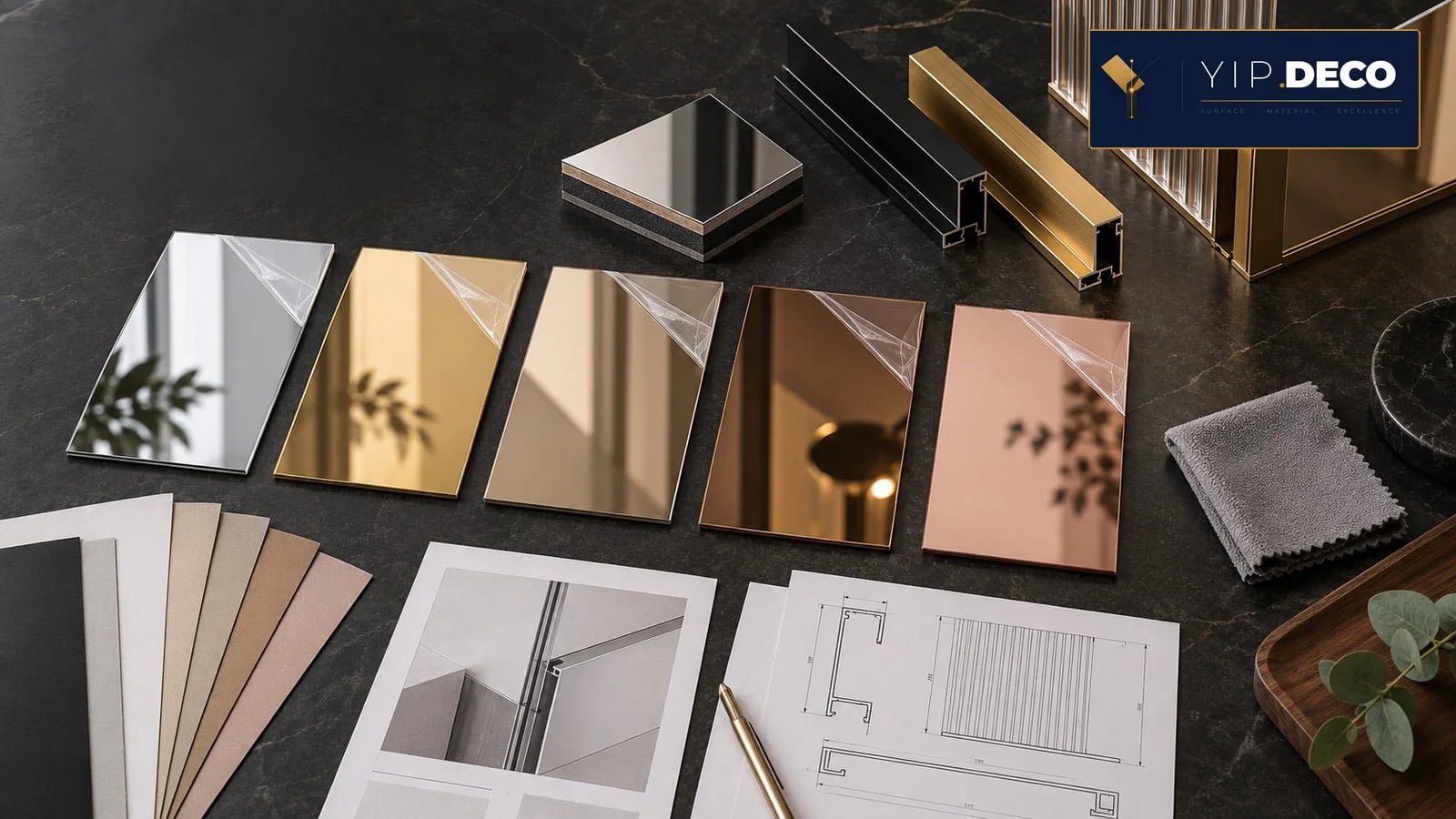
A project sample set should confirm mirror tint, backing, profiles, edge treatment and the drawing reference before bulk production.
Our Sample Kits route can be used to organize the mirror finish with matching wall and profile references before a bulk decision.
What Buyers Should Send With an Inquiry
The quality of the first quotation depends on the quality of the project information.
Send:
- project country and application;
- interior location and whether it is vertical, curved or overhead;
- decorative-reflection or precision-viewing requirement;
- preferred mirror color;
- approximate panel size and total quantity;
- sheet-only or finished-panel requirement;
- proposed backing material;
- wall or frame substrate;
- visible edge and joint requirements;
- drawings or marked-up elevations;
- fire, safety, VOC or other document requirements;
- expected installation method;
- sample or mock-up requirement;
- target delivery stage.
This information lets the supplier identify early whether acrylic mirror, glass mirror or a mixed-material solution fits the project.
Explore Our Range
| Project requirement | YipDeco path | Why it matters |
|---|---|---|
| Decorative reflective wall areas | Acrylic Mirror Panel | Review mirror colors, sheet or finished-panel direction and project use |
| Coordinated wall materials | Wall Solution | Plan reflective surfaces with the complete wall package |
| Corners, joints and decorative profiles | Mouldings & Grille | Coordinate feature sections, edge details and texture |
| Connection and LED details | Wall Connection Accessories | Match panel thickness, joining method and lighting profiles |
| Cabinet and furniture coordination | Surface Foil | Continue the finish from wall to cabinet surfaces |
| Physical approval before bulk order | Sample Kits | Check color, reflection, profile and joint together |
Frequently Asked Questions
Is acrylic mirror as clear as glass mirror?
It can provide a strong decorative reflection, but glass is usually the reference for the most stable close-range image. Acrylic mirror quality depends heavily on thickness, size, backing flatness and installation. Approve a representative sample for the actual viewing condition.
Why does an acrylic mirror sometimes look wavy?
The flexible sheet can follow irregularities in the wall, backing or adhesive layer. Local fastener pressure can also create dimples. A smooth rigid backing, suitable thickness and controlled fixing method reduce the risk.
Can acrylic mirror be installed directly on a wall?
It may be possible on a rigid, clean, dry and sufficiently flat base using a compatible system. Large decorative areas often benefit from a prepared backing or finished-panel construction. Test the adhesive and mounting method before full installation.
Can acrylic mirror panels be used in bathrooms?
Do not assume suitability from the mirror face alone. Humidity, temperature change, edge sealing, backing, adhesive and local glazing requirements must be checked. Glass often remains the more familiar choice for vanity and shower-related applications.
Can acrylic mirror be used on ceilings?
Only with an installation system designed for overhead use. An edge-engaging frame or mechanical retention is normally required; an unverified adhesive-only approach is not enough.
Is acrylic mirror fire-rated?
Acrylic is a thermoplastic. Any fire claim must identify the exact sheet or finished construction, test method, thickness, substrate and adhesive. Ask for a report that matches the ordered system and target market.
Should I order mirror sheets or finished mirror panels?
Choose sheets when you have a qualified fabricator and a verified backing and installation system. Choose finished panels when you want the supplier to coordinate the mirror face with a rigid substrate, size, edge and adjoining wall components.
Final Recommendation
Choose glass mirror when precise close-range reflection, familiar cleaning and high scratch resistance lead the specification. Consider acrylic mirror panels when the project is primarily decorative and values colored finishes, custom-cut elements, easier handling or integration with a coordinated wall system.
Whichever direction you choose, approve the actual construction rather than a catalog image. Check the panel at the intended size and viewing distance, confirm the backing and fixing method, review the maintenance routine and match every project document to the installed system.
> Request an acrylic mirror panel sample and project review from YipDeco.