Sourcing decorative wall panels internationally puts a lot of pressure on the pre-inquiry stage. If you ask the wrong questions, or ask them in the wrong order, you can lock yourself into a supplier relationship based on misunderstood MOQs, unrealistic lead times, or compliance assumptions that do not hold up in your target market. This SPC wall panel FAQ for importers is built from the supplier side of that conversation.
For importers, the most important questions before ordering SPC and decorative wall panels are not only "price" and "MOQ." You should confirm the application environment, stock or custom color strategy, sample kit, production approval process, certificates by market, shipping term, trims and accessories, and the exact information required for a formal quotation.
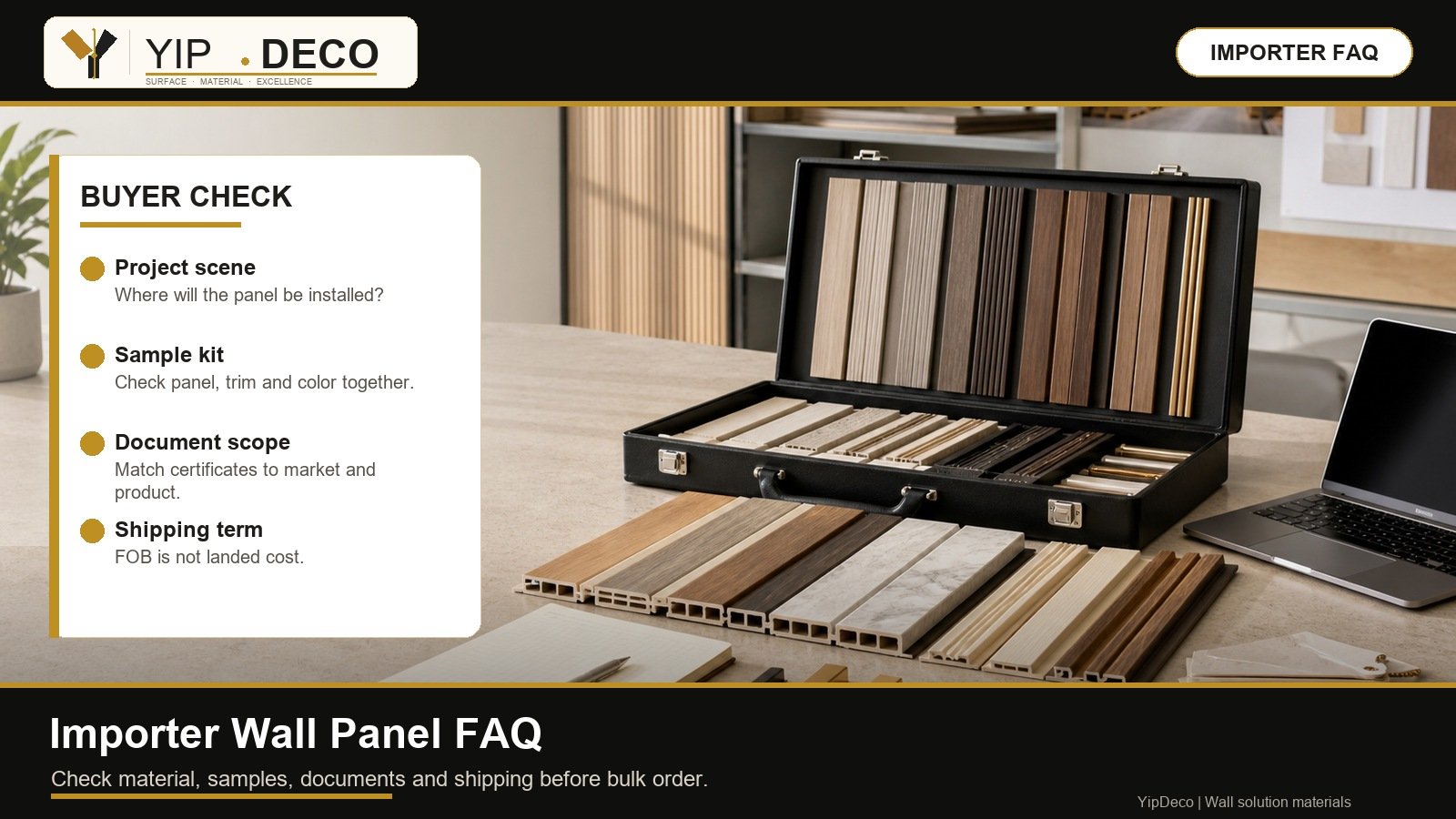
Getting these fundamentals right before you send a single message to a supplier saves weeks of back-and-forth. It also helps the supplier judge whether your request is a sample trial, distributor stock order, hotel or commercial project, private-label development, or repeat-order program.
From our experience handling wall-panel inquiries, many problems do not start after production. They start when the buyer uses the wrong mental model: treating MOQ as a fixed gate, treating sample speed as production speed, treating FOB as a complete landed price, or treating flooring certificates as wall-panel proof.
This FAQ replaces those models with questions that match how wall panel sourcing actually works.
Quick Answer: What Should Importers Confirm Before Sending an Inquiry?
Most importers lose time in the first round of supplier communication because they treat the inquiry like a product search. It is not. It is a project qualification step.
Before sending an inquiry for SPC or decorative wall panels, confirm your target market, application environment, product type, color requirement, order volume, sample needs, certificate requirements, shipping term, and whether trims or wall connection accessories must match the panels.
| Checklist Item | Why It Matters | What to Send the Supplier |
|---|---|---|
| Target market | Certificates and labeling may differ by country | Country or region of sale |
| Application | Wet area, lobby, corridor, retail, office and home use require different risk checks | Room type and installation area |
| Product type | SPC wall panel, PVC wall panel, grille, moulding and accessory systems are not the same | Product category and photos if available |
| Color requirement | Stock colors and custom colors have different MOQ logic | Stock color code or custom reference |
| Estimated quantity | MOQ is affected by color count, SKU count and container plan | Square meters, pieces or container estimate |
| Accessories | Trims, profiles, skirting and corners may have separate MOQ | Accessory list or drawing |
| Compliance | Documents must match product and market | Required certificate names and usage |
| Shipping term | FOB, CIF and DDP change the cost comparison | Preferred Incoterm and port |
| Sample plan | Physical samples reduce mismatch risk | Sample type and delivery country |
Wall Solution orders should be treated as a system. The panel, surface, profile, trim, sample, certificate and packing plan should be checked together, not as separate afterthoughts.
FAQ 1: What Is the Difference Between SPC Wall Panels and Decorative PVC Wall Panels?
This is one of the most common early inquiry problems. Buyers who already know SPC flooring sometimes assume SPC wall panels are the same product category. They are not.
SPC wall panels use a rigid stone-polymer composite core and are commonly selected for humid, wet-area, hospitality and project wall applications where dimensional stability and moisture resistance are important. Decorative PVC wall panels use PVC-based rigid, hollow, foam or co-extruded structures depending on the product family. They are widely used for dry commercial interiors, feature walls, corridors, retail, offices, hospitals, schools and residential wall decoration.
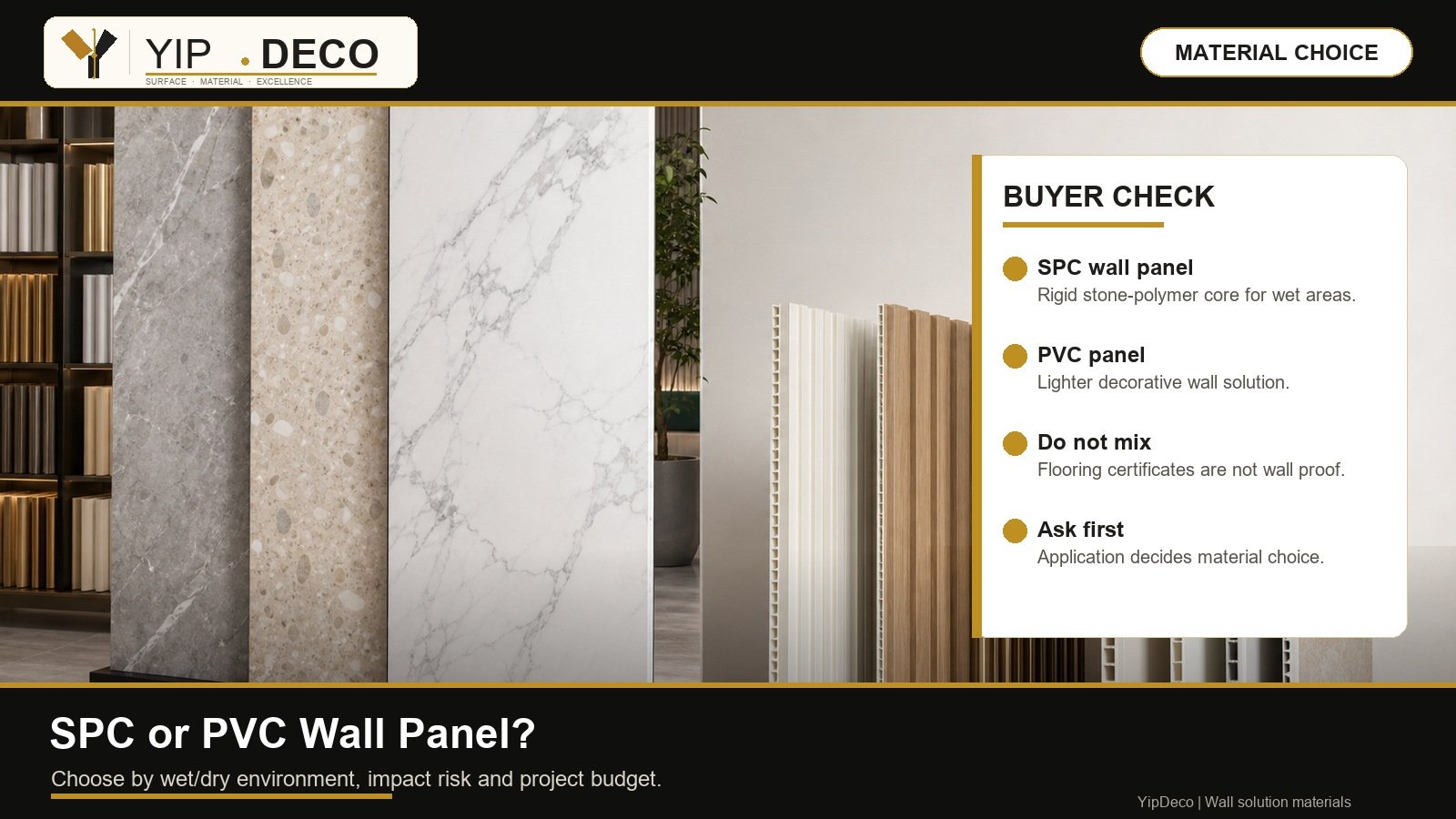
The buyer's first decision should be application environment, not material name.
Use SPC Wall Panels when the project includes bathroom walls, shower surrounds, humid rooms, hotel bathroom renovation, or tile-replacement scenes where the wall system must tolerate moisture better than ordinary decorative panels.
Use PVC Wall Panels when the project is a dry decorative wall, corridor protection wall, retail display wall, office feature wall, school or hospital corridor, or a value-driven commercial interior where easy installation, finish variety and cost control are the main requirements.
| Decision Point | SPC Wall Panels | Decorative PVC Wall Panels |
|---|---|---|
| Typical project logic | Moisture-heavy or wet-area wall system | Dry decorative or impact-resistant interior wall |
| Buyer concern | Water resistance, substrate, sealing, trims | Surface finish, impact, easy cleaning, cost control |
| Style demand | Marble, terrazzo, stone, grid, wood, wet-area looks | Marble, wood, carbon crystal, grille, anti-collision, solid colors |
| Accessory need | Corner, joint, edge and sealing details | Trims, skirting, corner profiles, grille and moulding matching |
| Common mistake | Treating SPC wall panels like SPC flooring | Using PVC in areas where water exposure is too high |
The point is not that SPC is always better. It is that SPC and PVC solve different wall problems.
FAQ 2: Why Shouldn't Buyers Use Flooring Standards to Judge Wall Panels?
Flooring and wall panels face different use conditions. A floor needs walking resistance, slip resistance, rolling load performance and floor installation standards. A wall panel needs vertical fixing, fire behavior, surface cleanability, dimensional stability, edge protection and compatibility with trims or connectors.
When an importer asks whether SPC wall panels have a flooring certificate, the supplier first has to clarify the application. A FloorScore or floor-covering certificate does not automatically prove that a wall panel is suitable for a wall project. The buyer should ask for documents that match the product category and target market.
For example, the U.S. EPA explains that TSCA Title VI formaldehyde rules apply to regulated composite wood products such as hardwood plywood, MDF and particleboard. That does not mean every plastic or SPC wall panel uses the same document logic. The buyer must identify the product structure first, then request the correct document set.
For EU-oriented projects, REACH and RoHS questions should also be product and market specific. The European Commission describes REACH as a chemicals regulation that places responsibility on industry to manage chemical risks and provide safety information. That is a useful compliance reference, but the actual document request still depends on material type, export market and product use.
Practical rule: ask "which documents apply to this wall panel for my target market?" rather than "do you have all certificates?"
FAQ 3: How Should Buyers Understand MOQ for Stock Colors, Custom Colors and Mixed Orders?
When importers ask "what is your MOQ?" they usually expect one number. In real sourcing, MOQ is a structure.
MOQ can change according to product category, stock color availability, custom film development, color count, SKU count, surface finish, accessory requirement, packing method and whether the order is a sample order, trial order, project order or distributor stock order.
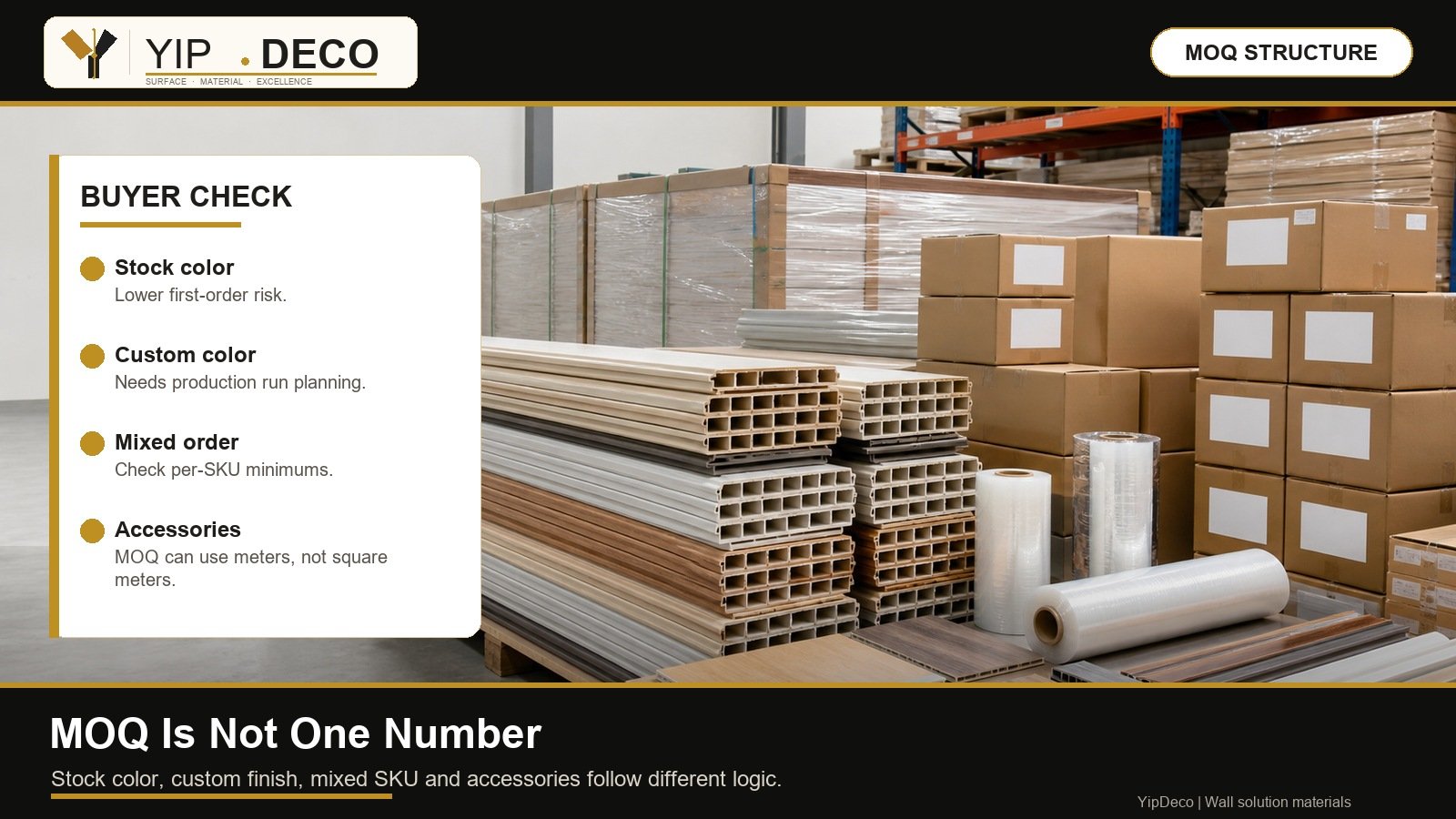
From the supplier side, we usually need to ask:
- Is this a single-color bulk order or a mixed-color trial order?
- Are you selecting from stock colors or requesting a custom match?
- Is the order for one project, distributor inventory, or showroom display?
- Do you need panels only, or panels plus trims, grilles and accessories?
- Are the accessories color-matched or standard aluminum finishes?
| Order Type | MOQ Logic | Buyer Risk If Ignored |
|---|---|---|
| Stock color wall panels | Usually more flexible because materials are already available | Buyer may overpay for custom development when stock color works |
| Custom color panels | Requires color matching, film or surface preparation and production setup | Buyer may underestimate development time and minimum volume |
| Mixed color order | Can be limited by per-color or per-SKU minimums | Buyer may plan too many colors for one first shipment |
| Sample kit | Separate from production MOQ | Buyer may confuse sample availability with bulk readiness |
| Accessories | Often calculated by meters, pieces or model | Buyer may receive panels but lack matching finishing parts |
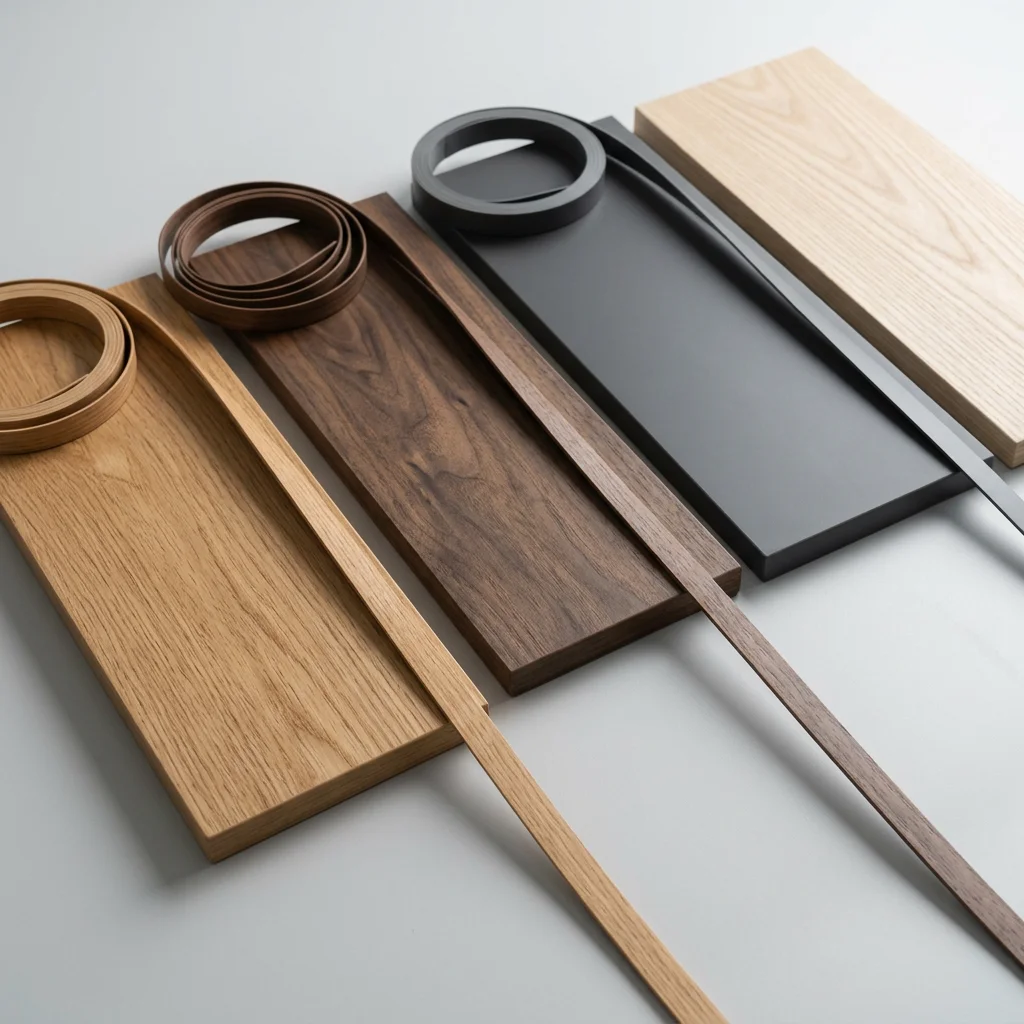
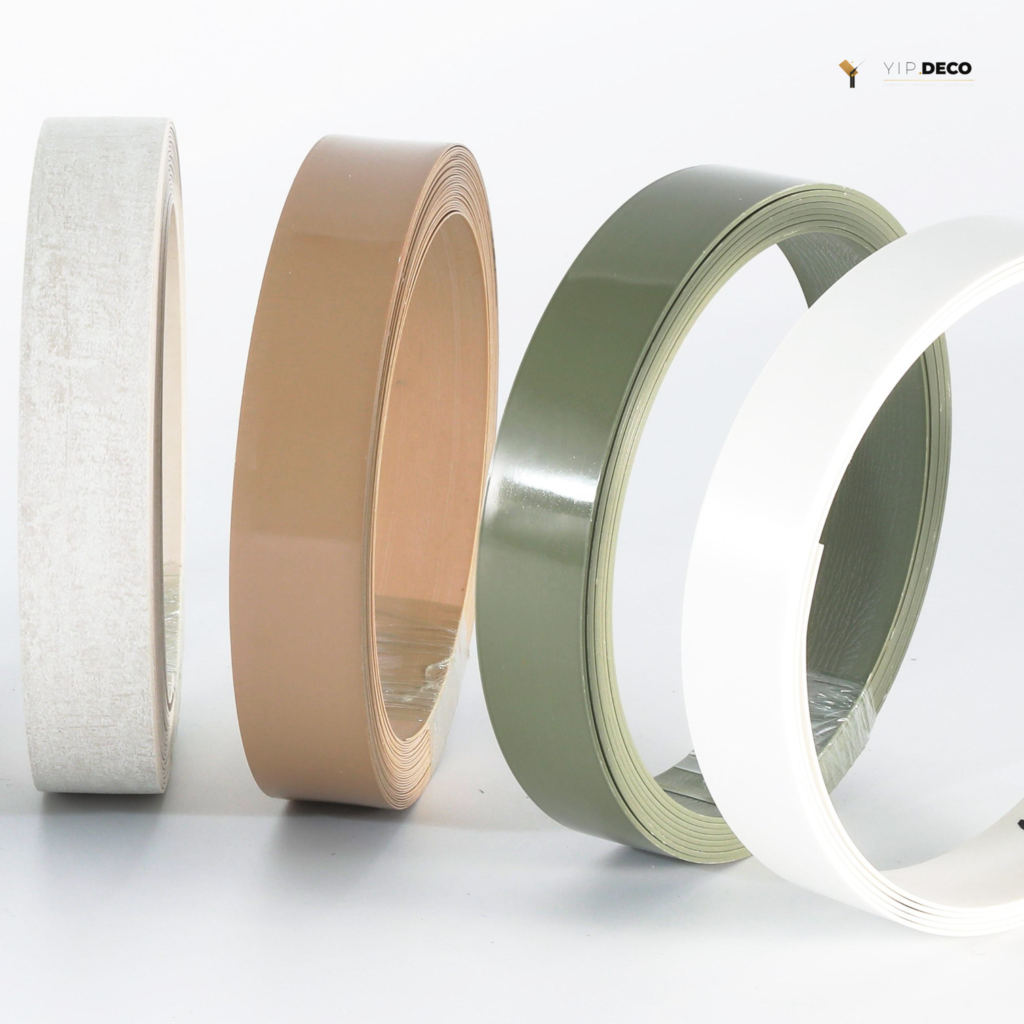
| Edge banding or cabinet support materials | Different unit from wall panels | Buyer may mix square-meter logic with meter-roll logic |
For YipDeco, one advantage of a wall-led product system is that the buyer can discuss the panel, moulding, grille, accessory and color matching plan together. That does not remove MOQ logic, but it makes the order easier to structure.
FAQ 4: What Sample Kit Should an Importer Request Before Bulk Order?
Digital images are not enough for wall-panel purchasing. Color, gloss, texture depth, core structure, edge finish and accessory compatibility need physical confirmation.
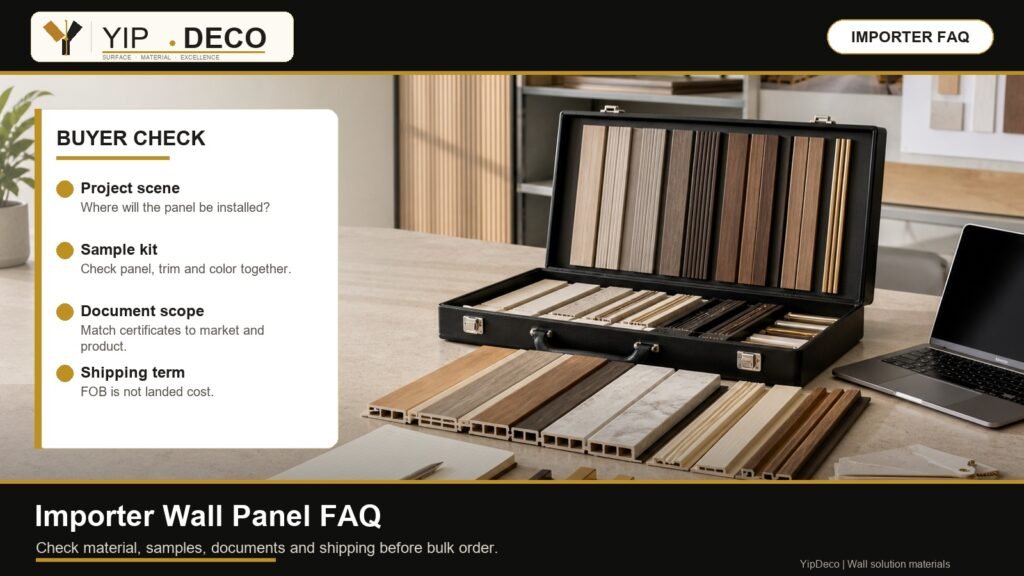
Before placing a bulk order, importers should request a sample kit that reflects the real purchase decision, not just a small decorative swatch.
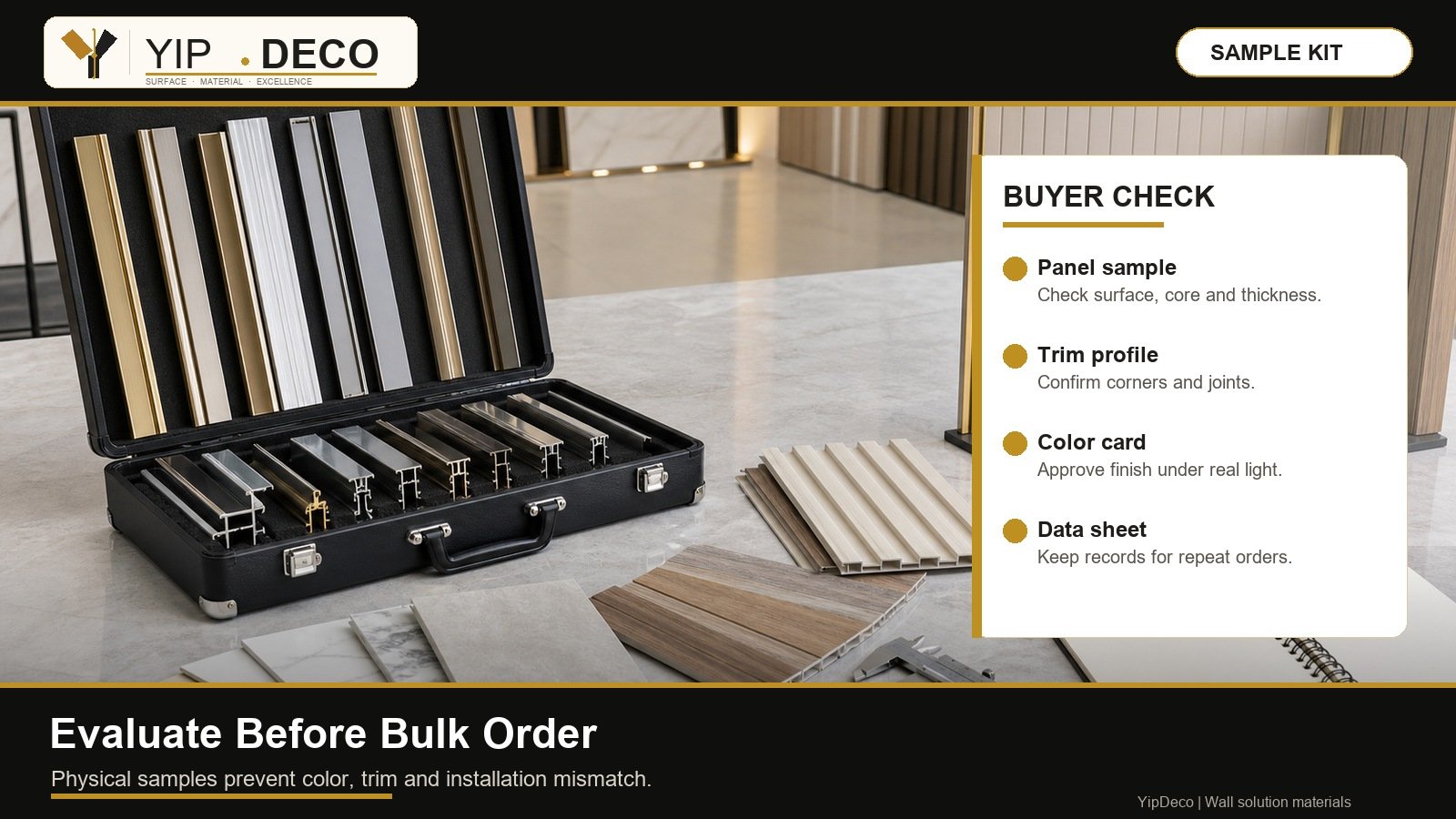
A useful sample kit should include:
- Main panel samples in the target product family.
- At least one color or surface finish close to the project requirement.
- Cross-section samples to check core structure and thickness.
- Trim and profile samples if the project uses corners, joints, skirting, LED details or wall-ceiling transitions.
- Color card or physical reference for stock color selection.
- If the project includes cabinets or furniture, matching edge banding or surface foil swatches.
- Product data sheet and available document list.
For color-sensitive projects, the most important step is not only receiving a sample. It is confirming that the approved sample can be repeated in bulk production. This is where batch control matters.
If a hotel, apartment, office or retail chain project needs the same finish across multiple areas, the buyer should request a production color confirmation before mass production. This helps avoid the common problem where the showroom sample looks good but the later batch shifts in tone, gloss or grain direction.
YipDeco's Sample Kits page should be used as the inquiry entry for buyers who need physical confirmation before bulk order.
FAQ 5: How Should Lead Time Be Planned from Sample to Bulk Shipment?
Sample lead time and production lead time are different clocks. Many project delays start because the buyer sees a fast sample arrangement and assumes bulk production can move at the same speed.
Sample preparation is small and flexible. Bulk production requires color approval, raw material planning, production scheduling, QC, packing, export handling and loading.
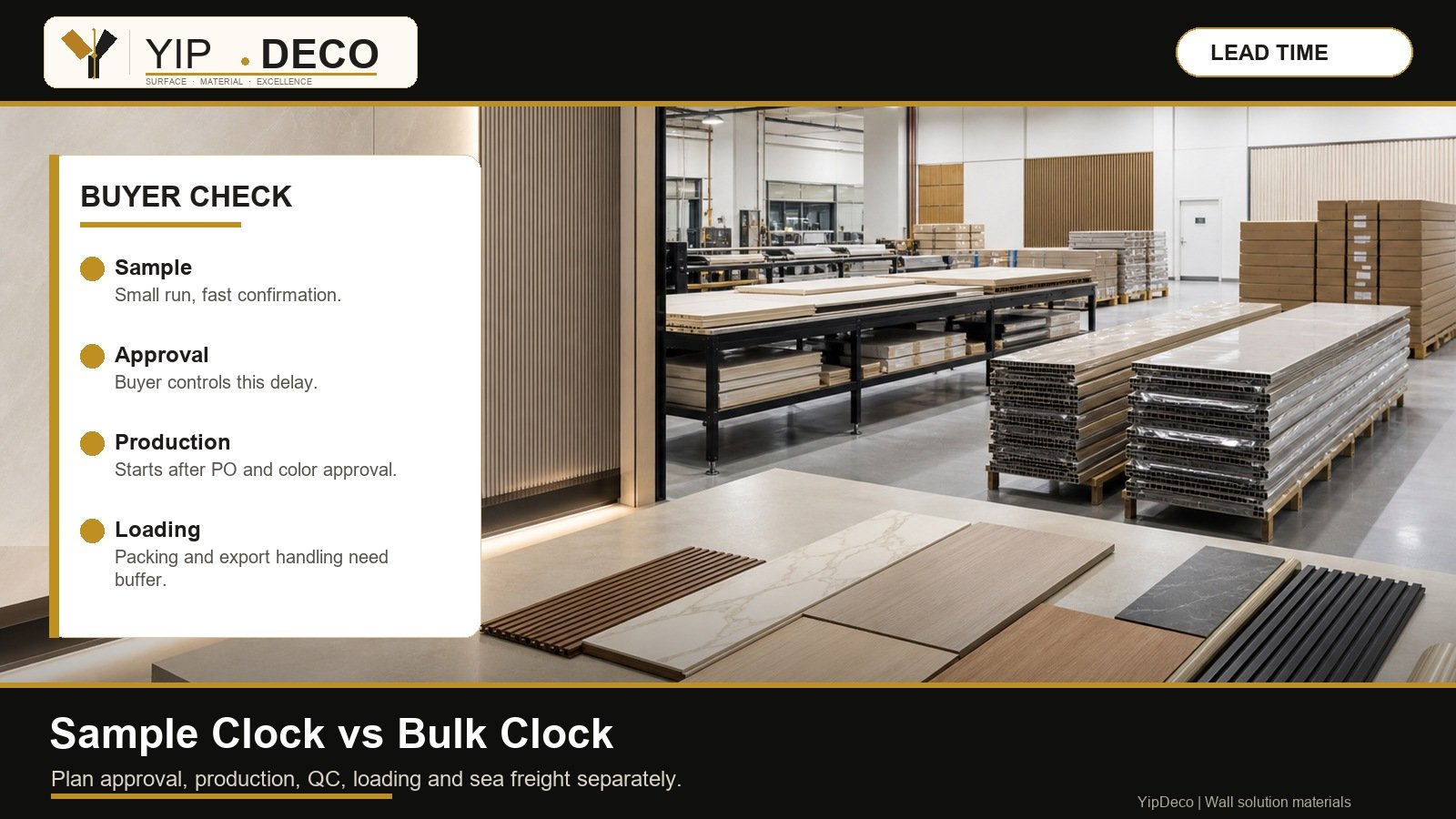
| Stage | What Must Be Confirmed | Who Controls the Delay Risk |
|---|---|---|
| Sample request | Product type, color, address, courier method | Buyer and supplier |
| Sample evaluation | Color, texture, core, accessory fit, installation method | Buyer |
| Quotation | Quantity, SKU count, packing, shipping term, document request | Buyer and supplier |
| Production approval | PO, deposit, final color, final accessory list | Buyer |
| Production | Material preparation, line scheduling, QC | Supplier |
| Packing and loading | Carton, pallet, container plan, export documents | Supplier and freight forwarder |
| Sea freight and arrival | Vessel schedule, port, customs, inland transport | Forwarder and buyer |
For standard products, a supplier may be able to arrange samples quickly. For custom finishes, unusual accessories, mixed containers or project-specific documentation, the timeline needs more buffer.
The practical advice is simple: build sample approval into the project schedule. Do not wait until the contractor is ready to install before confirming color, trim and document requirements.
FAQ 6: Which Certificates and Documents Should Be Confirmed by Market and Product?
Certificate questions should be handled carefully. The buyer's market, product material and application decide the document logic.
Do not ask only, "what certificates do you have?" Ask, "for this specific product, used in this specific market, which documents can be provided and which require confirmation before production?"
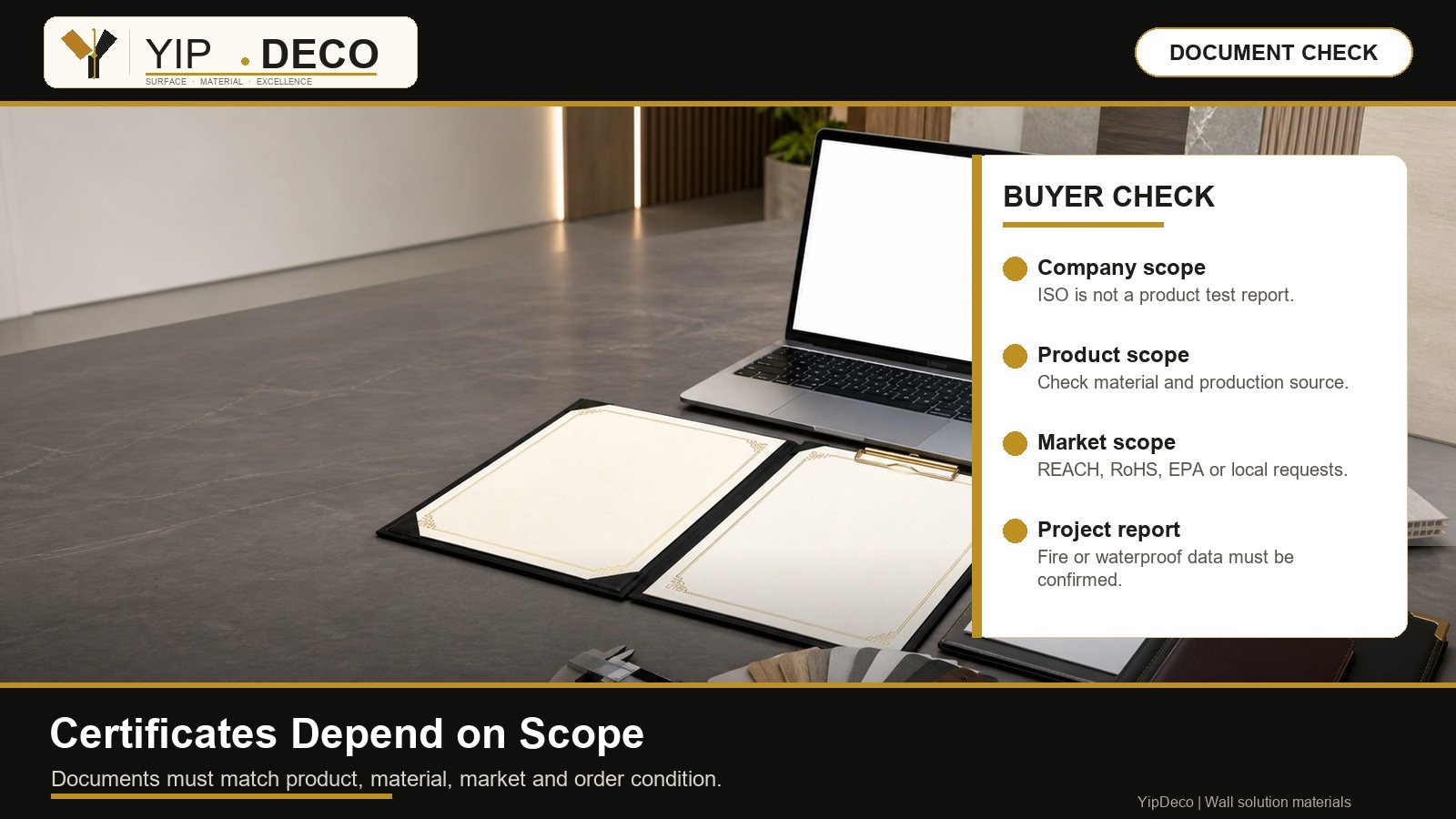
YipDeco's public document logic should be understood this way:
- Held, for applicable products and company scope: ENF for applicable PVC-based wall products, CARB P2 for applicable wood-based cabinet products, ISO 9001, ISO 14001 and ISO 45001.
- Available per order where applicable: EPA TSCA VI, FSC, REACH, RoHS and SGS.
- Product-specific performance reports, such as fire performance, waterproof, flame-retardant or scratch-resistance, must be confirmed by product, production base and target market before they are used in a project submission.
This matters because a certificate is not a marketing label. It is a document tied to a material, test method, product scope, production source, batch or standard. A document that is valid for a wood-based cabinet panel may not apply to an SPC wall panel. A flooring certificate may not apply to a wall panel. A company management certificate does not replace a product test report.
For North America, buyers often ask about EPA TSCA VI and CARB P2 because composite wood products are regulated. For Europe, REACH and RoHS are common chemical-safety and restricted-substance questions. For Middle East hotel and commercial projects, fire performance and project documentation may become important. For Southeast Asia, moisture resistance, value, packing and local installation practicality may be more important than a long certificate list.
The correct supplier response should be precise: "This document applies to this material and this order condition," not "we have all certificates."
FAQ 7: What Should Buyers Know About FOB, Shipping and Landed Cost?
FOB is not the final cost of your goods at your warehouse. FOB is a shipping term that usually means the seller delivers goods on board the vessel at the named port, while later freight, insurance, destination charges, customs duties and inland delivery may be outside the seller's FOB quotation.
That distinction is important for first-time importers. Two suppliers can quote similar FOB prices, but the final landed cost may differ because of carton size, loading efficiency, pallet plan, container utilization, destination port charges, customs tariff classification and inland transport.
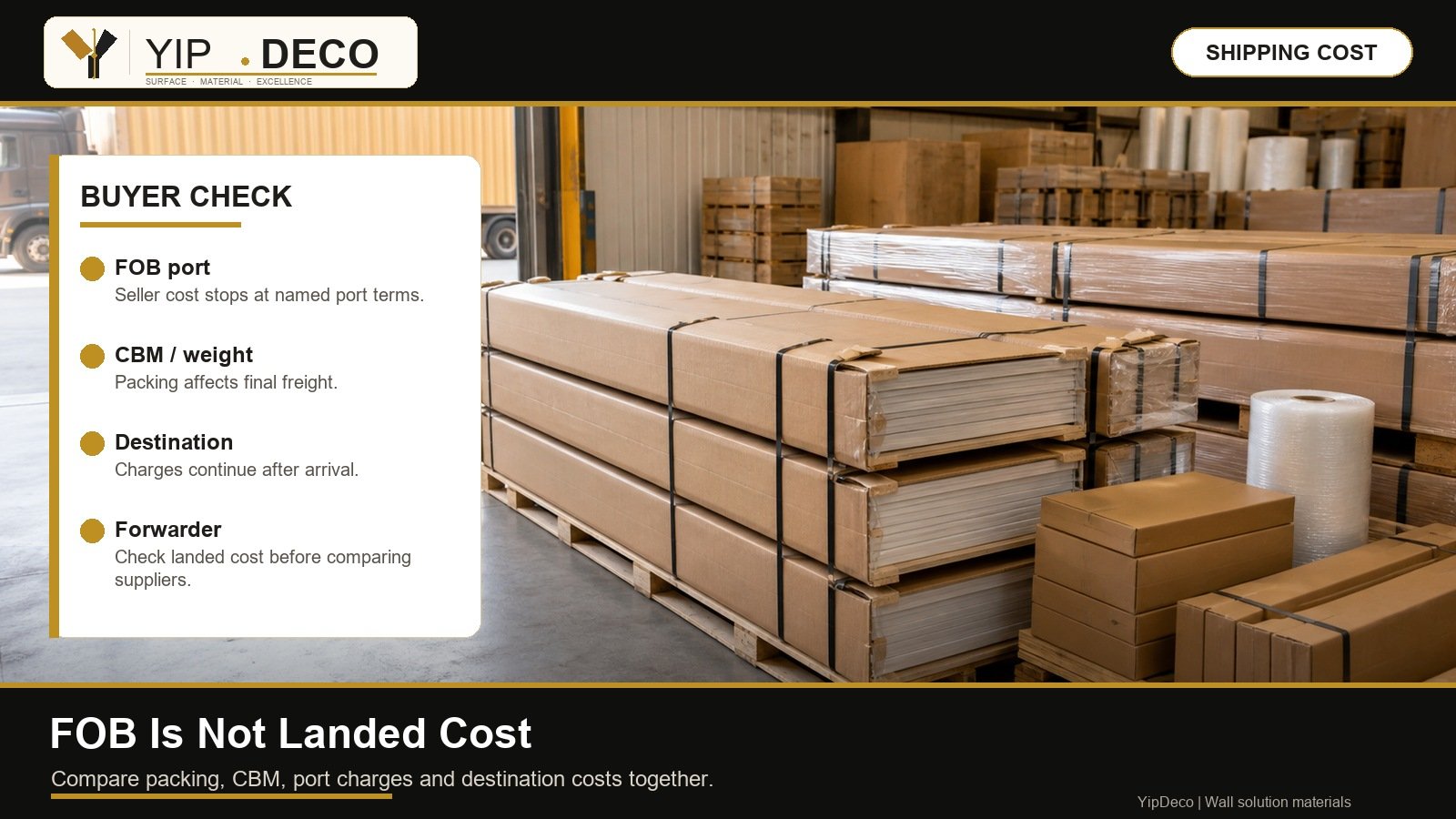
Before comparing supplier prices, ask:
- Is the quotation FOB, CIF, EXW or another Incoterm?
- Which port is used?
- Are cartons, pallets and export packing included?
- What is the estimated CBM and gross weight?
- Can the supplier provide packing list and HS-code guidance?
- Has the buyer checked destination charges with the forwarder?
- Does the order require mixed loading with accessories?
For wall panels, packing is not a small detail. Long panels, hollow-core profiles, decorative surfaces and matching trims can be damaged if packing is not planned correctly. A low FOB price can become expensive if goods arrive with crushed corners, scratched surfaces or missing accessories.
FAQ 8: Why Do Trims, Profiles and Accessories Need to Be Confirmed With the Panel?
A wall panel project is not complete when the main board is selected. The project needs a finish system.
Corners, joints, exposed edges, skirting, light strips, door openings, wall-ceiling transitions and end caps decide whether the installation looks professional. They also decide whether the installer can finish the project quickly.
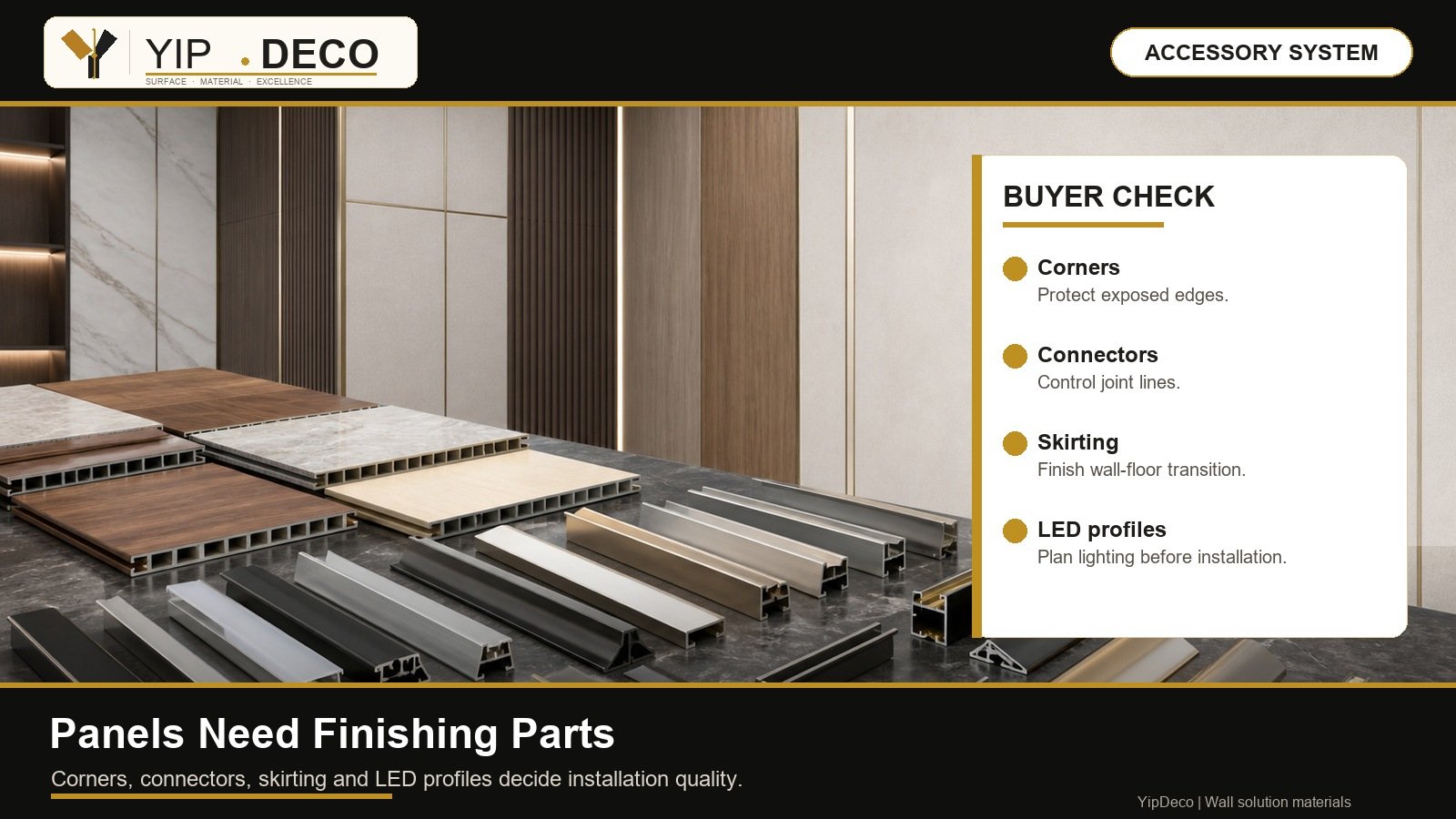
YipDeco's Mouldings & Grille and Wall Connection Accessories categories should be treated as part of the wall solution, not separate optional decoration.
For example:
- A hotel corridor may need anti-collision panels, skirting and corner protection.
- A lobby feature wall may need marble-look SPC panels plus metal trims and LED profiles.
- A retail wall may need grille panels, shadow gaps and same-color connectors.
- A bathroom renovation may need SPC panels with sealed corners and waterproof edge details.
- A distributor sample program may need small sections of profiles so local installers understand how the system fits.
If accessories are confirmed after the panel order, the buyer risks color mismatch, missing trim models, separate shipping cost or installation delays. Confirm the accessory list before the purchase order.
FAQ 9: What Details Should Be Included in the First Serious Inquiry?
A strong first inquiry does not need to be long, but it should be complete enough for the supplier to answer accurately.
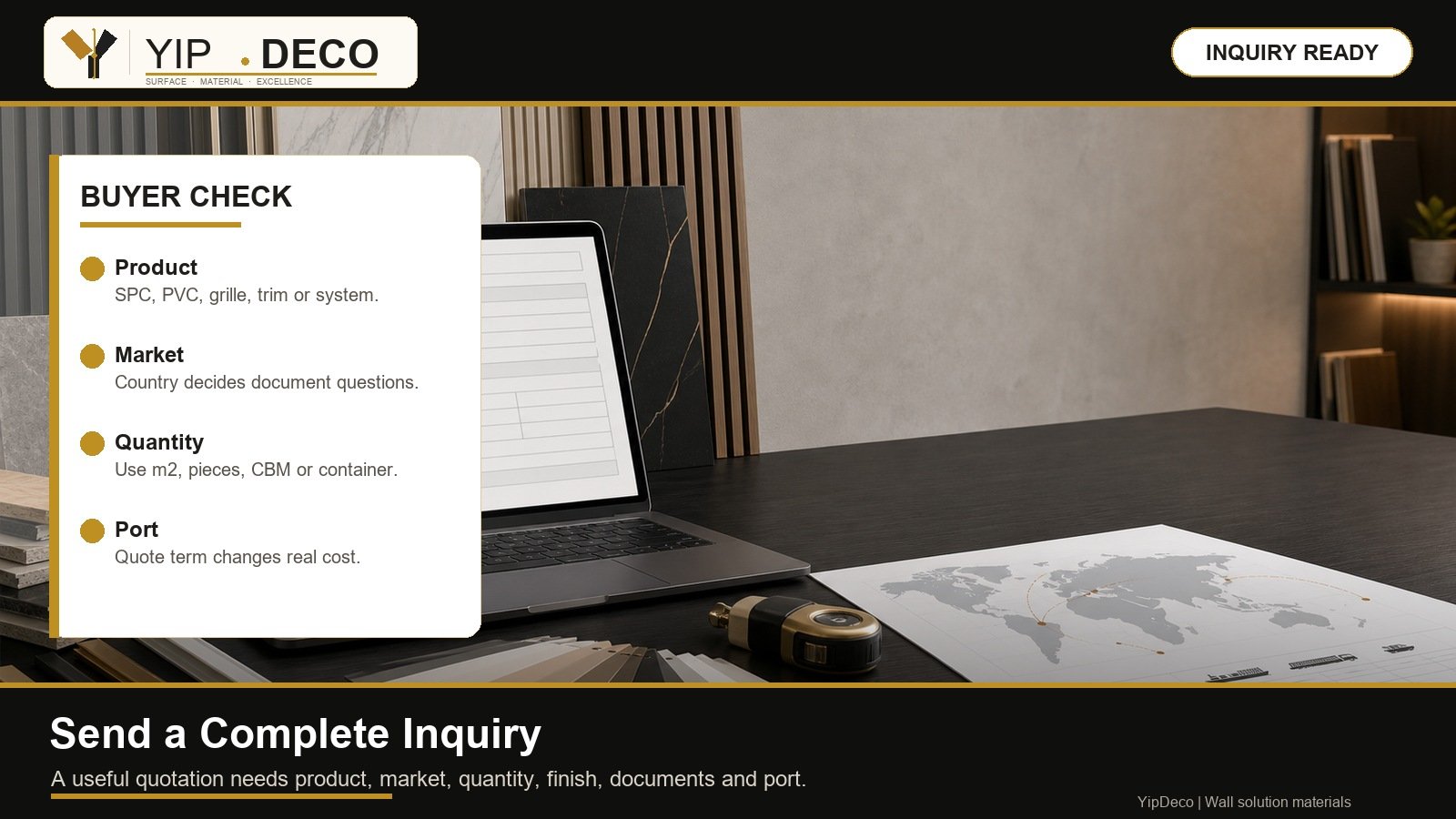
Send these details:
| Inquiry Detail | Example |
|---|---|
| Product category | SPC wall panels, PVC flat panels, grille panels, trims |
| Application | Hotel bathroom, lobby feature wall, corridor, retail, office |
| Target market | UAE, Saudi Arabia, Germany, United States, Philippines |
| Quantity | 500 m2 trial order, one 20GP, one hotel project |
| Color or finish | Marble white, oak wood grain, matte beige, custom sample match |
| Accessories | Corner trim, T-trim, skirting, LED profile, grille moulding |
| Sample need | Physical sample kit, color card, profile sample case |
| Certificate request | REACH, RoHS, SGS, EPA TSCA VI, project fire report if applicable |
| Shipping term | FOB Guangzhou/Shenzhen, CIF destination port, forwarder pickup |
| Timeline | Sample deadline, project installation date, desired shipment month |
The more precise the inquiry, the more useful the supplier's answer will be. A vague message such as "send price for wall panel" usually leads to a vague quotation. A structured inquiry lets the supplier recommend the right product family, explain MOQ properly, and avoid quoting a material that does not fit the project.
FAQ 10: How Can Importers Reduce Repeat-Order and Batch-Matching Risk?
Repeat-order risk is easy to underestimate. The first shipment may look good, but six months later the distributor needs the same color again. If there is no color code, sample record, batch reference or approved physical sample, the reorder may not match.
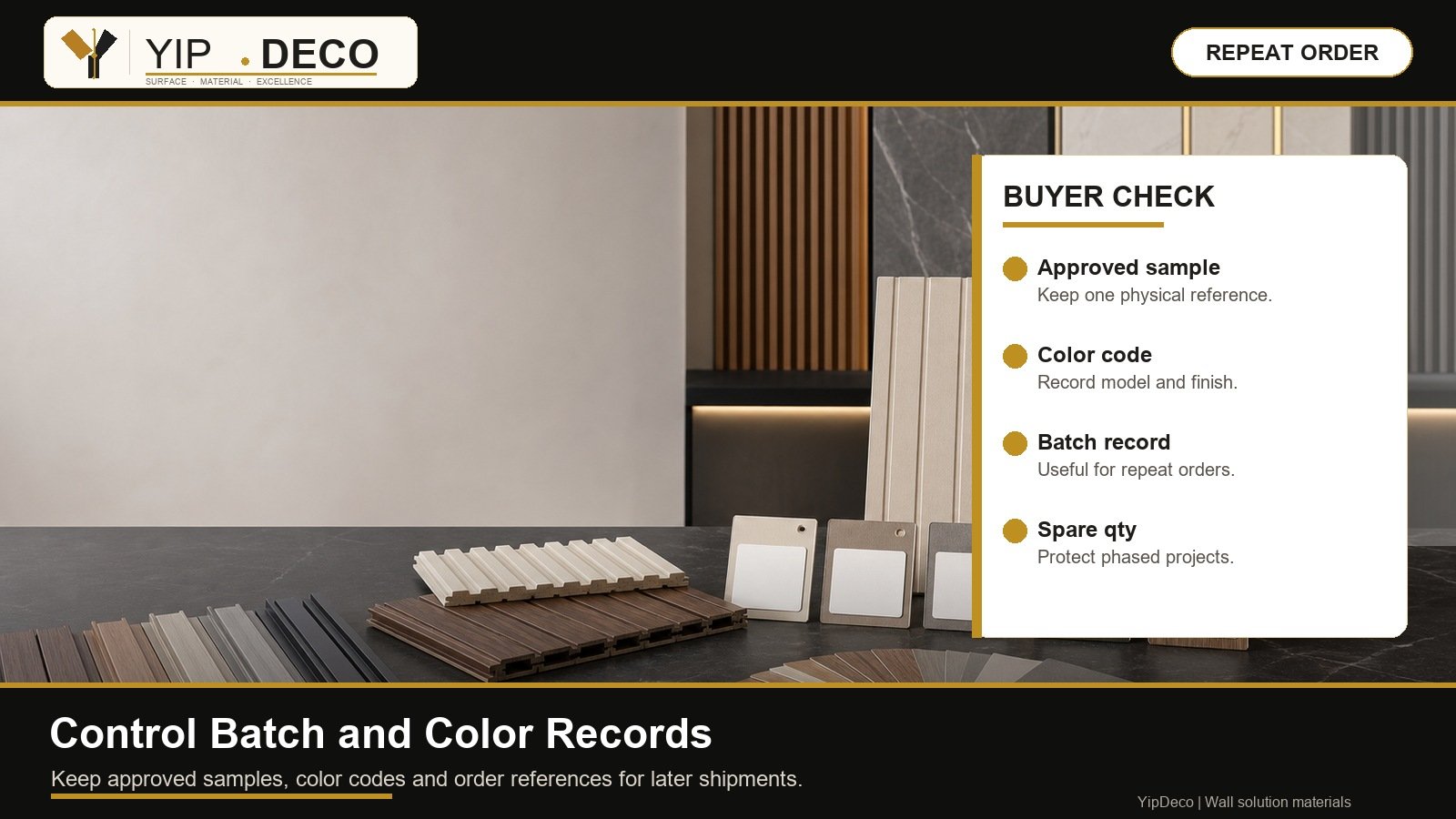
For wall panels, batch matching is especially important when the panels cover large visible areas. Slight differences in marble grain, wood tone, gloss or surface texture can be obvious when new material is installed beside old material.
To reduce repeat-order risk:
- Keep one approved physical sample from the first order.
- Record the color code, model, thickness and surface finish.
- Keep the production batch or order reference.
- Confirm whether the same film or surface material is still available.
- For large projects, order a reasonable spare quantity.
- For phased projects, tell the supplier before production so batch planning can be considered.
This is where a one-color-library approach helps. If the buyer needs wall panels, profiles, cabinet panels, surface foil or edge banding to coordinate across one project, the supplier should manage color continuity from the beginning.
Explore Our Range
Use the article as a planning checklist, then choose the relevant YipDeco category for the next step.
| Need | Recommended Page | Why It Helps |
|---|---|---|
| Complete wall material planning | Wall Solution | Start from panel system, not one isolated board |
| Wet-area or hotel project panels | SPC Wall Panels | Compare SPC options for bathrooms, humid rooms and project walls |
| Dry commercial decorative walls | PVC Wall Panels | Review PVC flat panels, carbon crystal board and anti-collision options |
| Feature walls and decorative profiles | Mouldings & Grille | Select grille, fluted, curved and moulding profiles |
| Corners, joints and finishing parts | Wall Connection Accessories | Confirm trims, connectors, skirting and edge details |
| Physical sample confirmation | Sample Kits | Check color, texture, profile and installation fit before bulk order |
| Formal quotation or project review | Contact YipDeco | Send product, quantity, market, document and timeline requirements |
Final Recommendation
For importers, the safest way to evaluate SPC and decorative wall panels is to move from project conditions to product selection, then from sample confirmation to order structure.
Do not start with only price. Start with the wall environment, product family, color requirement, accessories, documents and shipping term. Then the supplier can answer MOQ, lead time and quotation questions with real meaning.
When you are ready to request a quotation, send YipDeco your target market, application scene, preferred product type, quantity estimate, color reference, accessory requirement, certificate request and delivery port. That gives our team enough information to recommend a practical wall-panel sourcing plan instead of a generic price list.
For physical evaluation before bulk order, start with a wall panel sample kit or send your project details through the contact page.