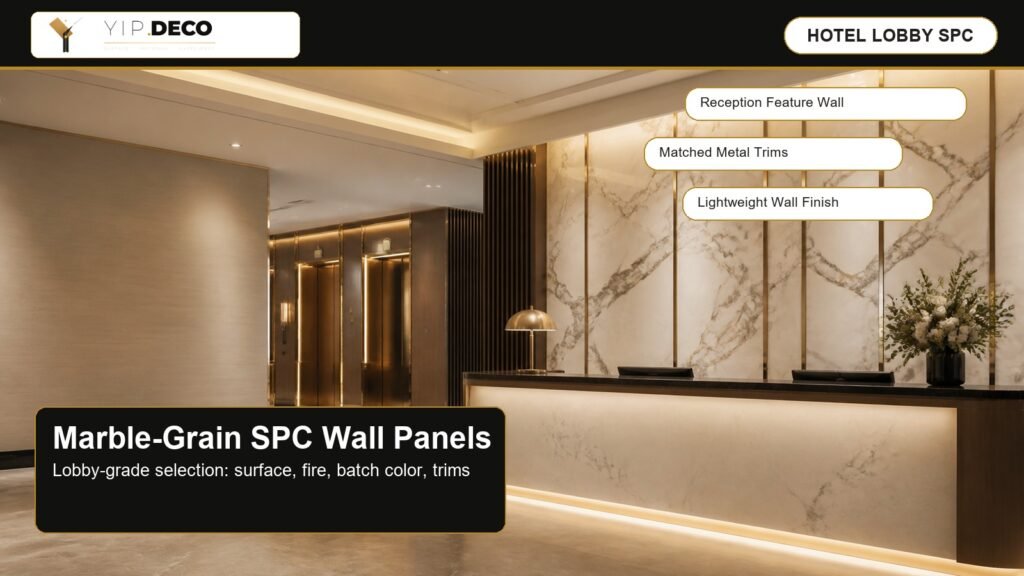
Specifying wall finishes for a hotel lobby is one of the highest-stakes decisions in a fit-out project. SPC wall panels for hotel lobbies are increasingly shortlisted — but the wrong product tier, a missed fire-rating requirement, or a single batch color shift across a 200 m² feature wall can turn a fast installation win into a costly remediation. The question is not whether SPC works. It is whether you are buying the right SPC for this specific application.
Marble-grain SPC wall panels are a viable lobby wall finish when the product is specified correctly: a rigid SPC core with documented surface hardness, UV-stable coating, matched trims, verified fire rating, and confirmed batch color control. They reduce structural load and installation time compared to natural stone, hold up against hotel cleaning chemicals, and deliver consistent marble visuals across large surfaces — provided the buyer validates surface durability, lot consistency, and accessory integration before committing to a full project order.
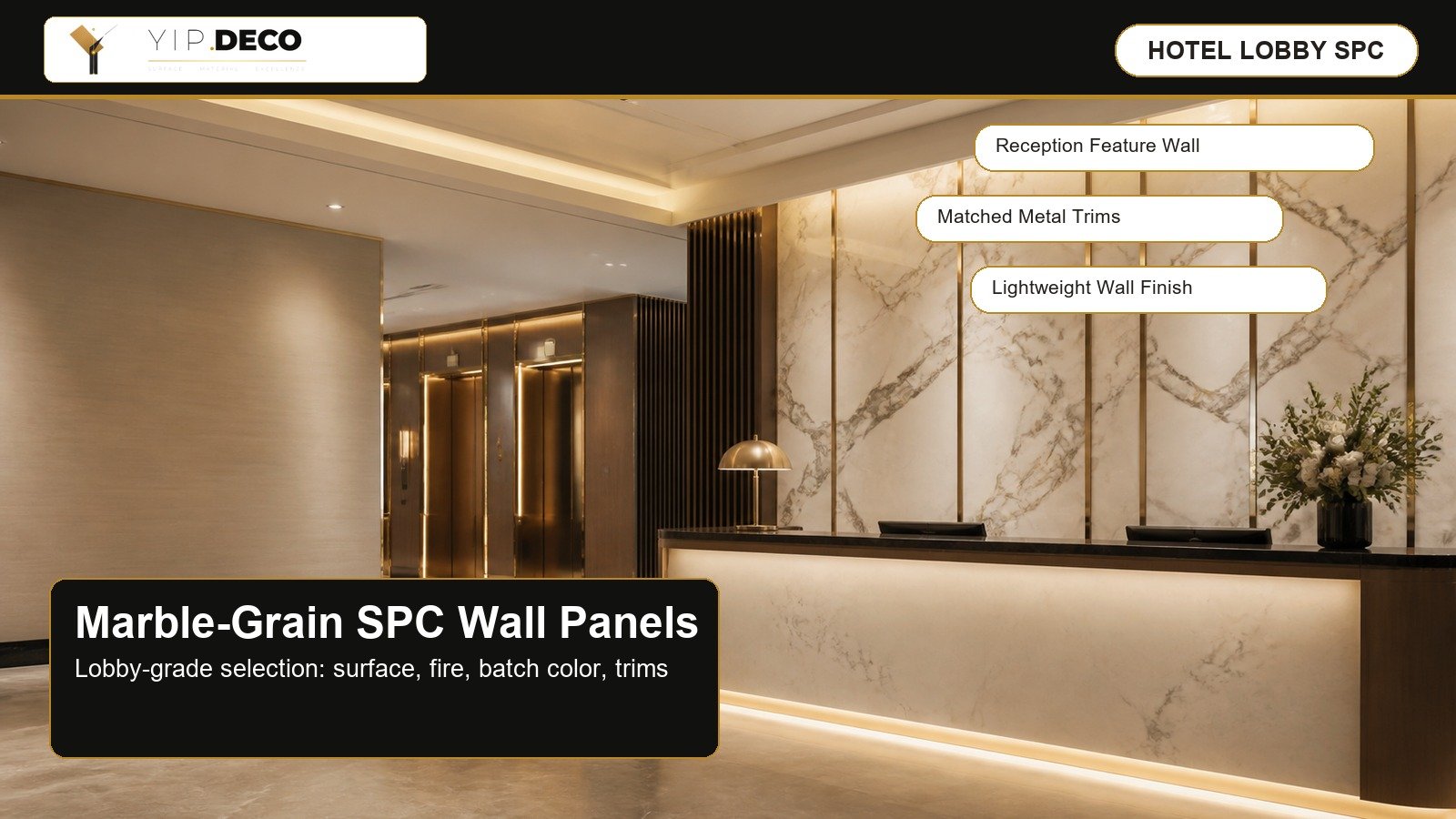
Understanding why SPC is gaining specification share in hotel lobbies requires more than a materials comparison. It requires understanding what actually fails in these environments — and at what stage of the project that failure becomes expensive. The sections below work through that logic in the order a procurement decision actually unfolds.
Why Hotel Lobbies Need a Different Wall-Panel Decision Framework
Most wall-panel buyers approach specification the same way regardless of application. Hotel lobbies do not forgive that approach.
A lobby wall faces a combination of stresses that few other interior surfaces share: foot-traffic abrasion near base zones, luggage and trolley impact at mid-height, chemical exposure from daily cleaning crews, HVAC-driven humidity cycling, and — most critically — visual scrutiny from guests who are forming their first impression of the property. A finish that performs well in a residential corridor or retail fitting room may show visible wear, color inconsistency, or joint failure within 12–18 months in a hotel lobby.
What makes lobby specification different from standard interior projects
- Traffic intensity: High-footfall lobby zones often receive constant contact from guests, luggage, service carts, and cleaning equipment.
- Cleaning frequency and chemistry: Hotel lobbies are cleaned frequently, sometimes with alkaline or disinfectant solutions that degrade surface coatings not designed for chemical resistance.
- Visual proximity: Guests stand within arm's reach of lobby walls waiting at reception or in seating areas. Surface imperfections, color shifts between panels, and visible joint lines are immediately noticeable at this distance.
- Regulatory environment: Many hotel projects — particularly in the Middle East, Southeast Asia, and North America — require documented fire performance for wall finishes in public circulation areas; in the EU, the Construction Products Regulation provides the framework for comparable product-performance information across markets (European Commission CPR). This is not optional, and the required standard varies by market and building classification.
- Reorder risk: A lobby renovation is not a one-time purchase. Damaged panels get replaced. New phases get added. If a supplier cannot match the original batch color on reorder, the wall tells that story visibly.
The decision framework for lobby wall panels should therefore start with durability tier, fire compliance, and batch color control — not with aesthetics or price per square meter.
SPC vs Natural Stone and Ceramic Tile for Lobby Walls
Buyers replacing natural stone or large-format tile with marble-grain SPC wall panels are making a substitution decision, not just a materials selection. The comparison deserves honesty on both sides.
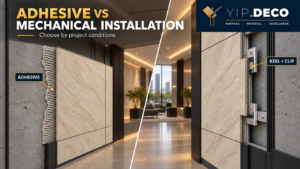
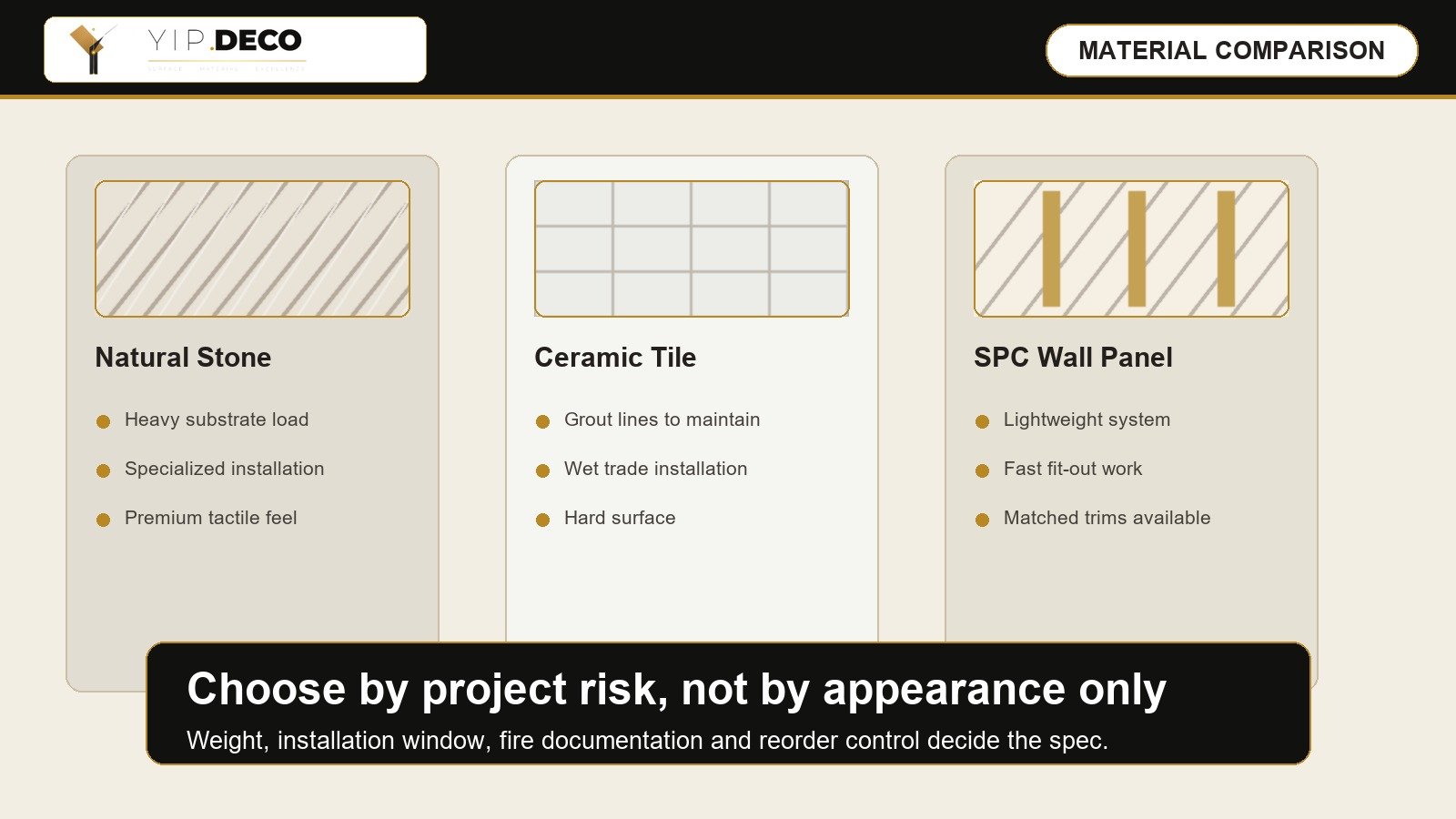
The primary reason hotel projects switch from natural stone to SPC is structural and logistical, not cosmetic. Natural stone slabs impose significant dead load on wall substrates, and OSHA's stone-slab handling guidance treats large slab movement and storage as a serious caught-by/crushed-by risk (OSHA). In renovation projects especially, this load can exceed what existing framing or adhesive systems can safely carry without structural reinforcement. SPC wall panels are much lighter than thick stone slabs, depending on the exact thickness and structure, and can be installed with mechanical clip systems or adhesive on prepared substrates far more quickly.
Practical comparison across the three main options
| Parameter | Natural Stone | Large-Format Ceramic Tile | Marble-Grain SPC Wall Panel |
|---|---|---|---|
| Weight per m² | Heavy, especially with thick slabs | Moderate to heavy depending on tile thickness | Much lighter depending on panel structure |
| Installation speed | Slow — substrate prep, mortar bed, curing | Moderate — adhesive, grouting, curing | Fast — clip/adhesive, dry installation |
| Substrate requirements | Structural reinforcement often needed | Solid, level substrate required | Prepared, flat substrate still required |
| Visual marble reproduction | Authentic — natural variation | Good — high-quality digital inkjet | Very good — digital print under UV coating |
| Tactile difference | Cool, heavy feel | Similar to stone | Slightly less dense feel |
| Water resistance | Varies by stone type; grout joints absorb moisture | Tile resists; grout joints are vulnerable | SPC core is water-resistant; joints need treatment |
| Maintenance | Sealing required; staining risk | Low maintenance; grout discolors over time | Low maintenance; wipe-clean surface |
| Fire performance | Non-combustible | Non-combustible | Requires verified B1 or local equivalent certification |
| Reorder consistency | Natural variation — exact match not guaranteed | Good with same production batch | Excellent with documented lot control |
| Cost relative to stone | Baseline | Lower | Significantly lower |
| Suitable for ultra-luxury lobby | Yes — preferred | Conditional | Conditional — tactile and resale perception gap exists |
Where SPC does not replace stone
I want to be direct about this: in ultra-luxury hotel segments where the tactile experience of natural stone is part of the brand proposition — think five-star properties where guests touch and lean against feature walls — SPC is not an equivalent substitute. The visual result can be very close. The feel under hand is different. For properties where that difference matters to the brand and guest experience, natural stone or engineered stone remains the correct specification.
For four-star, select-service, extended-stay, and renovation projects where installation speed, structural load, and maintenance cost are primary drivers, the substitution case is strong and well-established.
Where Marble-Grain SPC Wall Panels Make the Most Sense
Not every zone of a hotel lobby presents the same specification challenge. Matching the product to the zone is part of getting this right.
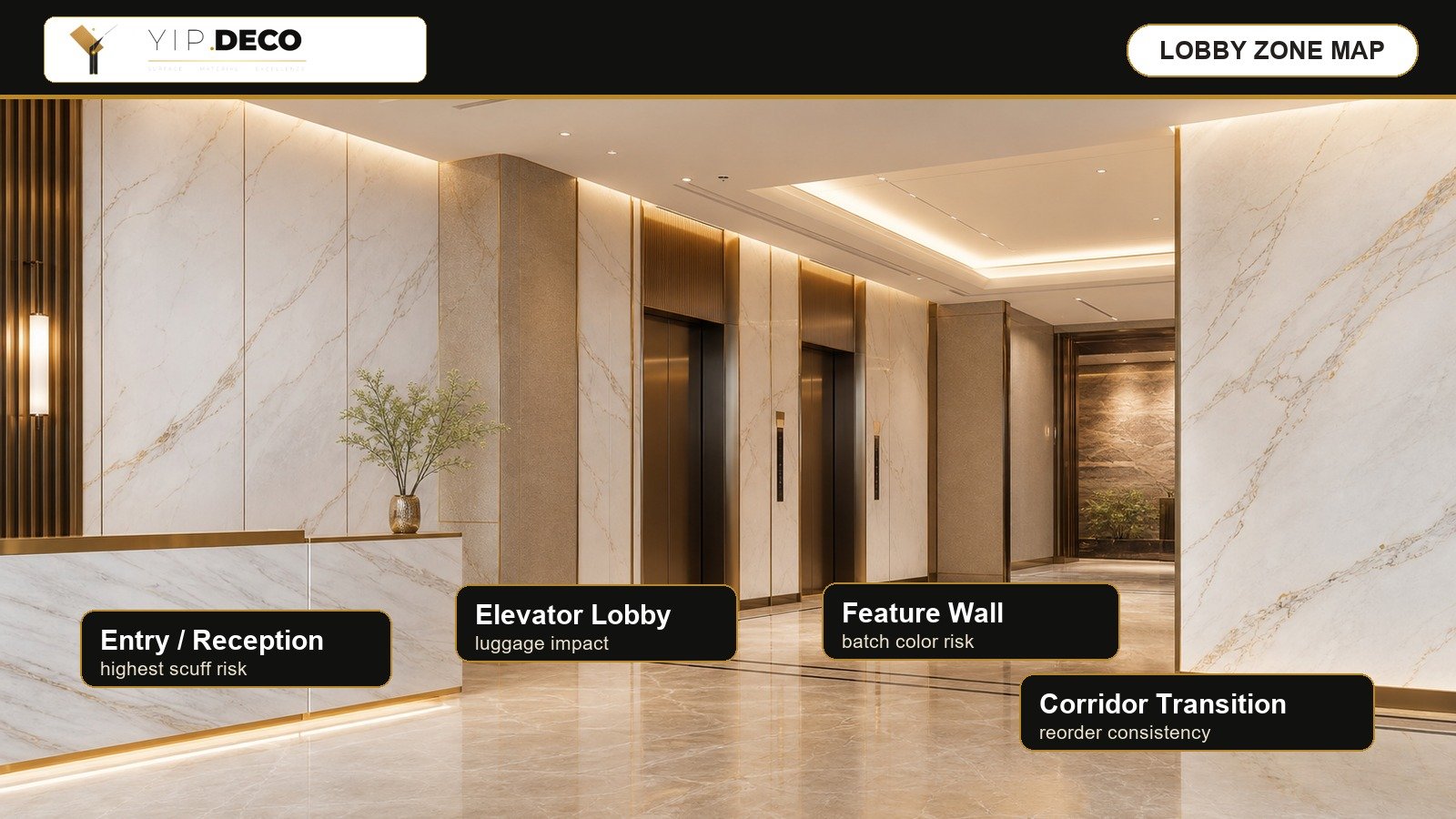
Marble-grain SPC wall panels perform best in lobby zones where the combination of visual impact, moisture exposure, and installation logistics favors a dry, lightweight system. Reception backwalls, elevator lobbies, corridor entry walls, and feature accent walls behind seating areas are the most common and most successful applications in projects I have seen specified at factory level.
Zone-by-zone application logic
Reception and check-in walls: High visual prominence, moderate impact risk, regular cleaning exposure. Marble-grain panels with gloss or satin finish perform well here. Surface hardness and chemical resistance are the priority specifications.
Elevator lobby walls: High impact risk from luggage and trolleys, moderate cleaning frequency. Specify panels with documented surface hardness (Pencil hardness 2H minimum as a starting point for inquiry; verify with supplier test data). Consider anti-collision panels at base zones. Explore our Wall Solution
Corridor-to-lobby transition walls: Often specified as part of a continuous design scheme. Batch color consistency becomes critical here because panels from the lobby and corridor sections are visually adjacent. A single production lot covering both zones eliminates the risk.
Feature accent walls and columns: Lower traffic impact, higher visual scrutiny. This is where marble-grain pattern quality and UV color stability matter most. Ask for UV resistance test data and a physical sample under hotel-equivalent lighting before approving.
Wet-adjacent zones (pool entry, spa lobby): SPC core handles humidity well. However, I would not specify standard marble-grain SPC wall panels as the primary finish in areas with direct water spray or standing water contact at the wall base without additional joint sealing and waterproof detailing at the perimeter. SPC is water-resistant, not waterproof in the immersion sense. Be precise about this with your project team.
What to Check Before Ordering: Surface, Fire Rating, Batch Color, Trims, and Samples
This is where most lobby project failures originate — not in the wrong product category, but in skipped verification steps before commitment to full-project quantities.
In specification conversations with hotel project buyers, I have seen the same gaps appear repeatedly: buyers who confirm aesthetics but miss fire documentation; buyers who approve a display sample and receive production panels with a visible gloss-level shift; buyers who specify panels without confirming matching trim profiles exist in the same color.
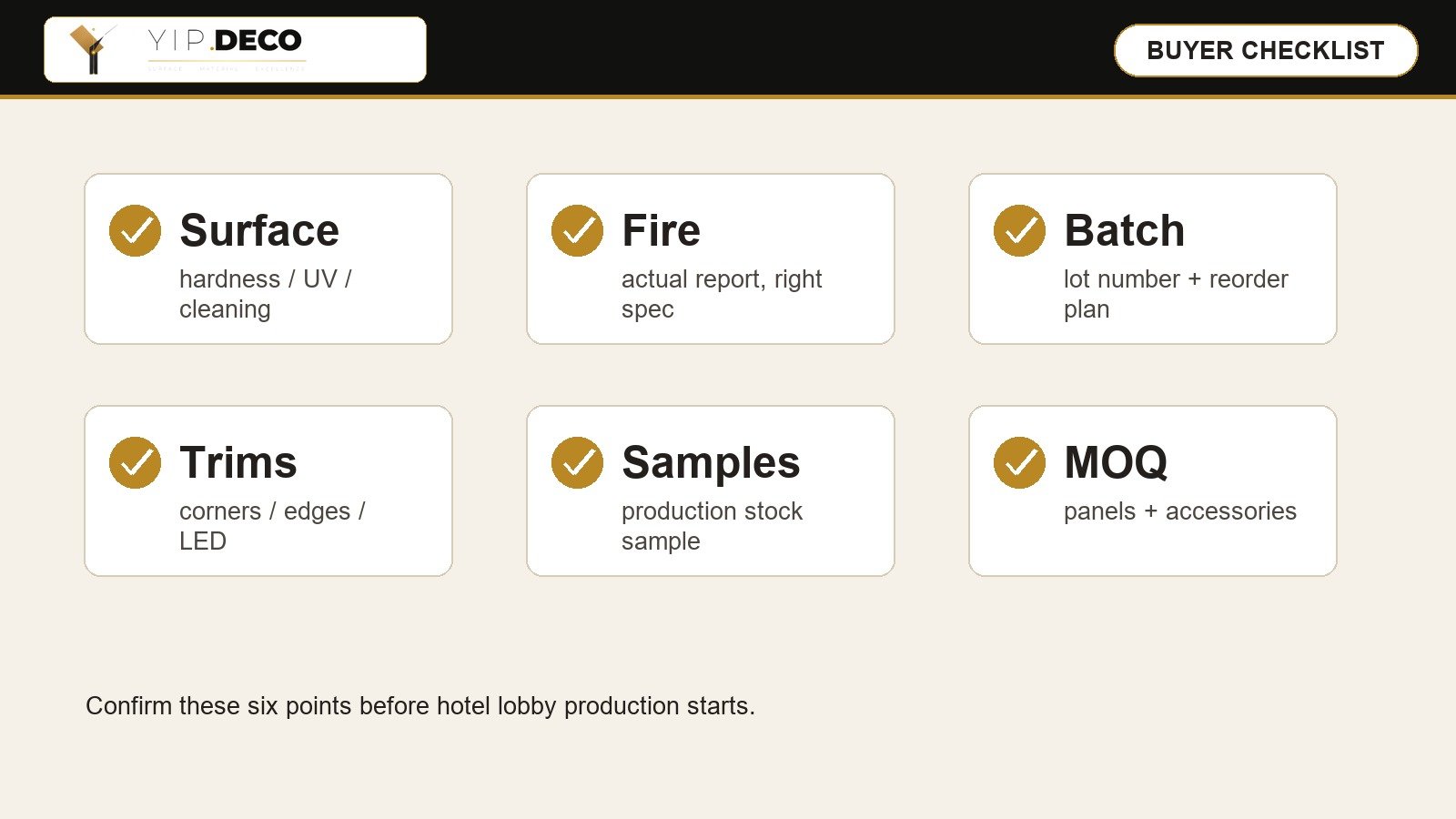
Pre-order verification checklist for lobby-grade marble-grain SPC wall panels
Surface performance
- Confirm surface hardness rating (pencil hardness or equivalent test method, not a verbal claim)
- Confirm UV stability — ask for test data or accelerated aging report, not just a specification sheet
- Confirm chemical resistance — particularly to alkaline cleaning agents used in hotel housekeeping
- Confirm gloss level consistency panel-to-panel within the same production lot
- Confirm scratch and scuff resistance for high-contact zones
Fire compliance
- Identify the fire rating standard required for your market and building classification (B1, Class B, ASTM E84, or equivalent)
- Request the actual test report, not just a certificate number — verify the test was conducted on the same product specification
- Confirm the rating applies to the complete panel assembly, not just the substrate
- Note that fire requirements vary by country, project type, and local authority — engage a qualified fire compliance consultant for your specific project
Batch color control
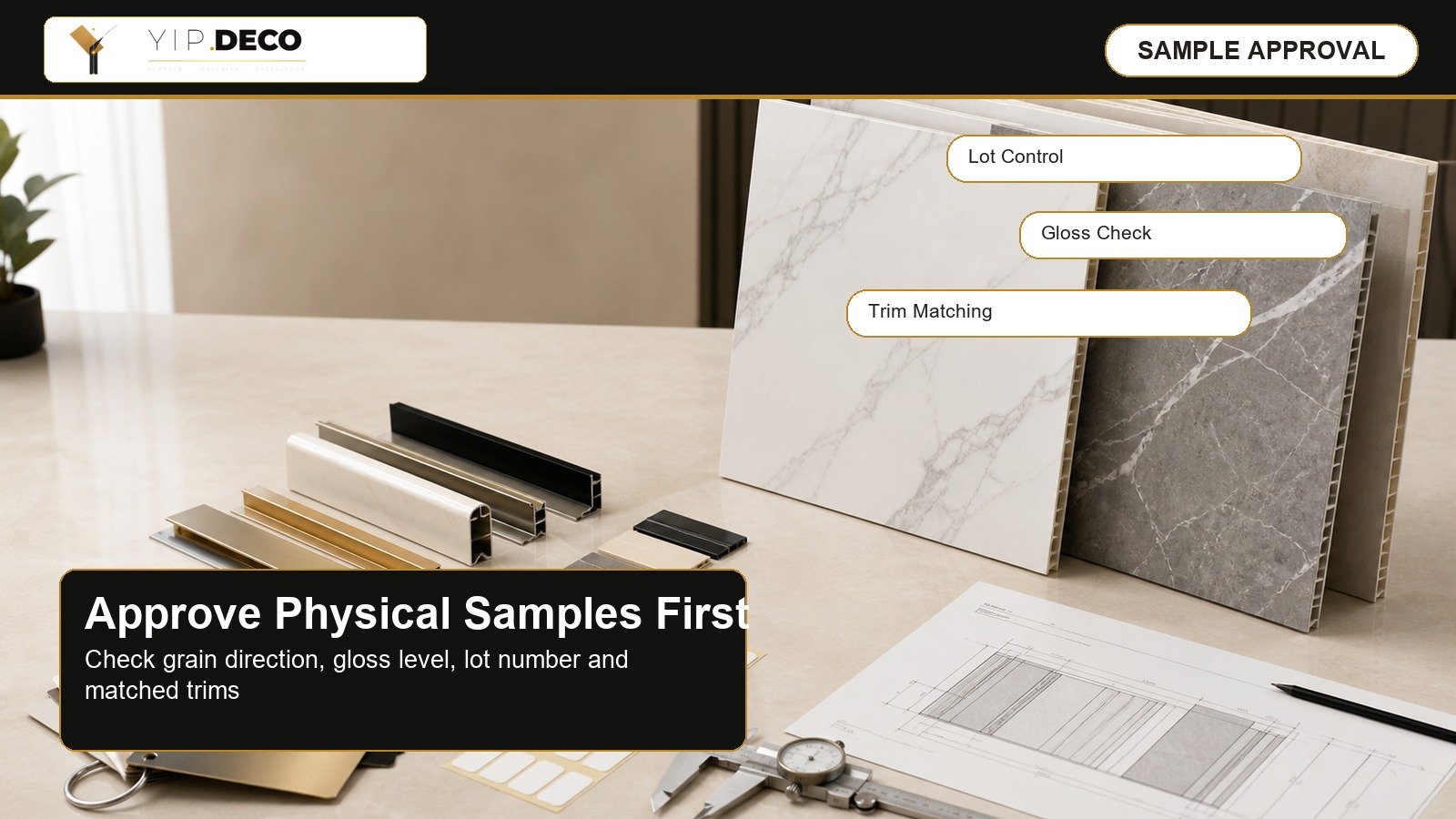
- Request a physical production sample (not a catalog card) from the same lot that will be used for production
- Confirm the supplier's lot-control process — how are panels from different production runs identified and separated?
- Confirm reorder availability and the process for matching color on future orders
- For marble-grain patterns specifically: review the repeat pattern length and how visible the repeat is at installation spacing
Trims, profiles, and accessories
- Confirm matching corner profiles, edge trims, and transition mouldings exist in the same color/finish
- Confirm connector and clip systems are compatible with your substrate and installation method
- Confirm LED profile options if the design includes illuminated features View Wall Connection Accessories
Sample approval and MOQ
- Request a custom sample in the exact finish and color before placing a production order
- Confirm MOQ for both panels and matching accessories — mismatched MOQs create supply gaps
- Confirm production lead time and whether stock is available for fast-start projects Request a Sample Kit
Why batch color matters more for marble grain than solid colors
Solid-color panels can tolerate small production variations because the eye reads the surface as a uniform field. For professional color control, Delta E is commonly used to quantify visible color difference across batches (Konica Minolta). Marble grain is a directional, high-contrast pattern. A visible shift in background tone or vein color between two adjacent panels on the same wall is immediately visible to a standing observer. I have seen this failure mode create significant remediation costs on projects where buyers approved a catalog image rather than a physical production sample.
The correction is straightforward: insist on a physical sample from production stock, confirm the lot number, and align that lot number with your production order.
How to Reduce Installation and Reorder Risk
Selecting the right panel is necessary but not sufficient. How the panels arrive, how they are installed, and what happens when you need additional material six months later all determine whether the lobby wall performs as specified over its service life.
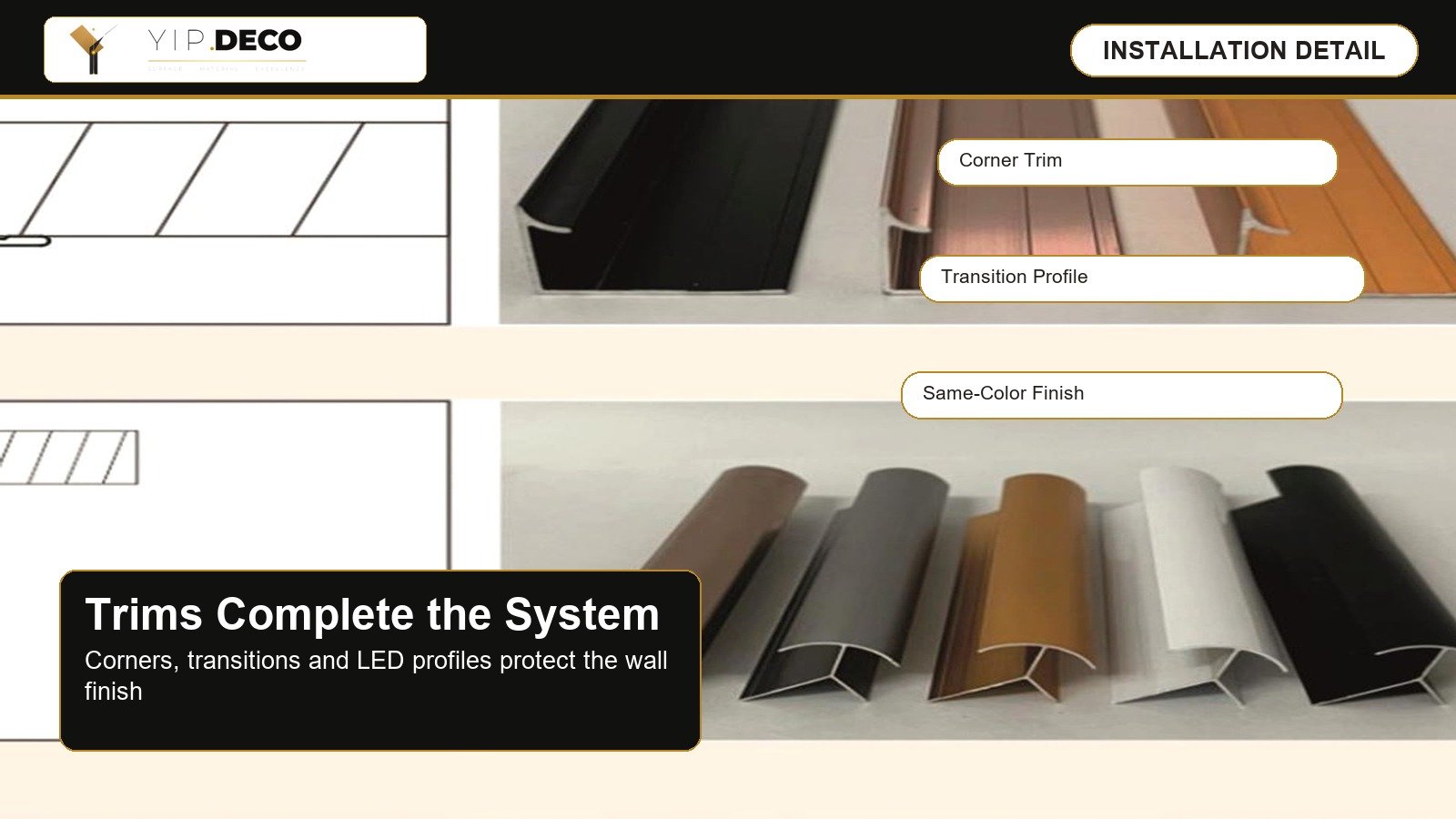
Installation risk factors specific to lobby-scale projects
Substrate flatness: SPC wall panels with mechanical clip installation are more tolerant of minor substrate variation than large-format tile, but significant unevenness will telegraph through rigid panels at graze-light angles. Specify acceptable flatness tolerances with your installer before panels arrive.
Temperature acclimation: SPC panels shipped to hot climates (Middle East, Southeast Asia) should be acclimated to site temperature before installation. Rigid panels installed cold and then exposed to ambient heat can show joint gaps or bow if not handled correctly.
Joint and perimeter sealing: The SPC core does not absorb water, but the joints between panels and the perimeter connection to floor and ceiling are potential moisture pathways in cleaning-exposed environments. Use compatible sealant at perimeter joints and confirm the clip or adhesive system does not leave exposed gaps at panel edges.
Coordinated accessories: A lobby wall specified without matching corner profiles and transition mouldings will require field-cut edges and improvised joints. These fail visually and structurally. Confirming that Wall Connection Accessories, Mouldings & Grille profiles, and edge trims are available in the same color library before ordering eliminates this risk entirely. Explore the full Wall Solution
Reorder risk management
Reorder risk is underestimated on first-fit lobby projects. Panels get damaged during construction, in transit, or during building fit-out by follow-on trades. A property may also expand or renovate adjacent areas after initial completion.
The most effective mitigation is straightforward:
- Order 5–10% overage on initial production — hold this as on-site stock.
- Document the production lot number on the delivery documentation and store it with the project file.
- Confirm reorder lead time and minimum quantity with the supplier before committing to the initial order. A supplier with documented lot control and stable product ranges can handle supplementary orders more reliably than a supplier who treats every marble pattern as a short-run design.
- Confirm whether the marble-grain pattern is a permanent range or a short-run design — proprietary or limited patterns carry higher discontinuation risk.
Frequently Asked Questions
Are SPC wall panels genuinely waterproof for hotel lobby use?
SPC wall panels are water-resistant, not waterproof in the immersion sense. The rigid SPC core does not absorb moisture, and the surface coating handles regular cleaning and humidity exposure well. However, prolonged water contact at unsealed joints or panel bases can cause issues. For hotel lobby use, they perform reliably when installed with proper perimeter sealing.
What fire rating should I specify for SPC wall panels in a hotel lobby?
Fire rating requirements vary significantly by market, building classification, and local authority. Many hotel projects in Europe and the Middle East require B1, Class B, ASTM E84, or local-equivalent wall finishes in public circulation areas. In North America, ASTM E84 Class A or B may apply. Always verify the specific requirement for your project with a qualified fire compliance consultant and request the actual test report — not just a certificate — from your supplier.
How do I verify that marble-grain SPC wall panels will match across a large lobby wall?
Request a physical production sample — not a catalog card or digital image — from the same production lot that will be used for your order. Confirm the lot number, review the marble pattern repeat, and check gloss consistency across the sample under the lighting conditions of the installation environment. For large lobby orders, ask the supplier about their lot-control process and reorder matching capability.
Can SPC wall panels be installed directly over existing tile or plaster in a renovation?
In many renovation projects, yes — this is one of the installation advantages of lightweight SPC wall panels. The substrate must be structurally sound, reasonably flat, and free of loose material. Verify the specific installation method (clip system or adhesive) and substrate requirements with your supplier and installer before committing. Do not assume compatibility without confirmation.
What is the typical lead time for a custom marble-grain SPC wall panel order?
Lead time depends on whether the finish is stocked, whether matched trims are required, and whether the order is a sample set, trial order, or container-scale project. Confirm sample timing, production slot, packaging schedule, and stock availability with your supplier at the quotation stage — not after sample approval.
Explore Our Range
YipDeco's SPC Wall Panels are produced in 246 stocked wall colors across 8 series, including marble-grain options coordinated with matching profiles, corner trims, and edge banding. The complete Wall Solution connects wall panels, mouldings, LED profiles, and Wall Connection Accessories from one color library — reducing the color-matching risk that causes most lobby specification failures.
For hotel project buyers, YipDeco can support specification discussion with physical samples, matched trims and project-level order planning before production. The goal is not simply to supply marble-looking panels; it is to help the buyer confirm whether the panel, accessory system, wall condition and documentation all fit the project before money is committed.
| Need to Check | Recommended YipDeco Page |
|---|---|
| Marble-grain SPC wall panels | SPC Wall Panels |
| Full wall-material system | Wall Solution |
| Corners, trims, connectors and LED details | Wall Connection Accessories |
| Decorative grille and moulding options | Mouldings & Grille |
| Sample confirmation before bulk order | Sample Kits |
For a hotel lobby order, send the wall elevation, approximate quantity, target marble style, installation area and required market documentation. We can help check whether SPC wall panels are suitable, which trim details are needed, and what samples should be confirmed before production.
> Ready to review a hotel lobby wall specification? Contact YipDeco to request samples, trim options and a project quotation.