Wall Panel MOQ Explained for First-Time Importers
Sourcing wall panels from China for the first time is rarely just a question of "What is your MOQ?" In real inquiry communication, this is usually where many buyers start, but it is not where a reliable order plan ends.
For wall panels, MOQ is affected by color status, material type, surface finish, accessories, packaging, production scheduling, documentation, and shipping method. A buyer who treats MOQ as one fixed number may receive a quote, but still fail to understand the real order risk.
If you are comparing PVC wall panels, SPC wall panels, grille panels, trims, or a complete wall solution, this guide explains how to think about wall panel MOQ before sending your first serious inquiry.
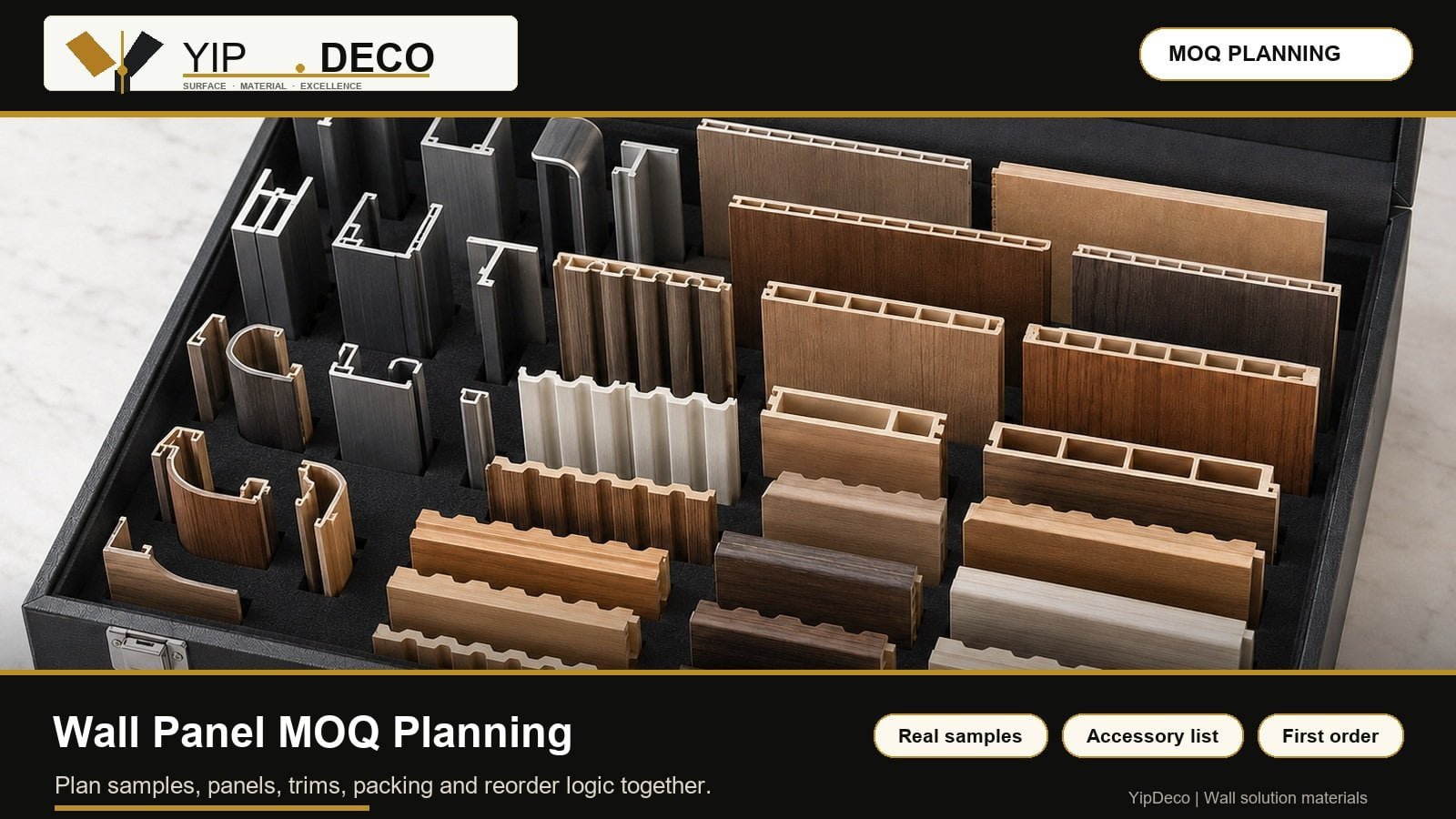
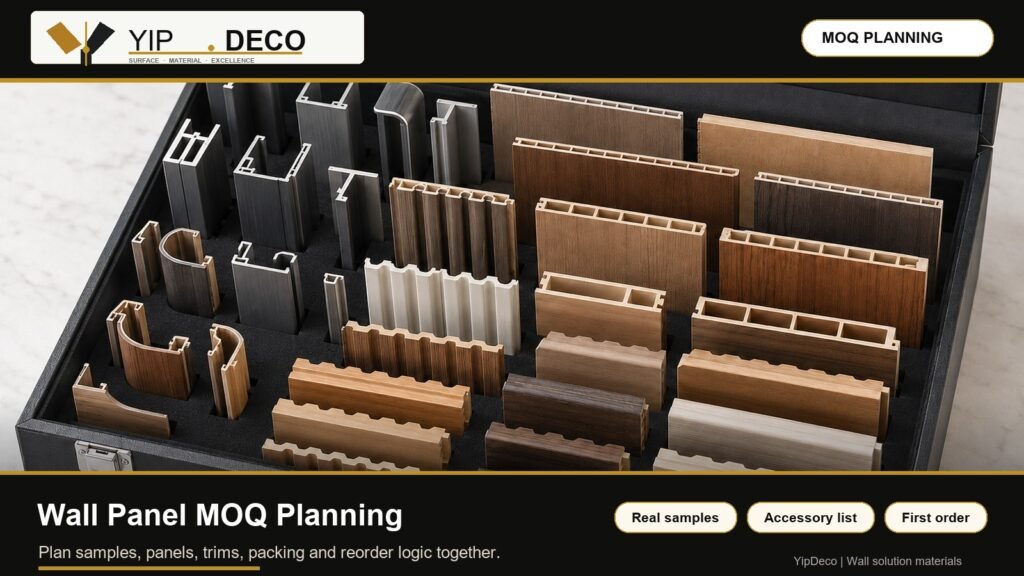
Wall panel MOQ, or minimum order quantity, should be understood as a sourcing framework rather than a single number to push down. The practical question is not only "How low can the supplier accept?" It is also "Can this order size support the right color, accessories, packing, documents, and shipping plan?"
For first-time importers, the goal should be to reduce mistake cost, not only reduce quantity.
Why Wall Panel MOQ Is Not One Fixed Number
When a buyer asks for wall panel MOQ, they are often thinking about one product: one panel model, one color, one carton quantity. But a commercial wall panel order is usually a system.
A real project may include:
- main wall panels;
- grille or fluted wall panels;
- matching trims;
- internal and external corner accessories;
- skirting or edge profiles;
- connectors for joints;
- sample sets for buyer approval;
- packaging labels;
- documentation for customs, project files, or local resale.
Each of these items can have a different MOQ logic. The panel may be available in a stock color, but the matching trim may not be in stock. The surface may be standard, but the length or packaging request may require special production. The buyer may only want a small first order, but the project needs enough accessories to make the wall system complete.
This is why experienced suppliers do not answer MOQ with only one number. They first need to know what the buyer is trying to build.
Stock Colors vs Custom Colors: The Biggest MOQ Lever
The first and most important MOQ question is whether your requested color is a stock color or a custom color.
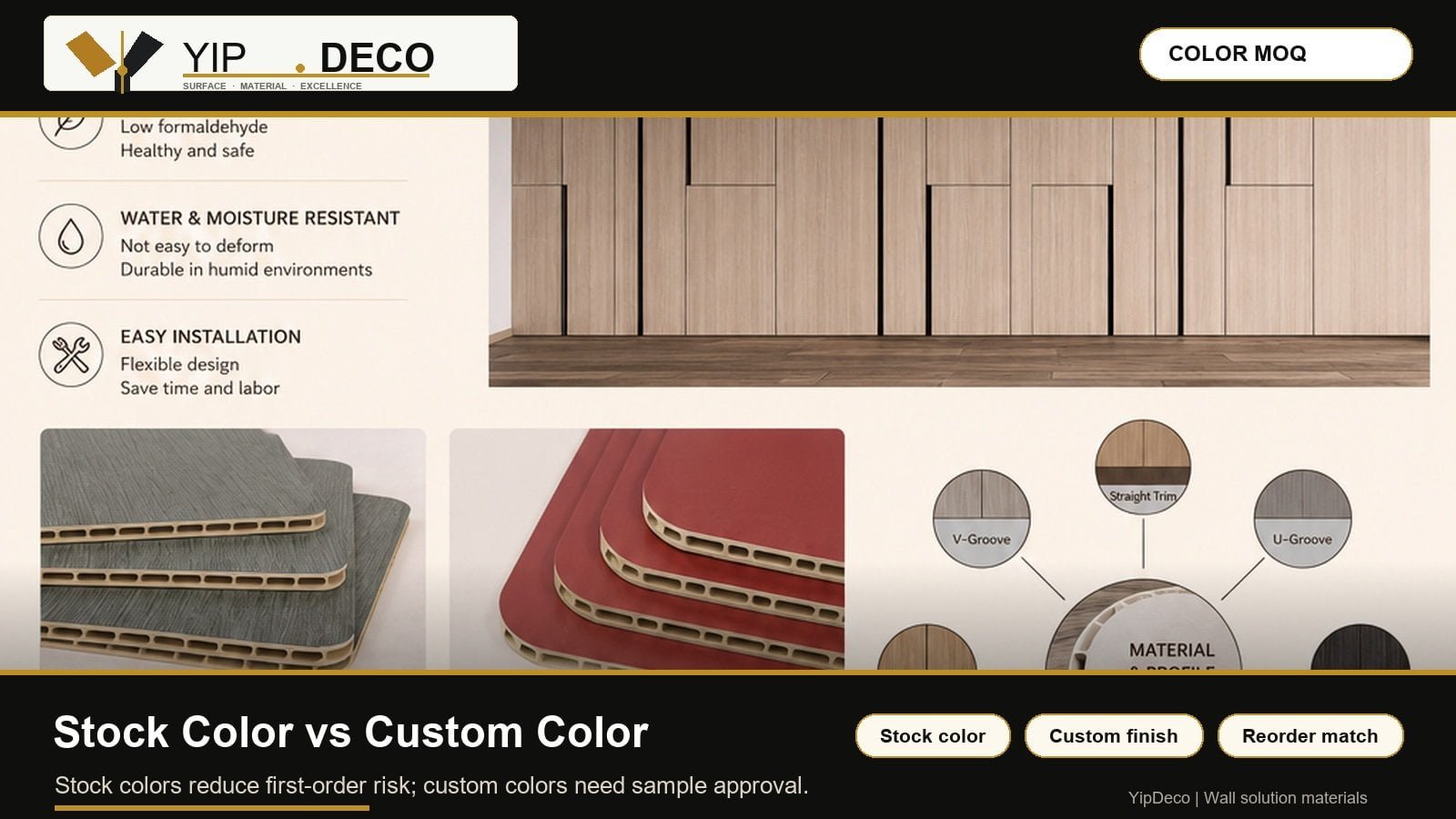
Stock colors are colors or finishes the factory already produces regularly. They are easier to arrange because the material, decorative film, surface finish, or matching accessories may already be part of normal production planning.
Custom colors are different. They may require:
- custom film matching;
- special color approval;
- minimum raw material purchase;
- separate production setup;
- extra sample confirmation;
- longer lead time;
- higher color-matching risk across panels and trims.
For a first-time importer, stock colors are usually the safer starting point. They help you test the market, check customer response, and understand real installation feedback before committing to a heavier custom-color order.
This does not mean custom colors are wrong. Custom colors are often necessary for hotel chains, branded retail stores, developer projects, and distributors who want a unique product line. But custom color should be treated as a planned development project, not a casual first purchase.
Material Type Also Changes MOQ Logic
Wall panels are not one category. PVC, SPC, WPC, grille panels, carbon crystal boards, anti-collision boards, and decorative profiles may all be used in wall projects, but they do not share the same production and MOQ structure.
For example:
- PVC wall panels are often used for dry decorative walls, commercial interiors, feature walls, corridors, and light renovation.
- SPC wall panels are more suitable when the buyer needs a rigid, moisture-resistant wall surface, especially for bathroom, wet-area, or tile-alternative projects.
- Grille and fluted profiles require attention to effective width, model shape, installation direction, accessories, and color coordination.
- Accessories may be aluminum, PVC, or matching-color profiles, and their MOQ may be separate from the panel itself.
Before asking for MOQ, define the material family and application scene. A vague request such as "wall panel MOQ" will usually produce a vague answer. A stronger inquiry is:
> We are testing PVC wall panels for commercial office and retail interiors. We prefer stock colors for the first shipment, and we need matching trims and corner accessories. Can you suggest a trial-order structure?
That kind of inquiry allows the supplier to help you reduce risk instead of only quoting a number.
Accessories Have Their Own MOQ
Many first-time importers focus only on panels. This creates a common problem: the panel order looks simple, but the installation becomes incomplete because trims, corner pieces, connectors, or edge accessories were not planned from the beginning.
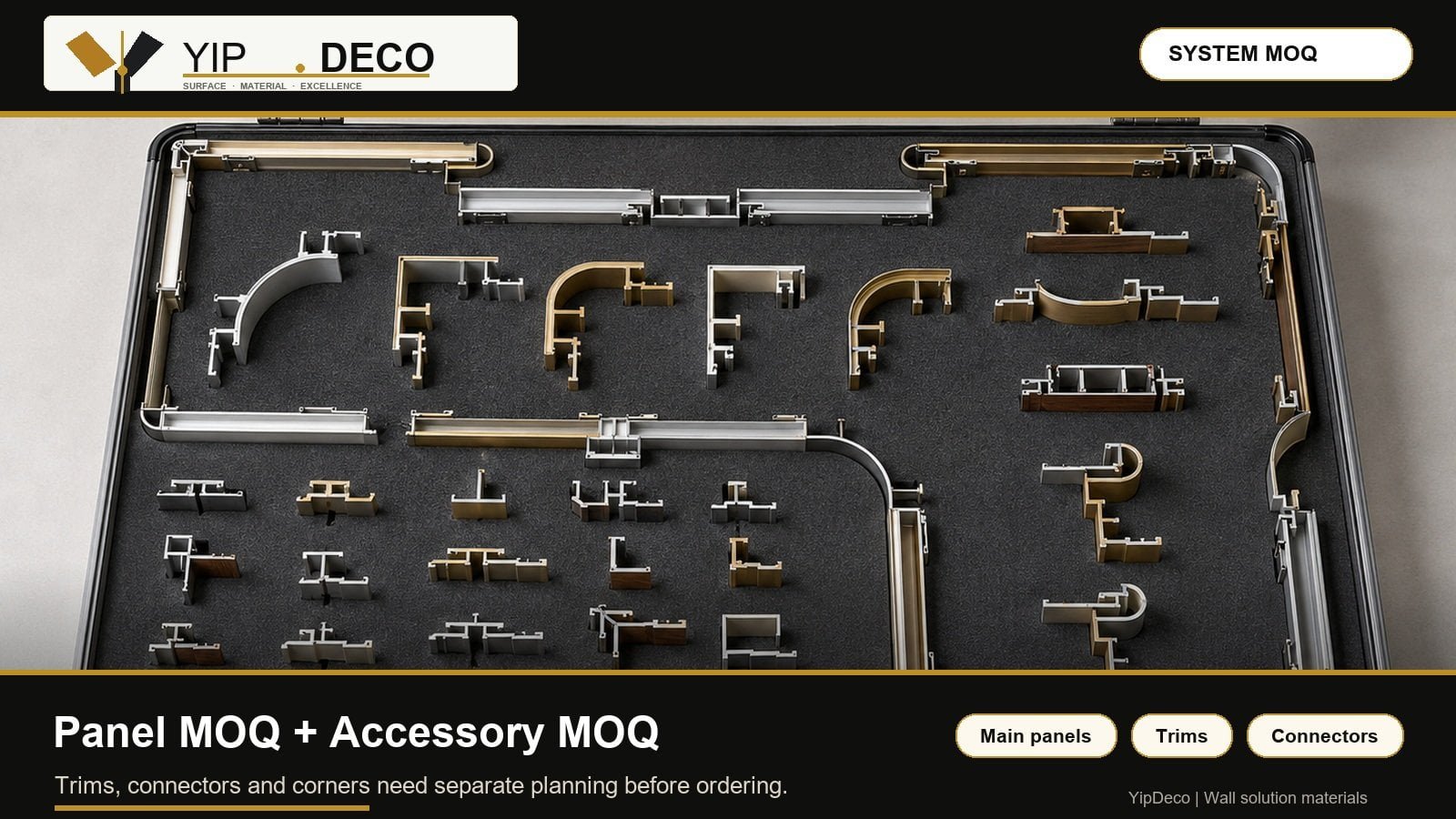
A wall panel system may need:
- outside corner trims;
- inside corner trims;
- end caps;
- skirting profiles;
- H-profile connectors;
- U-groove or T-shaped joint trims;
- decorative lines;
- grille transition pieces;
- LED or metal profiles for special projects.
These accessories may be produced in different materials, colors, and lengths. Some may be stocked, while others require production. If you only ask MOQ for panels, you may later discover that the accessory MOQ, color, or lead time does not match the main panels.
For project buyers, this is more than a purchasing detail. Accessories decide whether the final installation looks professional. The wall surface may look good, but exposed edges, mismatched trims, or missing connectors can make the whole project look unfinished.
When sending an inquiry, include these questions:
- Which trims and connectors are normally used with this panel model?
- Are matching-color accessories available for the selected finish?
- Do accessories have a separate MOQ?
- Can accessories and panels ship together?
- Can the supplier provide section drawings or installation references?
This is especially important for buyers sourcing mouldings and grille together with flat wall panels.
Lower MOQ Does Not Always Mean Lower Risk
It is natural for a new importer to want the lowest possible first order. That instinct is understandable. Nobody wants to hold unsold inventory or spend too much before testing the market.
But the lowest MOQ is not always the safest order.
A very small order may create several hidden problems:
- unit cost becomes higher;
- packaging cost is less efficient;
- shipping cost per square meter increases;
- color selection becomes limited;
- accessories are harder to coordinate;
- documentation may be less complete;
- replacement pieces may be difficult to arrange later;
- the buyer may not have enough material to test real sales demand.
If the order is too small, it may look safe on paper but fail as a commercial test. You may not have enough panels to show a full display wall, supply one small project, build distributor samples, and keep replacement stock at the same time.
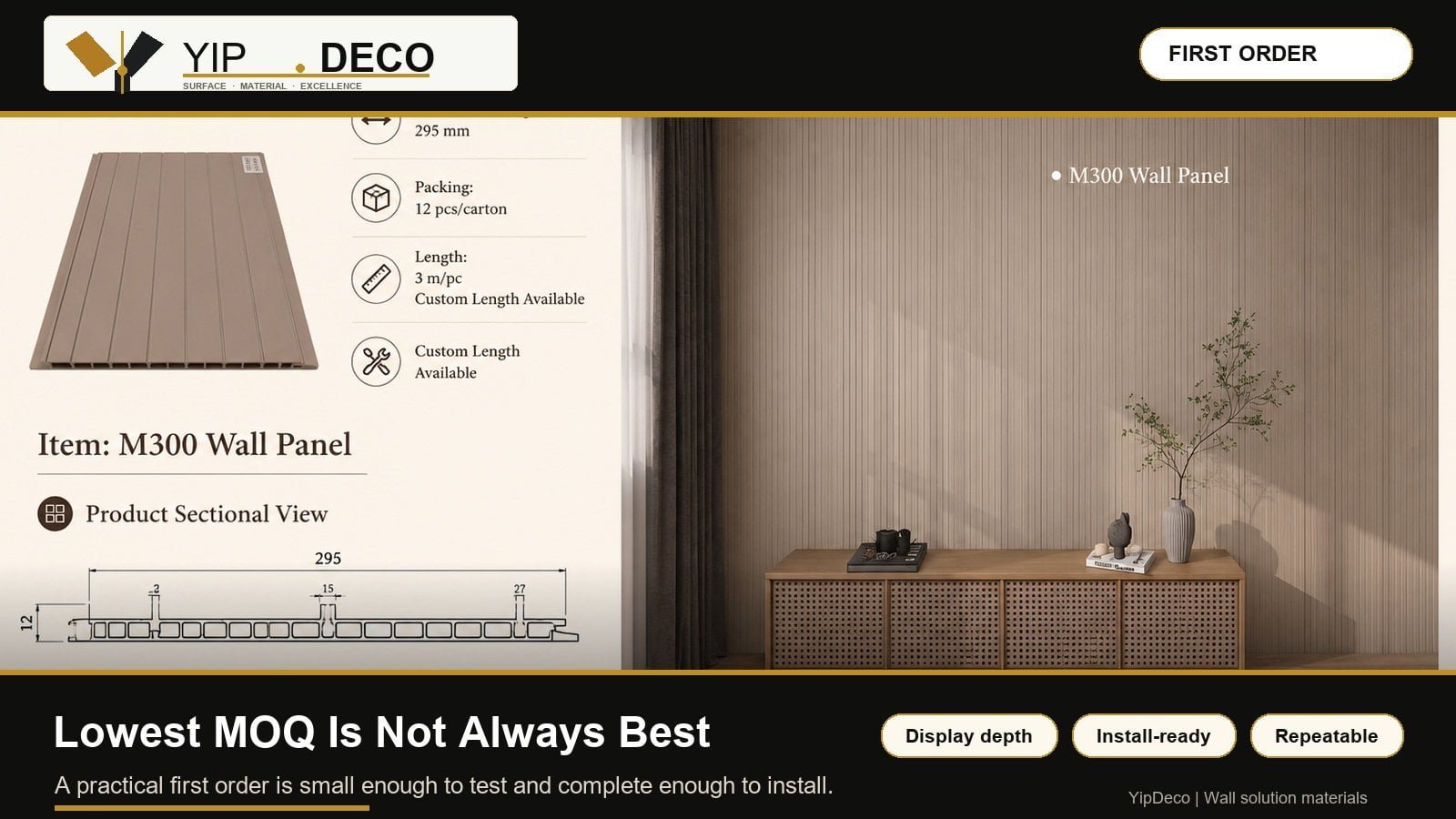
A better first order is not the lowest possible order. It is the smallest order that can still test your real business model.
Sample Order vs Production Order
Sample orders and production orders should not be confused.
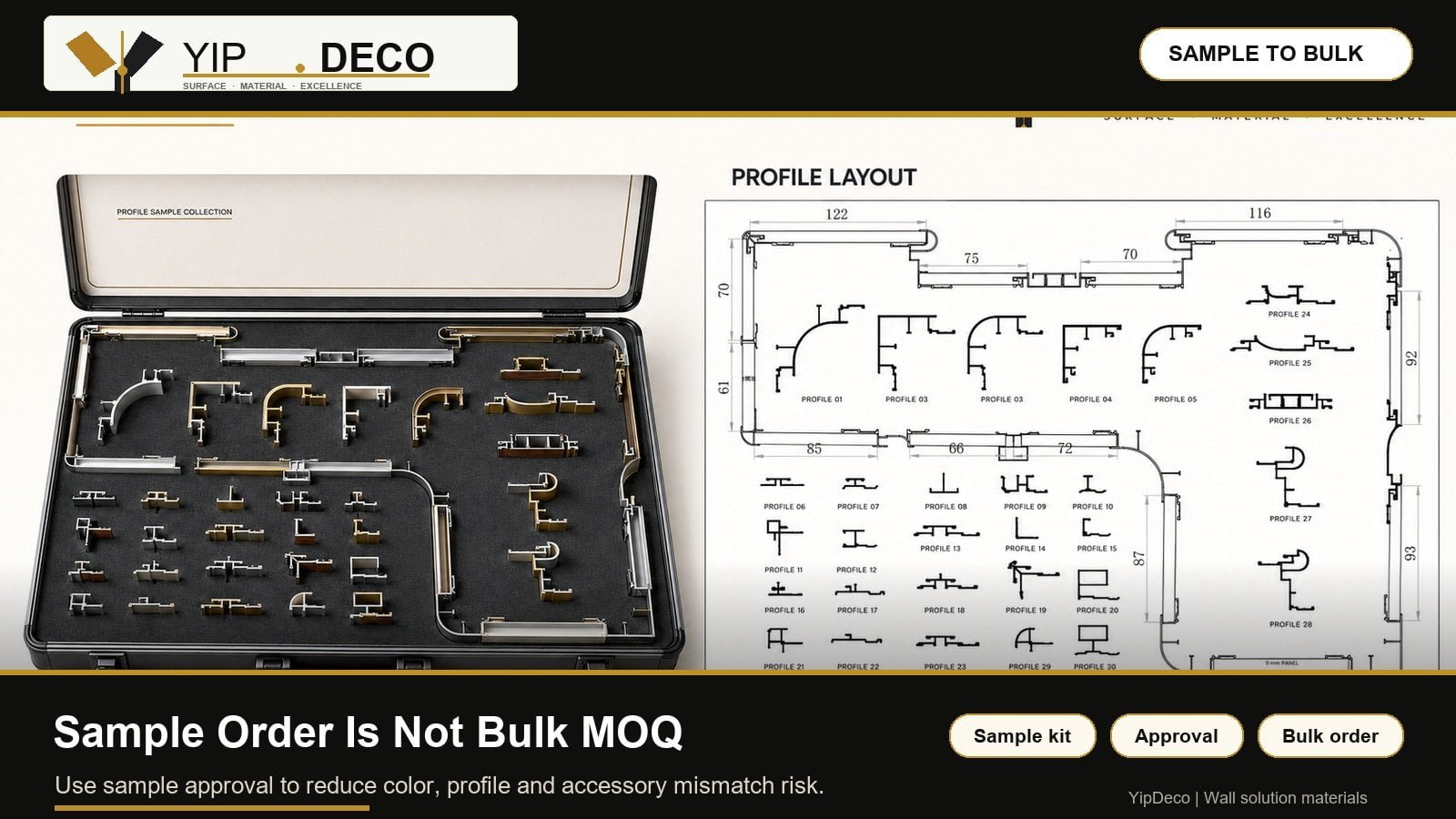
A sample kit is used to check color, texture, thickness, profile shape, installation method, and buyer preference. It is not designed to represent full production economics.
A production order must support:
- actual panel quantity;
- carton packing;
- accessory matching;
- batch color control;
- export documents;
- loading plan;
- after-sales replacement logic;
- future reorder consistency.
For first-time importers, the best sequence is usually:
- Request samples.
- Confirm material type and surface finish.
- Choose stock colors for market testing.
- Match trims and accessories.
- Calculate a practical first production order.
- Review packaging, labels, and documents.
- Plan the reorder path before selling out.
This sequence reduces the chance of ordering a beautiful panel that cannot be repeated, installed, or sold efficiently.
MOQ and Mixed Container Planning
Many buyers ask whether different colors or different panel models can be mixed in one shipment. The answer depends on stock status, production scheduling, carton dimensions, and loading efficiency.
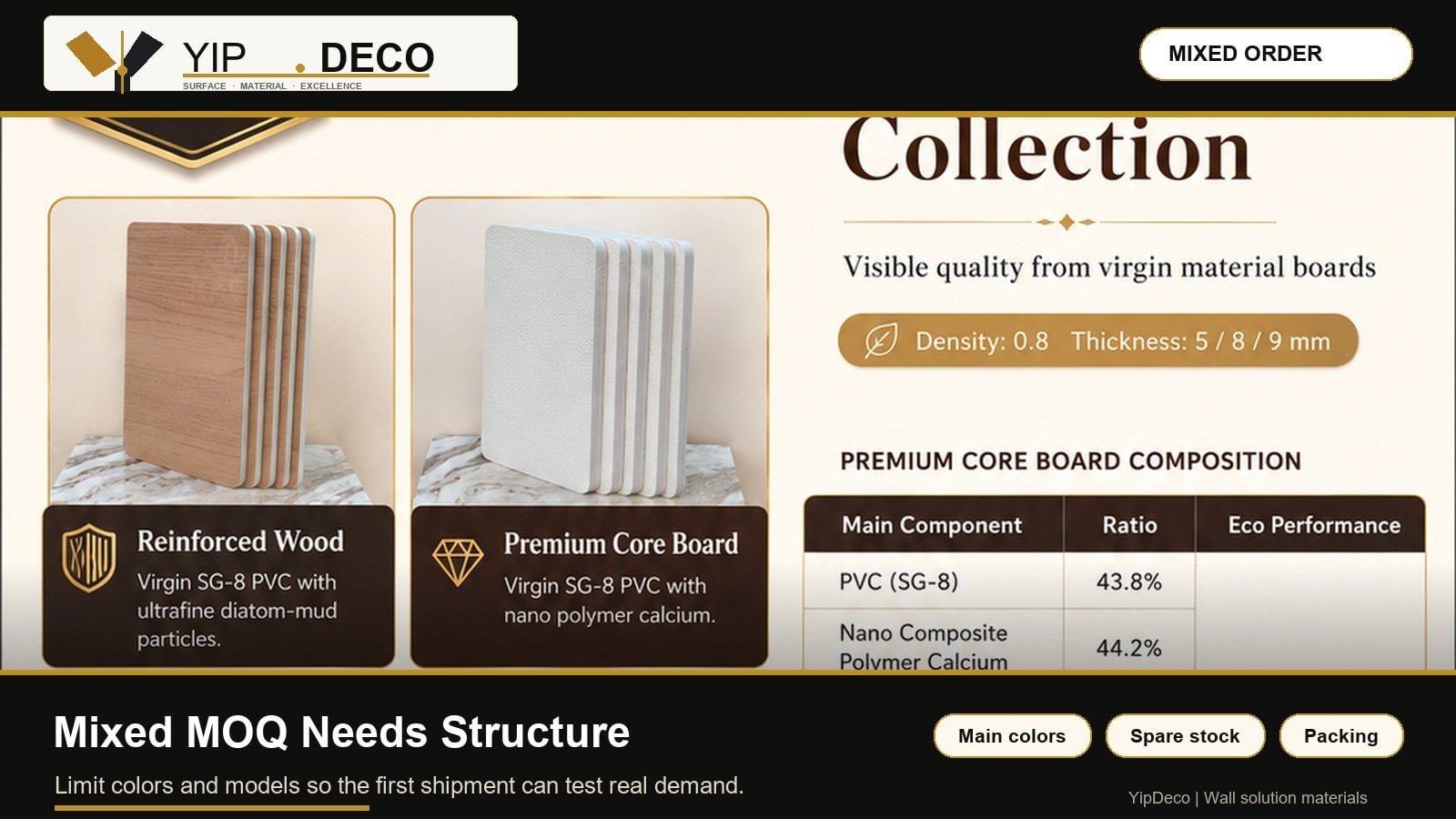
Mixed orders can help first-time importers test multiple finishes, but they also require careful planning. If too many colors or models are mixed in a small order, the shipment becomes harder to manage.
For example, a first order may need to balance:
- one or two main selling colors;
- one feature color for showroom display;
- enough trims for actual installation;
- enough samples for salespeople or dealers;
- spare material for claims or rework;
- carton quantities that make loading practical.
If you are planning LCL shipment, pay attention to packing protection and local handling risk. If you are planning FCL shipment, pay attention to container efficiency, loading sequence, and whether accessories should be packed together with the matching panel color.
The supplier should not only quote panel price. They should help you think through order structure.
Certification and Document Limits
Some buyers ask for formaldehyde, fire rating, REACH, or other compliance documents even for very small trial orders. It is reasonable to ask what documents are available, but not every document can be customized for every small order.
For example, formaldehyde-related compliance may be relevant for markets that reference composite wood product standards such as the EPA formaldehyde emission standards. Other markets may ask for REACH-related documentation, fire performance references, or product data sheets.
The practical issue is this: documents should match the product category, material structure, and real production batch as much as possible. If your order is too small or too customized, documentation may need to be discussed before production, not after goods are finished.
Before placing the order, ask:
- What existing documents are available for this material?
- Are they for the same product type or only a similar category?
- Can the document support customs, local resale, or project submission?
- Is extra testing required for my market?
- Does testing affect MOQ, lead time, or cost?
This avoids a common mistake: negotiating only price and MOQ first, then discovering later that the project requires documents the order plan did not support.
A Practical First-Order Framework
For first-time importers, I usually suggest thinking in terms of order purpose.
Your first order may have one of three purposes:
| First-order purpose | Recommended MOQ thinking | Main risk to control |
|---|---|---|
| Showroom display | Focus on representative stock colors and complete accessories | Good-looking display but no repeatable supply plan |
| Market test | Select sellable colors and enough quantity for real customer feedback | Too many colors, too little depth |
| Project trial | Match panel, trim, packing, and installation detail to one real project | Missing accessories or wrong installation assumptions |
Each purpose requires a different structure. A showroom display can use a wider sample range. A market test needs fewer colors but better quantity depth. A project trial needs complete accessories, spare quantity, and stronger installation planning.
Before confirming your first order, prepare this checklist:
- target application: hotel, office, retail, apartment, bathroom, corridor, or showroom;
- material type: PVC, SPC, grille, WPC, carbon board, or mixed system;
- stock or custom color;
- matching trims and connectors;
- sample approval status;
- packing and label needs;
- documents required by your market;
- expected reorder timing;
- whether the order is LCL, mixed container, or full container.
If you can answer these points clearly, the supplier can give a more useful MOQ suggestion.
How to Write a Better Inquiry
A weak inquiry says:
> What is your MOQ and best price?
A stronger inquiry says:
> We are a first-time importer testing wall panels for commercial interior projects. We want to start with stock colors, mainly PVC wall panels and matching trims. The first use will be showroom display plus small contractor sales. Please suggest a first-order structure, accessory list, sample process, packing method, and MOQ range based on stock availability.
This gives the supplier enough context to protect your order. It also helps them know whether to recommend PVC wall panels, SPC wall panels, grille panels, accessories, or a mixed wall solution.
If you are not sure which material to start with, begin from the application environment:
- Dry decorative wall: start with PVC wall panels or grille panels.
- Bathroom or wet wall: review SPC wall panels and waterproof installation details.
- Feature wall or hotel lobby: consider grille, fluted, curved, or matching profile systems.
- Distributor display: request sample kits and stock color boards first.
- Contractor project: confirm accessories, installation drawings, and packing details early.
Common MOQ Questions from First-Time Buyers
Can I mix several colors in one order?
Often yes, especially if the colors are stock colors. But the number of colors should match your order purpose. Too many colors in a small shipment can weaken each color's test value.
Can I order only panels first and accessories later?
You can, but it is not ideal for project orders. Accessories should be checked together with the panel because color, thickness, edge shape, and installation detail need to match.
Is custom color possible for a first order?
It is possible, but usually not the lowest-risk path. For first-time importers, stock color testing is usually more practical unless you already have a confirmed project or strong local demand.
Does lower MOQ mean better supplier support?
Not necessarily. A supplier who only says "low MOQ" may not be helping you plan accessories, documents, packing, and repeat orders. Supplier support should be judged by order planning quality, not only by the minimum quantity.
Should I start with samples or a small production order?
Start with samples when color, surface, material, or accessory matching is still uncertain. Move to production only after the product system is clear.
Final Thought
Wall panel MOQ is not only a quantity problem. It is a sourcing decision that connects color, material, accessories, packing, documents, logistics, and future reorder planning.
For first-time importers, the right question is not "What is the lowest MOQ?" The better question is:
> What is the smallest order that can test my market properly without creating avoidable project risk?
At YipDeco, we handle wall panel inquiries from buyers who are testing new product lines, preparing showroom displays, developing distributor channels, and supporting commercial interior projects. If you are planning your first order, you can start by reviewing our Wall Solution, checking PVC wall panels and SPC wall panels, then requesting samples or an order-structure discussion through our Contact page.
The most useful MOQ is not always the lowest one. It is the one that helps your first order become a repeatable business.